English
- All
- Product Name
- Product Keyword
- Product Model
- Product Summary
- Product Description
- Multi Field Search

Views: 0 Author: Site Editor Publish Time: 2026-08-17 Origin: Site
Machinists and production managers constantly balance aggressive Material Removal Rates (MRR) against tool longevity, machine rigidity, and final part tolerances. Using finishing end mills for heavy bulk material removal hides massive operational costs on the shop floor. This practice leads to premature tool wear, uneven edge degradation, excessive spindle load, and compromised cycle times. Plowing a finisher through heavy roughing passes destroys its edge predictability. You cannot expect a tool that just hogged out tool steel to leave a mirror finish on the final contour.
Selecting the correct tool geometry dictates your success. You must know exactly when to introduce a dedicated roughing profile before a finishing pass. This choice directly impacts cost-per-part, tool predictability, and overall shop profitability. Understanding the mechanical differences between these tools allows you to optimize your CAM programming, reduce scrap rates, and maximize machine uptime.
Tool geometry dictates how a cutter interacts with raw material. Standard finishing end mills feature sharp, continuous flutes designed to shear material cleanly and evenly. They produce a smooth surface finish but generate high cutting forces. The entire length of the flute engages the workpiece simultaneously during heavy radial cuts. This continuous engagement creates immense pressure on the tool core, pushing the tool away from the cut and inducing deflection.
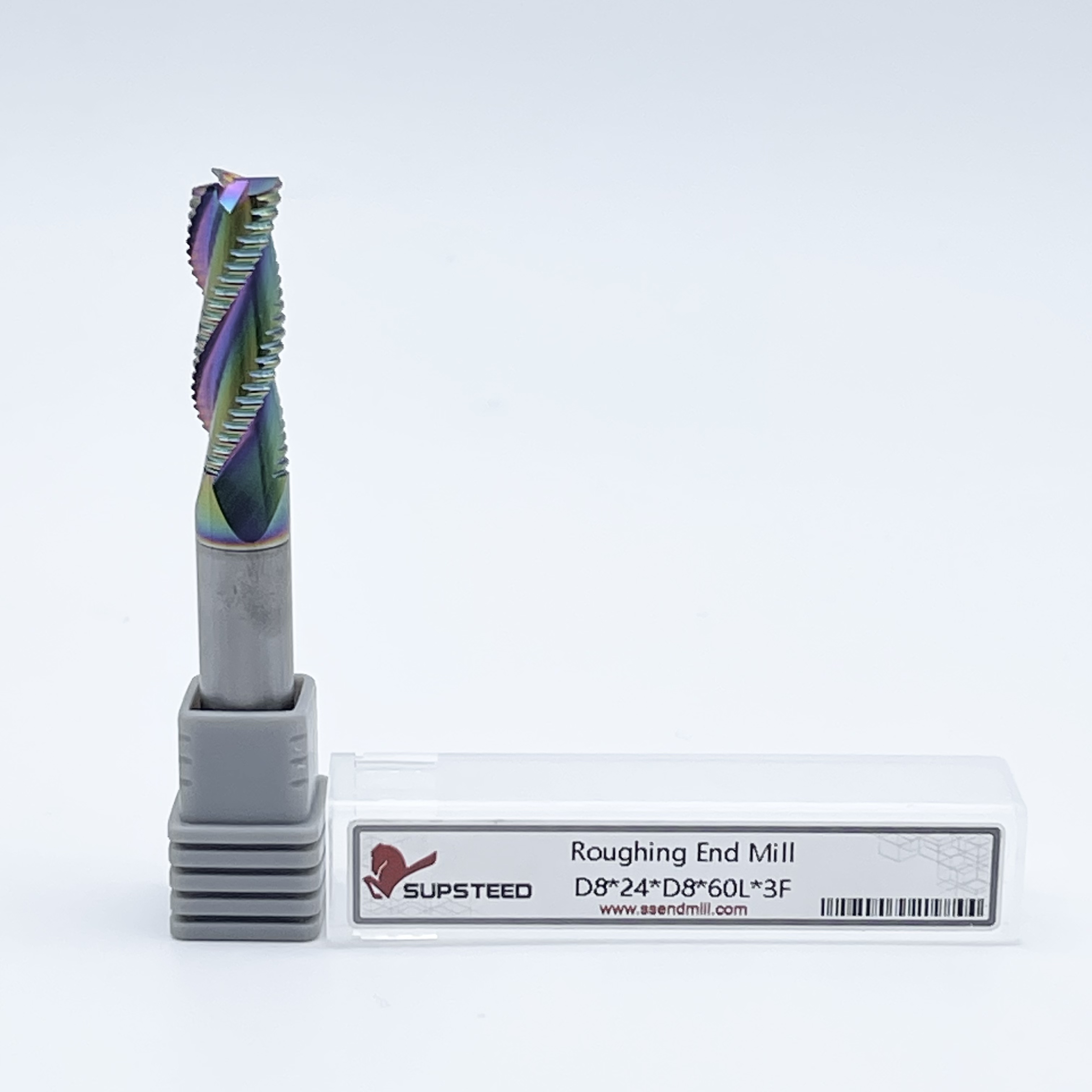
Roughing end mills utilize a completely different structural design. They feature knurled or serrated edges along the flutes, commonly referred to on the floor as a "corncob" profile. These serrations create an interrupted cut. The peaks of the serrations bite into the material sequentially, preventing the entire flute from engaging at once. This interrupted cutting action drastically reduces the physical resistance encountered by the spindle. It allows the tool to plow through tough alloys with significantly less horsepower. The serrated profile effectively breaks the cutting action into hundreds of tiny impacts per second, rather than one continuous, heavy drag.
Flute count selection interacts directly with roughing geometries. You must match the flute count to the material you are cutting. A 3-flute rougher works best for aluminum and non-ferrous materials. Aluminum produces high chip volumes that require massive evacuation space. If you use a high flute count in aluminum, the chips will weld to the tool. A 4-to-6 flute design suits ferrous metals, cast iron, and high-temp alloys. Tougher materials require a thicker tool core to withstand cutting pressures, and the smaller chips generated do not need as much evacuation room.
Gullet capacity is the empty space between the cutting flutes. Roughers feature optimized gullet spaces to handle increased volumes of fractured chips. A continuous flute finisher shears off long chips that can easily pack into a tight gullet. Roughers break chips into tiny pieces. The gullet design on a rougher ensures these small chips evacuate rapidly without packing. Chip packing leads to instant tool failure. Proper gullet optimization prevents this catastrophic outcome during heavy slotting or deep pocketing operations.
Chip formation defines the success of any milling operation. Finishing end mills often produce long, stringy chips. These stringy chips can wrap around the tool holder, block coolant flow, and ruin surface finishes. carbide rougher end mills solve this problem through their serrated geometry. The serrations force the material to fracture into small, manageable chips.
Small chips evacuate easily from deep pockets. They also play a critical role in heat dissipation. In metal cutting, the chip should carry away the majority of the heat. Small, thick chips absorb heat efficiently and fly away from the cutting zone. This prevents the heat from transferring into the workpiece or the tool core. Efficient chip evacuation prevents chip packing in deep cavities. It keeps the cutting zone clear and maintains consistent tool life. When you look at the chip bin, you want to see small, uniform chips rather than a bird's nest of continuous metal strings.
Sometimes a two-tool setup wastes valuable cycle time. This is where hybrid geometries enter the equation. rougher finisher end mills feature a modified profile. They often utilize a sinusoidal or variable pitch flute design. The serrations are less aggressive than a traditional corncob rougher. The peaks and valleys blend more smoothly into the flute.
This hybrid tool eliminates the need for a tool change in specific scenarios. You can use it for mid-tier applications where absolute surface finish is not the primary requirement. It removes material faster than a standard finisher and leaves a better surface finish than a pure rougher. You must acknowledge the trade-off. The surface finish will not meet strict aerospace or medical tolerances. However, for structural components, hidden brackets, or weldments, this hybrid approach saves significant programming and machining time.
You must calculate when increased MRR justifies adding a dedicated roughing tool. Time saved during the roughing pass must exceed the time spent on tool changes. Roughers excel when you need to remove massive volumes of material quickly. They handle aggressive Axial Depth of Cut (ADOC) and Radial Depth of Cut (RDOC) parameters. You can often run a rougher at a full diameter ADOC, utilizing the entire flute length.
Standard finishers will snap under these extreme parameters. Roughers distribute the cutting forces across the serrations. This allows you to push the feed rate significantly higher. You must evaluate your current cycle times. If your machine spends 70% of its cycle slowly peeling away material with a finisher, you are losing money. Implementing a dedicated roughing pass will drastically shrink that bulk removal time.
To properly implement this, follow these setup steps:
Not every shop floor features heavy-duty, high-horsepower CNC machines. Lighter-duty machines, such as those with BT30 tapers, struggle with aggressive cuts. A standard finishing end mill taking a heavy cut will spike the spindle load meter. It will stall the spindle or trigger machine alarms. Roughing end mills provide the solution for lower-horsepower machines.
The reduced cutting pressure of a rougher benefits less rigid setups. The chip-breaking geometry reduces the horsepower required to shear the metal. You can take deeper cuts on a light-duty machine without overloading the spindle. This geometry also reduces spindle wear during high-feed milling. Lower cutting resistance means less wear on spindle bearings. It extends the mechanical life of your CNC equipment while maintaining high production rates.
Tool deflection ruins dimensional accuracy. Chatter destroys surface finishes and shatters carbide tools. Long-reach applications and deep-pocketing operations are highly susceptible to chatter. A continuous flute end mill generates consistent harmonic frequencies. These frequencies build up and cause the tool to vibrate violently against the workpiece.
The interrupted cut of a rougher disrupts these harmonic frequencies. The serrations engage the material at different intervals. This prevents the vibration from amplifying. It significantly reduces chatter in unstable machining conditions. When you face extended-reach applications, a rougher maintains stability. It minimizes tool deflection by lowering the radial cutting pressure. You achieve a straighter wall and a safer cutting environment.
Roughers are aggressive tools. They impart significant shock into the workpiece despite lowering overall spindle load. This shock can warp or damage thin-walled components. When machining delicate parts, structural integrity is your primary concern. The interrupted cut of a corncob rougher can cause thin walls to vibrate, bend, or snap.
You must rely on low-force, high-shear finishing tools for these applications. A sharp finishing end mill slices through the material with minimal impact. It maintains the structural integrity of delicate features. You must reduce your depth of cut and rely on the continuous shearing action. Using a rougher on a wall thinner than 0.100 inches invites scrap and rework.
Roughers cannot hold tight dimensional tolerances. The serrated edges leave a wavy, unpredictable surface. You cannot use them to finish a bearing bore or a precision mating surface. Micro-machining applications also render roughers useless. When you are cutting features smaller than an eighth of an inch, roughing geometries do not scale down effectively.
You must evaluate the total volume of material removal. Scenarios exist where the required material removal is minimal. If you only need to remove 0.050 inches of stock, a roughing pass is mathematically inefficient. The time spent changing tools exceeds the time saved by the rougher. In these cases, a single pass with a high-quality finishing end mill is the most profitable strategy.
Soft plastics, brass, and certain aluminums behave differently than steel. These materials shear easily. Standard finishing end mills can achieve massive MRR in these soft materials without the need for serrated roughers. Specialized O-flute tools or polished 2-flute finishers excel in plastics.
A rougher can actually cause problems in very soft plastics. The serrations can tear the material rather than cutting it cleanly. It can cause delamination in composites. When chip clearing is manageable and the material offers low cutting resistance, skip the rougher. Optimize your feed rates with a sharp, polished finishing tool to maximize efficiency.
High-temp alloys and hard metals destroy standard cutting tools. Materials like Titanium and Inconel work-harden rapidly. If a tool rubs against the material instead of cutting it, the surface becomes harder than the tool itself. Carbide roughers are mandatory for these work-hardening materials. The aggressive serrations ensure the tool bites into the material, preventing rubbing and heat buildup.
You must evaluate your toolholding when roughing tough alloys. The interrupted cut generates high-frequency impacts. Standard collet chucks may allow the tool to pull out during heavy cuts. You must use rigid toolholding. Shrink fit holders or hydraulic chucks provide the necessary gripping force. They prevent tool pull-out and maximize the effectiveness of the roughing geometry.
Cast iron and abrasive composites present unique tool wear realities. Castings often feature a hard outer scale full of sand and impurities. This scale destroys the sharp edge of a finishing end mill instantly. Abrasive materials cause rapid, localized notching on continuous flutes.
Roughing geometries distribute wear more evenly across the cutting edge. The serrations break through the hard casting scale efficiently. If one serration chips, the rest of the flute continues to cut. A chip on a finishing end mill leaves a permanent score mark on the workpiece. Roughers absorb the abuse of abrasive materials, preserving your expensive finishing tools for the final precision passes.
Carbide alone cannot withstand the heat of modern high-speed machining. Coatings dictate tool life. Industry-standard coatings perform differently on roughers versus finishers. Thermal stability requirements differ wildly between the bulk-removal stage and the finishing stage.
Roughers generate immense heat at the cutting edge. Tougher, thicker coatings on roughers yield a higher return on investment. They preserve the carbide edge under heavy impact and extreme temperatures. Finishers require thinner, smoother coatings to maintain a razor-sharp edge. Applying a thick roughing coating to a finisher dulls the edge and increases cutting pressure. Match the coating to the specific function of the tool.
Tool Geometry Application Matrix
| Tool Type | Primary Function | Surface Finish Quality | Best Material Applications |
|---|---|---|---|
| Corncob Rougher | Maximum MRR, Bulk Removal | Poor (Visible Serrations) | Tool Steels, Cast Iron, Titanium |
| Rougher Finisher | Moderate MRR, Single-Tool Setup | Acceptable (Semi-Finished) | Mild Steels, Structural Aluminum |
| Standard Finisher | Precision Sizing, Tight Tolerances | Excellent (Mirror Finish Possible) | Plastics, Finishing Passes on All Metals |
Every tool in your carousel costs money. You must provide a cost-per-part evaluation framework for your shop. Does the cycle time saved by roughing offset the cost of purchasing, tracking, and setting up an additional tool? If you save two minutes per part on a run of 500 parts, you save over 16 hours of machine time. That easily pays for the roughing tool.
However, if you are making a single prototype, adding a rougher might waste setup time. You must weigh the tool inventory costs against machine hourly rates. High-volume production always benefits from dedicated roughing tools. Low-volume, high-mix shops must evaluate the MRR gains on a case-by-case basis.
Many shops employ a dangerous cost-saving tactic. They use an older, worn finishing end mill as the designated "rougher" in the tool pot. They follow it with a brand-new finisher for the final pass. This "identical tool" strategy seems economical, but it is deeply flawed. A worn finisher still creates massive cutting pressure. It still generates stringy chips. It still deflects and causes chatter.
You must analyze the workflow impact of programming a dedicated carbide rougher followed by a finisher. A true serrated rougher offers superior predictability and MRR. It removes material faster and safer than a dull finisher. The two-tool strategy using proper geometries extends the life of your machines and guarantees consistent part quality. Stop using dull finishers as roughers.
Scalability dictates your tooling choices. Solid carbide roughers dominate small to medium diameter applications (under 3/4 inch). They offer superior rigidity and flute density. However, as tool diameters increase, solid carbide becomes prohibitively expensive. You must evaluate when high-volume production warrants shifting to indexable roughing tools.
Indexable roughers use replaceable carbide inserts. They lower long-term insert replacement costs for large-diameter bulk removal. If you are roughing massive steel blocks, indexable tools provide better economy. Solid carbide remains the king for deep pockets, smaller radii, and high-speed dynamic milling paths. Choose the platform that matches your part scale and production volume.
Roughers generate thousands of tiny chips per second. If these chips remain in the cutting zone, the tool will recut them. Recutting chips destroys carbide edges instantly. It causes micro-chipping and catastrophic tool failure. You must highlight the risk of coolant starvation in deep pockets. Small chips can form a sludge that blocks coolant from reaching the cutting edge.
You must implement proper mitigation tactics. Air blast is often superior to coolant when roughing tool steels and cast iron. Thermal shock from coolant can crack carbide during heavy interrupted cuts. High-pressure air blasts clear the small chips effectively without causing thermal shock. Use high-pressure coolant for aluminum and titanium to prevent chip welding and manage extreme heat.
You cannot program a rougher the same way you program a finisher. You must leave appropriate stock allowance for the finishing tool. If you leave too little stock, the finisher will rub against the serrated grooves left by the rougher. This ruins the finishing tool. Leave at least 0.015 to 0.030 inches of stock for the final pass, depending on the tool diameter.
Address feed and speed adjustments specific to corncob geometries. Roughers require higher chip loads to function properly. If you feed them too slowly, they will rub and generate excess heat. Consult your CAM software and update your tool libraries. Ensure your dynamic milling toolpaths account for the increased feed capabilities of your dedicated roughing tools.
Carbide rougher end mills are indispensable for maximizing MRR, reducing spindle load, and extending the life of finishing tools in heavy-duty applications. They are entirely unsuitable for final dimensioning. You must stop using finishing end mills for bulk material removal if you want to remain competitive.
Take the following actions to optimize your machining processes:
A: No. Roughing end mills leave a visible, serrated surface finish due to their corncob geometry. They cannot hold tight dimensional tolerances. A secondary finishing pass with a standard end mill is mandatory for precision parts.
A: A rougher finisher is a hybrid tool featuring a modified, often variable-pitch flute geometry. It removes material faster than a standard finisher while leaving a much better surface finish than a traditional corncob rougher. It is ideal for mid-tier applications.
A: Using a finisher for heavy material removal causes uneven edge wear, high spindle loads, and micro-chipping. This destroys the tool's ability to leave a predictable, clean surface on the final pass, leading to scrapped parts.
A: Yes. The serrated edges create an interrupted cut. This breaks up harmonic vibrations and significantly reduces chatter. They are highly effective in deep pockets, long-reach applications, or unstable machining setups.
A: Roughers can often handle 20% to 50% higher chip loads depending on the material and machine rigidity. Their geometry distributes cutting forces, allowing for significantly more aggressive feed rates and deeper axial cuts.
A: Yes. Roughers excel in tough metals like titanium and stainless steel. They break chips efficiently, reduce heat buildup, and prevent the work-hardening that quickly destroys the continuous edges of standard flutes.
A: The serrations break the cutting action into smaller segments. This interrupted cut reduces radial pressure, lowers horsepower requirements, and forces the material to fracture into small, easily evacuated chips rather than long strings.