English
- All
- Product Name
- Product Keyword
- Product Model
- Product Summary
- Product Description
- Multi Field Search

Views: 0 Author: Site Editor Publish Time: 2026-08-12 Origin: Site

Machining highly abrasive materials like graphite, carbon fiber composites, and high-silicon aluminum destroys standard uncoated carbide tooling. This rapid edge wear kills shop margins and creates a massive hidden drain on profitability. Frequent tool changes halt production runs and force operators to constantly reset machine offsets. Worn cutting edges lead directly to out-of-tolerance dimensions, poor surface finishes, and scrapped parts. You face a constant battle balancing upfront tooling investments against the hidden costs of machine downtime and ruined workpieces. diamond coated end mills offer a specialized, high-performance solution designed specifically for these exact non-ferrous applications. By thoroughly evaluating your production volume and workpiece material types, you can determine if upgrading your tooling strategy justifies the initial investment and eliminates these manufacturing bottlenecks.
Growing a crystalline diamond layer on a carbide substrate requires a highly specialized chemical vapor deposition process. Manufacturers place the raw carbide tools inside a vacuum reactor chamber. They introduce gases like methane and hydrogen, which are then ionized into a plasma state. Carbon atoms separate from the gas mixture and deposit directly onto the tool surface, growing a genuine diamond structure atom by atom. This process creates a coating that shares the exact physical properties of natural diamond, providing unmatched hardness and thermal conductivity.
Manufacturers must carefully prepare the carbide substrate before applying the coating to ensure success. Proper edge preparation and cobalt depletion represent critical manufacturing steps. The underlying tungsten carbide substrate typically contains a cobalt binder to provide toughness. However, cobalt actively prevents diamond adhesion and promotes the formation of soft graphite at the boundary layer instead. Acid etching removes this surface cobalt, creating a rough, porous surface. The diamond crystals grow into these microscopic pores, ensuring strong mechanical adhesion and preventing the diamond layer from flaking off during aggressive milling operations.
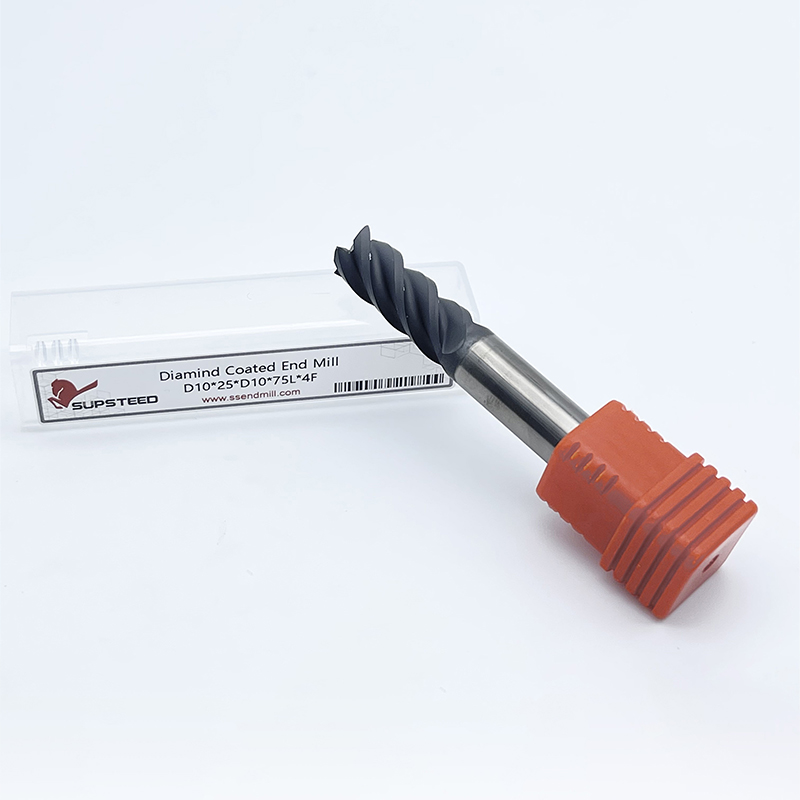
You can easily distinguish true CVD diamond coated end mills on the shop floor. They typically feature a matte grey, black, or slightly crystalline finish that catches the light differently than standard tools. This distinct visual appearance helps machinists verify their tooling inventory quickly. It separates the high-performance diamond tools from standard shiny carbide coatings like titanium aluminum nitride. Proper identification prevents costly mistakes, ensuring operators load the correct tool for abrasive non-ferrous jobs.
Tooling choices often come down to balancing complex geometry requirements against sheer edge strength. Chemical Vapor Deposition allows manufacturers to grow diamond directly onto fluted carbide end mills. This conformal coating process accommodates complex geometries, variable helix angles, chip breakers, and multiple flutes. You can utilize ball nose, corner radius, and compression router geometries with a full diamond layer.
Polycrystalline Diamond (PCD) tooling utilizes a completely different manufacturing method. PCD involves brazing a solid diamond wafer directly onto a steel or carbide tool body. PCD offers extreme sheer edge strength and impact resistance. However, the brazing process restricts you to simpler, straight-flute designs that cannot match the intricate profiling capabilities of a fluted solid carbide tool. PCD tools excel in heavy roughing of aluminum engine blocks but fall short in 3D contouring applications.
True crystalline diamond coatings also vastly outperform amorphous Diamond-Like Carbon (DLC) coatings. DLC coatings are applied using physical vapor deposition. They provide a smooth, low-friction surface but lack the true sp3 carbon bond structure of pure diamond. CVD layers provide superior hardness, greater coating thickness, and much higher thermal stability during heavy milling operations. While DLC works well for light aluminum machining or cutting soft plastics, it quickly wears away when exposed to the extreme abrasion of aerospace composites or EDM graphite.
Coating Technology Comparison
| Technology | Structure Type | Relative Hardness | Best Application | Geometry Limitations |
|---|---|---|---|---|
| CVD Diamond | Pure Crystalline (sp3 bonds) | Extremely High | Graphite, CFRP, Ceramics | None (Coats complex flutes) |
| PCD (Brazed) | Solid Diamond Wafer | Maximum | Heavy roughing of Aluminum | Limited to straight/simple flutes |
| DLC Coating | Amorphous Carbon | Moderate | Light Aluminum, Plastics | None (Coats complex flutes) |
Electrical Discharge Machining relies entirely on the precise geometry of graphite electrodes. Machining these electrodes presents a unique challenge because graphite produces highly abrasive dust rather than traditional chips. This fine dust acts exactly like a grinding wheel against cutting edges, rapidly destroying standard uncoated carbide tools. When you machine graphite with standard carbide, the tool loses its edge radius within minutes. If the end mill loses its precise radius due to wear, the resulting electrode will transfer that dimensional error directly into the final steel mold cavity.
Diamond coatings excel in these harsh, dusty environments. They dominate operations like 3D milling of contoured surfaces, deep pocketing, and groove rounding. Diamond coatings maintain sharp cutting edges over extended machining cycles. This prolonged edge retention ensures the tight tolerances and intricate 3D shapes required in modern electrode manufacturing. Operators can rough and finish an entire complex electrode using a single tool without worrying about taper or dimensional drift caused by tool degradation. Furthermore, a sharp tool reduces cutting pressure. When milling thin, deep ribs on an electrode, reduced cutting pressure prevents the fragile graphite ribs from snapping off during the finishing pass.
Cutting carbon fiber reinforced polymers (CFRP) and fiberglass presents unique mechanical challenges. These composite materials consist of highly abrasive fibers embedded in a softer, heat-sensitive resin matrix. The alternating layers easily suffer from delamination, fiber pull-out, or resin melting if machined incorrectly. Standard carbide dulls quickly against the hard carbon fibers. A dull edge pushes and tears the fibers instead of shearing them cleanly, destroying the structural integrity of the composite part.
Diamond coatings resist the intensely abrasive nature of glass and carbon fibers. They slice cleanly through composite layers without dulling prematurely. This sustained sharpness guarantees clean cuts and prevents structural damage over long production runs. When machining composites, you must achieve specific quality metrics to pass aerospace or automotive inspections.
Aerospace and automotive industries rely heavily on high-silicon aluminum alloys to reduce weight while maintaining structural strength. Alloys like A390 contain massive amounts of silicon. The silicon particles suspended in the aluminum matrix act like coarse sandpaper on cutting edges. This severe abrasion causes rapid tool wear, dimensional instability, and poor surface finishes. Diamond coatings withstand this extreme silicon abrasion, outlasting conventional tools by a wide margin.
Aluminum naturally wants to weld itself to carbide cutting tools. This phenomenon creates a built-up edge (BUE) that ruins surface finishes and eventually snaps the end mill. Diamond coatings feature an incredibly low coefficient of friction. This slick, non-stick surface prevents built-up edge entirely. Chips slide smoothly up the flutes and evacuate the cutting zone, allowing for aggressive feed rates and extended unattended machining. You can push surface footage much higher with a diamond tool in aluminum, drastically reducing cycle times.
The dental and medical industries require extreme precision when milling unsintered ceramics. Dental laboratories mill crowns, bridges, and veneers from chalk-like green state zirconia. While soft, this material is notoriously abrasive and brittle. Micro-end mills equipped with diamond coatings provide the necessary wear resistance for these delicate operations. They deliver clean, chip-free margins on delicate dental restorations and medical implants.
Precision dictates success because the final ceramic part must fit perfectly inside a patient's mouth. Any tool wear during the milling process alters the dimensions of the crown, leading to a poor fit and a rejected part. Diamond coatings ensure that the first crown milled matches the exact dimensions of the hundredth crown milled, providing absolute consistency for medical manufacturers running automated, lights-out production cells.
You must never use diamond tooling on ferrous metals. A strong chemical affinity exists between the carbon atoms in the diamond coating and the iron atoms in the workpiece. Elevated machining temperatures trigger a rapid and destructive chemical reaction. The diamond coating literally dissolves into the steel or cast iron workpiece, converting back into soft graphite. This chemical breakdown leads to catastrophic and immediate tool failure. Attempting to cut steel with a diamond tool will destroy the premium coating in a matter of seconds, ruining both the tool and potentially the workpiece. Always segregate your diamond tools from your steel-cutting tools to prevent accidental misuse on the shop floor.
Machining titanium, Inconel, or other high-temperature superalloys generates intense heat directly at the cutting zone. Titanium possesses very low thermal conductivity, meaning the heat does not escape through the chips. Instead, the heat concentrates on the cutting edge. This intense heat quickly exceeds the thermal stability threshold of diamond coatings. The diamond layer oxidizes and degrades rapidly under these extreme temperatures. You should always choose alternative coatings like Aluminum Titanium Nitride (AlTiN) or Titanium Aluminum Nitride (TiAlN) for these specific high-temperature alloys. These specialized coatings thrive in high-heat environments where diamond fails.
Evaluating tooling investments requires looking far beyond the initial purchase price. You must compare the extended lifespan of a premium coated tool against the short life of standard uncoated carbide. Factor in the labor costs associated with constant tool changeovers. Include the machine downtime required to stop the spindle, swap the tool, reset tool lengths, and touch off new work offsets. High-volume production runs quickly justify the higher initial investment by drastically lowering the final cost-per-part.
Consider a scenario machining abrasive graphite. A standard tool might survive only a few hours before losing its tolerance. The machine sits idle while the operator intervenes. A premium diamond tool can run continuously for days, allowing for lights-out, unattended manufacturing. The reduction in scrapped parts, combined with increases in machine utilization, generates a rapid return on investment. The true value lies in keeping the spindle turning and producing good parts without interruption.
Diamond boasts exceptionally high thermal conductivity, transferring heat much faster than copper or standard carbide. This unique property pulls heat rapidly away from the cutting edge during aggressive milling operations. The heat travels up the tool shank and dissipates into the tool holder and spindle. This rapid heat transfer keeps the workpiece as cool as possible.
Effective thermal management prevents thermal deformation and warping. It proves especially critical when machining heat-sensitive composites, plastics, or thin-walled non-ferrous parts. By evacuating heat efficiently, the tool prevents resin melting in CFRP and stops delicate dimensional shifts in thin aluminum aerospace components. The coating acts as a thermal highway, protecting both the cutting edge and the structural integrity of the workpiece.
Prolonged retention of edge sharpness directly impacts final part quality. Dull tools tear material rather than shearing it cleanly. This tearing action leaves rough surfaces, heavy burrs, and unacceptable Ra values. Diamond coatings maintain their precise cutting geometry over incredibly long cycles. This geometric stability translates to highly consistent surface finishes across hundreds or thousands of parts.
This consistency drastically reduces or entirely eliminates the need for manual secondary polishing or deburring operations. Hand-finishing parts adds labor costs and introduces the risk of human error altering critical dimensions. By achieving a perfect surface finish directly off the CNC machine, you streamline your entire production workflow and guarantee dimensional accuracy.
Diamond coatings are exceptionally hard but inherently brittle. They lack the toughness of standard carbide. Any vibration, chatter, or harmonic instability will cause the crystalline coating to micro-chip. Once a micro-chip forms, the abrasive workpiece material quickly undermines the coating, leading to rapid flaking and tool failure. Successful implementation demands absolute rigidity throughout the entire machining setup.
You must utilize high-quality tool holders to protect the cutting edge. Shrink fit holders, hydraulic chucks, or high-precision milling chucks provide the necessary gripping force and concentricity. Standard ER collets often introduce too much runout for micro-milling with diamond tools. An ER collet collapses along a taper, and each interface introduces a tiny amount of runout. By the time you reach the tip of the end mill, that runout forces one flute to take the entire chip load, instantly chipping the coating. You must verify that spindle runout remains under 0.0002 inches. Workpiece fixturing must also be incredibly rigid to prevent part deflection during the cut.
These specialized end mills typically require higher spindle speeds to perform optimally. Running them too slowly reduces their shearing effectiveness and increases cutting forces. You must also maintain aggressive feed rates to ensure the tool takes a proper chip load. Conservative feeds increase the risk of rubbing rather than cutting. Rubbing generates excessive friction, which degrades the coating and work-hardens the workpiece surface.
When programming toolpaths for diamond tools, consider the following optimization strategies:
Troubleshooting Diamond Coated Tool Failures
| Failure Mode | Potential Cause | Corrective Action |
|---|---|---|
| Micro-chipping on flutes | Excessive spindle runout or vibration | Switch to shrink fit holders; verify spindle bearings. |
| Coating flaking off | Poor substrate adhesion or extreme heat | Verify material compatibility; increase coolant flow. |
| Built-up edge (BUE) | Feed rate too low causing rubbing | Increase feed per tooth; ensure proper chip evacuation. |
| Premature edge wear | Cutting speed (SFM) too high for material | Reduce spindle RPM; maintain aggressive chip load. |
Coolant choices depend entirely on the material being machined. Dry machining is almost always preferred for graphite. You must pair dry cutting with high-velocity dust extraction systems to remove abrasive particles from the cutting zone immediately. Liquid coolant turns graphite dust into a thick, abrasive sludge that destroys machine ways and clogs filtration systems.
Wet machining works best for high-silicon aluminum. Flood coolant or Minimum Quantity Lubrication (MQL) clears chips rapidly and prevents material from re-cutting. For composites like CFRP, specialized vacuum systems or localized air blasts clear the abrasive dust without introducing liquids that could contaminate the composite resin structure.
A: No. At high machining temperatures, the carbon in the diamond coating reacts chemically with the iron in steel. This causes the coating to rapidly degrade and fail. The chemical breakdown destroys the tool almost instantly. You must restrict diamond coatings strictly to non-ferrous materials.
A: Depending on the material, CVD diamond coated end mills can last anywhere from 10 to 50 times longer than uncoated solid carbide. When machining highly abrasive materials like graphite or CFRP, this massive increase in lifespan significantly reduces machine downtime and operator intervention.
A: CVD is a coating grown directly onto a fluted carbide end mill inside a reactor. This allows for complex geometries and multiple flutes. PCD involves brazing a solid diamond wafer onto a tool body. PCD offers extreme edge strength but restricts you to simpler, straight-flute geometries.
A: Yes, provided you use them on appropriate abrasive, non-ferrous materials in medium-to-high volume production. The reduction in tool changes, fewer scrapped parts, and increased machine uptime easily offset the upfront price. The true value comes from uninterrupted machining and a lower cost-per-part.
A: Generally, no. Stripping and recoating a true CVD diamond end mill is rarely cost-effective or technically viable. The intense chemical stripping process degrades the underlying carbide substrate. This alters the tool's critical dimensions and weakens the edge, making these high-performance tools a consumable item.