- All
- Product Name
- Product Keyword
- Product Model
- Product Summary
- Product Description
- Multi Field Search

Views: 0 Author: Site Editor Publish Time: 2026-08-27 Origin: Site

Running incorrect tooling on a CNC router destroys expensive hardwood stock fast. It forces you into hours of excessive sanding to fix severe tear-out and leads directly to premature tool breakage. Wood is an anisotropic material. The grain direction dictates exactly how the stock behaves under a cutting load. Standard metal-cutting end mills fail miserably in this environment. They cannot provide clean edges or clear chips effectively, which causes immediate friction burns and terrible surface finishes. You need a systematic approach to tooling selection. Flute geometry, cut direction, and machine capabilities must align perfectly to optimize cycle times and final part quality. We will break down exactly how to select the right end mills for woodworking to maximize your router's performance, eliminate post-processing bottlenecks, and keep your spindle running efficiently without burning up your bits.
Milling wood presents unique operational challenges on the machine bed. You must maximize material removal rates while simultaneously minimizing heat generation. High heat ruins the temper of the cutting edge and leaves dark burn marks on the wood that require heavy sanding to remove. Edge tear-out is another primary concern. Tearing occurs when the cutter pulls fibers away from the stock rather than slicing cleanly through them. Wood fibers act like a bundle of straws; cutting across the grain requires immense shearing force, while cutting with the grain risks splitting the material. A quality tool solves these problems through specialized geometry. It balances aggressive cutting action with efficient waste removal to keep the tool cool and the cut clean.
Metal and wood require entirely different cutting mechanics. Metal-cutting tools prioritize structural mass to withstand high cutting forces, often utilizing low or negative rake angles. Wood-cutting tools prioritize shearing action. They feature high positive rake angles. This aggressive angle slices cleanly through fibrous wood grain instead of plowing through it. They also utilize deeper flute valleys. Deep flutes accommodate the massive volume of sawdust generated at high feed rates. Using a metal-cutting bit on wood often results in packed flutes, immediate friction burning, and snapped tools because the chips have nowhere to go.
Flute design dictates how well a bit clears sawdust from the cutting channel. Efficient chip evacuation prevents recutting. Recutting happens when the bit churns through the same chips multiple times, grinding them into a fine powder. This process generates massive amounts of friction. Friction leads directly to burned edges and dulled carbide. Proper flute geometry ejects chips away from the cutting zone instantly. You can evaluate your chip evacuation efficiency directly at the machine by following these steps:
Woodworking requires razor-sharp cutting edges. Dull edges crush wood fibers instead of shearing them, causing fuzzy cuts and severe tear-out on the top surface. However, extreme sharpness often compromises edge durability. The tool must handle dense knots, abrasive exotic hardwoods, and high-resin softwoods without chipping the cutting edge. Premium tools strike a precise balance. They use micro-grain carbide to maintain a keen edge while providing enough toughness to survive impact with dense grain structures. Standard carbide often crumbles at the microscopic level when ground to the sharp angles required for wood.
Tool rigidity directly impacts dimensional accuracy. Deflection occurs when cutting forces bend the bit away from the intended path. This is especially problematic when profiling deep pockets or cutting dense materials like hard maple. A deflecting bit leaves tapered walls instead of perfectly square edges. A rigid tool resists these lateral forces. Choosing the shortest possible flute length and overall tool length for your specific operation minimizes deflection. If you only need to cut 1/2-inch deep, using a bit with a 1.5-inch cutting length introduces unnecessary flex and vibration into the cut.
Flat end mills serve as the primary tool for profiling and pocketing. They excel at roughing out large volumes of material quickly and leaving a flat bottom in pocket cuts. The 1/4" flat end mill stands as the foundational workhorse for most CNC routers. It offers an ideal blend of rigidity and maneuverability. You will use this profile for cutting out parts, clearing flat-bottomed pockets, and sizing stock. It handles aggressive feed rates without suffering from excessive deflection, making it the go-to choice for perimeter cutouts on 3/4-inch plywood and solid wood panels.
Ball nose bits dominate 3D carving and contouring applications. Their rounded tips create smooth organic gradients across uneven surfaces, translating digital 3D models into physical wood carvings. Achieving a flawless finish requires precise stepover calculations. Stepover dictates how much the tool moves laterally between passes. A small stepover leaves a finish requiring zero sanding. Operators typically follow a specific sequence for 3D relief carving:
V-bits are mandatory for sign-making and intricate lettering. They create sharp, crisp corners that round bits simply cannot replicate. The 60° and 90° variations are the most common profiles found in a woodworker's toolbox. A 90° bit handles larger, bolder lettering and chamfering edges on finished parts. A 60° bit excels at fine, delicate text and deep engraving where you need to pack detail into a small area. These tools rely on the CNC router's Z-axis movement to vary the width of the cut dynamically, pulling up to create sharp points and plunging down to create wide strokes.
Accurate CNC routing requires a perfectly flat foundation. Spoil-board cutters flatten the MDF wasteboard in a process called tramming. This ensures the Z-axis depth remains perfectly consistent across the entire cutting envelope. Without a surfaced wasteboard, you cannot achieve accurate depths for V-carving or shallow pockets; a 0.02-inch variance in the table surface will ruin a delicate engraving. These cutters feature large diameters (typically 1 inch to 2.5 inches) to cover the table surface quickly. They require a rigid spindle and a perfectly squared Z-axis to prevent leaving visible ridges across the MDF.
Upcut bits utilize an upward spiral geometry. This mechanism pulls chips and the material upward toward the spindle. The primary outcome is excellent chip evacuation. Because the chips clear the channel instantly, you can push the machine at very fast feed rates without burning the wood. However, the upward pulling action creates a high risk of top-surface tear-out. The bit lifts the wood fibers as it exits the cut, splintering the top edge. Upcut bits are best suited for deep pockets, blind holes, or thick solid wood where chip clearance is the absolute priority and the top edge will be routed or sanded later.
Downcut bits reverse the spiral direction. This mechanism pushes chips and the material downward into the table. The outcome is a pristine, tear-free top edge. The shearing action pushes the fibers down, supporting them against the surrounding wood during the cut. The trade-off is poor chip evacuation. The bit packs sawdust tightly into the cut channel. This creates a high risk of burning if feeds and speeds are not optimized. Downcut bits excel at shallow pockets, cutting thin veneers, and routing dados where a clean top edge is non-negotiable.
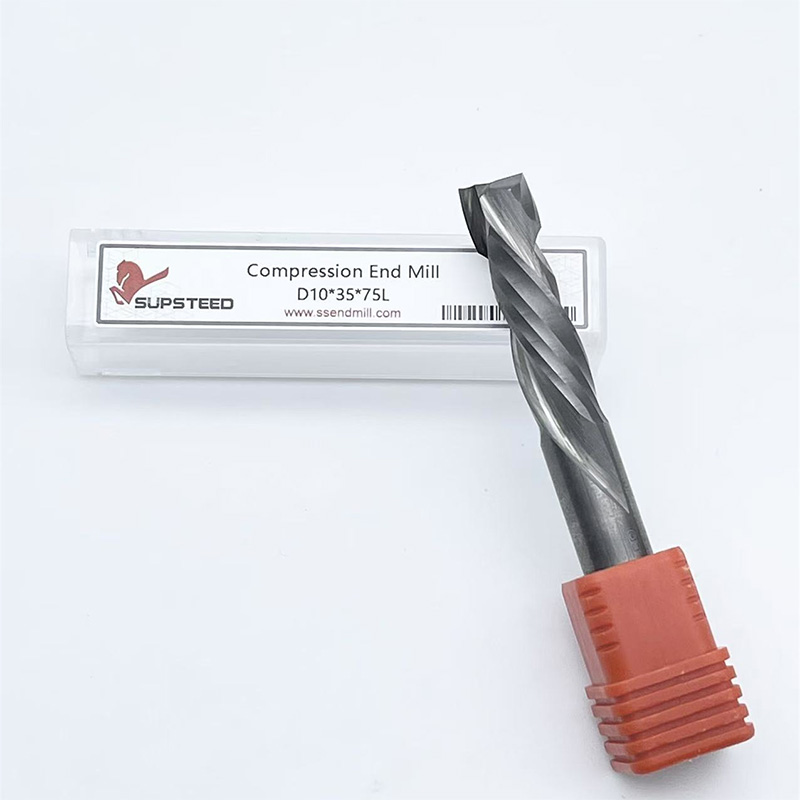
Compression bits combine both upcut and downcut geometries on the same cutting edge. The bottom portion pulls upward, while the top portion pushes downward. This mechanism compresses the top and bottom edges toward the center of the material. The outcome is flawless top and bottom edges. They are perfect for double-sided laminates, melamine, or delicate hardwood plywood. Implementation carries specific risks. The first pass must cut deeper than the upcut portion of the bit. If the upcut section breaches the top surface, it will tear out the veneer. This requires aggressive depth-of-cut settings and high feed rates to prevent burning.
Router Bit Cut Direction Comparison
| Bit Type | Chip Evacuation | Top Edge Quality | Bottom Edge Quality | Best Application |
|---|---|---|---|---|
| Upcut Spiral | Excellent | Prone to Tear-Out | Clean | Deep Pockets, Blind Holes, Hardwoods |
| Downcut Spiral | Poor (Packs Chips) | Clean | Prone to Tear-Out | Shallow Pockets, Veneers, Dados |
| Compression | Moderate | Clean | Clean | Plywood, Melamine, Double-Sided Laminates |
Tool diameter dictates material removal capacity and detail resolution. A 1/4" bit provides bulk removal and high rigidity. It resists deflection under heavy loads, allowing you to cut faster and deeper. Conversely, 1/8" and 1/16" bits offer fine detail but suffer from high fragility. They snap easily if pushed too hard or if chip clearing fails. The 1/16" bit plays a critical role in micro-carving and delicate wood inlays where sharp internal corners are required. Always choose the largest diameter possible for the geometry of the part. This strategy reduces cycle times, eliminates deflection issues, and extends tool life.
Flute count determines the required feed rate to maintain a proper chip load. Chip load is the actual thickness of the material removed by each cutting edge per revolution. If the chip load is too low, the bit rubs and burns. If it is too high, the bit snaps. Two-flute woodworking end mills represent the industry standard. They perfectly balance chip clearance capacity with realistic feed rate requirements for most routers. Single O-flute bits offer massive chip clearance. They act as a compact powerhouse for plastics and soft metals, but they also remain highly effective for softwoods with high resin content, preventing the sticky resin from packing the flutes.
Flute Count Applications
| Flute Count | Feed Rate Requirement | Chip Clearance | Primary Wood Application |
|---|---|---|---|
| 1 Flute (O-Flute) | Low to Medium | Maximum | High-resin softwoods, MDF, Plastics |
| 2 Flutes | Medium to High | Excellent | Standard hardwoods, Plywood, General routing |
| 3+ Flutes | Very High | Limited | Industrial high-speed routing, Fine finishing |
Material composition defines tool longevity and performance on the machine. Solid carbide offers superior stiffness and exceptional edge retention. It withstands the abrasive silica found in many hardwoods and the harsh glues used in MDF and plywood. High-Speed Steel (HSS) loses its edge rapidly in woodworking applications. The heat and abrasion dull HSS quickly, leading to burned cuts and fuzzy edges. Solid carbide makes HSS obsolete for serious CNC woodworking. Carbide-tipped bits offer a middle ground for large-diameter surfacing tools where solid carbide would be prohibitively heavy, but solid carbide remains the absolute standard for profiling, pocketing, and carving.
Industrial tooling often features coatings like TiN, ZrN, or DLC. These coatings reduce friction, increase surface hardness, and help dissipate heat. However, the physical coating process can slightly round the razor-sharp cutting edge. Woodworking requires absolute sharpness to shear fibers cleanly. A slightly rounded edge increases the risk of tear-out on delicate veneers. Therefore, uncoated, highly polished solid carbide is often preferred for pure wood applications. The polished flutes prevent resin buildup and allow chips to slide out effortlessly without sacrificing the keen edge required for clean cuts.
Avoid cheap, mass-produced bits found in bargain multi-packs. They suffer from poor quality control, leading to premature breakage and terrible cut quality. Evaluate brands based on strict manufacturing criteria. Look for tight runout tolerances. Runout causes the bit to wobble in the collet, effectively increasing the cut diameter, causing chatter, and reducing tool life. Premium brands use high-quality micro-grain carbide. This material holds a sharper edge longer and resists micro-fracturing. Investing in precision tooling eliminates troubleshooting headaches, keeps your spindle running smoothly, and saves expensive hardwood from the scrap bin.
Machine capability dictates your tooling choices. Industrial routers feature massive cast-iron frames, heavy gantries, and powerful 3HP to 10HP spindles. They push compression bits effortlessly at high chip loads without vibrating. Lightweight, belt-driven, or stock hobby CNCs lack this structural rigidity. They cannot maintain the aggressive feed rates required for advanced tooling. Attempting deep compression cuts on a hobby machine often leads to stalled stepper motors, skipped steps, and ruined parts. It also induces severe chatter that shatters solid carbide bits. Match your tooling to your machine's structural limits; use smaller diameter bits and shallower passes on lighter machines.
Wood burning is the most common CNC routing failure. It occurs when the bit generates too much friction in the cut channel. This is almost always caused by spindle speeds being too high relative to the feed rate. The bit rubs against the wood instead of cutting it, generating intense heat. To fix this, you must increase your feed rate to force the bit to take a thicker chip. The chip carries the heat away from the tool. If your machine cannot handle a faster feed rate without losing position, you must decrease your spindle RPM. Maintaining a proper chip load is the only way to prevent friction burns.
Cut direction dramatically impacts workholding requirements on the CNC bed. Upcut bits exert a strong lifting force on the material. They require aggressive workholding solutions to keep the stock flat. You must use vacuum tables, heavy clamping, or robust double-sided tape to prevent the stock from lifting. If the stock lifts even a fraction of an inch, the part is ruined and the bit may snap. Downcut bits do the opposite. They push the material down into the wasteboard. This natural downward pressure assists in holding the material flat, making workholding much simpler for thin stock, flexible plastics, and small parts.
A: You can, but it is highly discouraged. Metal-cutting end mills have shallow flutes and lower rake angles. They cannot evacuate sawdust efficiently. This leads to packed flutes, extreme friction, burned wood, and poor edge quality. Always use wood-specific geometry.
A: An upcut bit pulls chips and wood fibers upward, offering great chip clearance but causing top-edge tear-out. A downcut bit pushes chips and fibers downward, leaving a clean top edge but packing sawdust into the cut channel.
A: Burning occurs when the bit rubs against the wood rather than shearing it. This means your spindle RPM is too high, or your feed rate is too slow. Increase your feed rate or lower your RPM to achieve a proper chip load.
A: It can be. Compression bits require the first pass to cut deeper than the upcut portion of the bit. This demands aggressive depth-of-cut and high feed rates. Lightweight hobby machines often lack the rigidity to push through these heavy cuts without stalling.
A: Solid carbide is significantly stiffer and holds a sharp edge much longer than HSS. Wood contains abrasive silica and resins that dull HSS quickly. Carbide resists this abrasion, ensuring clean cuts and a much longer operational lifespan.