- All
- Product Name
- Product Keyword
- Product Model
- Product Summary
- Product Description
- Multi Field Search

Views: 0 Author: Site Editor Publish Time: 2026-08-22 Origin: Site
CNC machining professionals constantly face a tooling dilemma: choosing between 2-flute and 4-flute geometries. When cutting non-ferrous materials, 2-flute end mills provide the massive chip gullets needed to clear material but lack core rigidity. On the flip side, 4-flute tools offer excellent stiffness and surface finish but suffer from severe chip packing in softer metals. This forced compromise kills material removal rates (MRR), causes tool deflection, and extends cycle times.
Poor tool selection in high-speed machining leads to unpredictable tool life, chatter marks, and machine downtime. To fix this, tooling engineers developed a highly effective middle ground. This guide provides a technical framework for evaluating when to transition your operations to 3-flute geometries based on material properties, machine spindle capabilities, and specific milling dynamics. We will break down the exact parameters needed to optimize your shop floor production.
Selecting the correct end mill requires balancing competing physical forces at the cutting edge. The primary goals of any milling operation are maximizing the material removal rate, ensuring predictable tool wear, and achieving the required dimensional accuracy. All of this must happen without exceeding the available spindle horsepower or torque limits of the machine tool. When operators push a 2-flute tool too hard, the weak core deflects, causing dimensional inaccuracies. When they push a 4-flute tool in soft material, the chips cannot evacuate fast enough, leading to re-cutting, friction welding, and eventual tool breakage.
To diagnose tool deflection issues on the floor, operators should follow these steps:
The physics of chip evacuation dictate that softer materials like aluminum shear off in larger, stringier chips compared to the brittle, granular chips of cast iron or hardened steel. Historically, 2-flute tools were the default for soft materials because the wide, deep valleys between the cutting edges provided ample space for these large chips to curl and eject. However, removing that much carbide to create the gullets leaves a very thin central core. A thin core acts like a weak cantilever beam under lateral cutting forces, bending and deflecting during heavy roughing passes.
On the other end of the spectrum, 4-flute and 5-flute tools are designed for hard metals. They feature a thick, robust core that resists deflection, allowing for high-precision finishing. But the trade-off is minimal valley space. If you plunge a 4-flute tool into aluminum, the soft chips instantly pack into the tight gullets. The 3-flute design solves this by mathematically optimizing the cross-sectional area. It increases the core diameter significantly relative to a 2-flute tool while still retaining enough open valley space to evacuate non-ferrous chips effectively.
End Mill Geometry Comparison for Non-Ferrous Machining
| Flute Count | Core Rigidity | Chip Evacuation Space | Primary Application | Risk in Soft Materials |
|---|---|---|---|---|
| 2-Flute | Low | Maximum | Deep slotting, plastics | High tool deflection, chatter |
| 3-Flute | High | Optimal | High-speed aluminum roughing | Minimal (balanced performance) |
| 4-Flute | Maximum | Minimal | Steel, cast iron, finishing | Severe chip packing, tool breakage |
In milling, harmonic resonance occurs when the frequency of the cutting edges striking the material aligns with the natural frequency of the tool, tool holder, and spindle assembly. Symmetrical tools, such as 2-flute and 4-flute end mills, strike the workpiece at perfectly even intervals. Under certain RPM and feed conditions, these even intervals amplify vibrations, creating a self-sustaining resonance known as chatter. Chatter destroys surface finishes, chips the cutting edges of the carbide, and accelerates spindle bearing wear.
A 3-flute configuration inherently mitigates this issue. Because three is an odd number, the engagement frequencies are asymmetrical. As the tool rotates, the uneven spacing of the cutting forces naturally disrupts the harmonic buildup. This asymmetrical dynamic prevents the vibrations from amplifying, leading to superior harmonic stability. Machinists can push 3-flute tools through a wider range of aggressive cutting parameters without triggering the destructive chatter commonly experienced with symmetrical designs.
When optimizing non-ferrous operations, integrating 3 flute end mills for aluminum is the definitive industry standard. Aluminum alloys, particularly aerospace grades like 6061-T6 and 7075-T6, possess a low melting point and a high tendency to adhere to the cutting tool. This phenomenon, known as built-up edge (BUE), occurs when heat and pressure cause the aluminum to friction-weld itself to the carbide flutes. Once BUE forms, the tool stops cutting and starts tearing the material, ruining the part.
The geometry of a 3-flute tool specifically combats BUE. The gullets are spacious enough to allow the stringy aluminum chips to evacuate rapidly before they can superheat and weld to the tool. Furthermore, the added core strength allows machinists to run highly aggressive feed rates. Pushing the tool harder actually helps in aluminum machining because a heavier chip load transfers the generated heat into the chip itself, rather than allowing it to soak into the tool or the workpiece. You want the chips flying off the machine hot, leaving the part and the tool cool.
Beyond aluminum, 3-flute geometries deliver exceptional results in other non-ferrous metals such as brass, copper, and bronze. Copper, in particular, is notoriously gummy and prone to burring. The sharp shearing action of a 3-flute tool, combined with its high feed capacity, cleanly slices through copper without pushing or smearing the material. Brass machines easily, but the 3-flute design allows for maximum feed rates to clear bulk material faster than a 2-flute alternative.
Engineering plastics like Delrin (Acetal), PEEK, and polycarbonate present a different challenge: heat generation must be strictly minimized to prevent the plastic from melting and wrapping around the spindle. In these applications, a 3-flute tool clears the plastic chips efficiently while maintaining a continuous, stable cut. The odd-numbered flute count prevents the rapid, repetitive friction that a 4-flute tool would generate, keeping the cutting zone cool and the plastic structurally intact.
Despite their dominance in non-ferrous applications, 3-flute tools are generally not recommended for machining ferrous materials like carbon steel, stainless steel, or cast iron. Ferrous metals are significantly harder and generate immense cutting forces and extreme heat at the shear zone. You cannot treat 4140 steel the same way you treat 6061 aluminum.
Machining steel requires distributing these massive cutting forces across as many cutting edges as possible. A 4-flute, 5-flute, or even 6-flute end mill provides the necessary core mass to withstand the lateral pressure without snapping. Furthermore, the chips produced by steel are small and brittle, meaning they do not require the large evacuation gullets that a 3-flute tool provides. Using a 3-flute tool on stainless steel forces each cutting edge to take too heavy of a load, leading to rapid edge degradation, thermal cracking, and premature tool failure.
The performance of an end mill is inextricably linked to the capabilities of the machine driving it. Entry-level industrial routers and hobbyist CNC machines typically feature low-torque, high-RPM spindles. These machines lack the raw pushing power required to drive a heavy 4-flute tool through solid material at optimal chip loads. If you try to run a 4-flute tool on a low-torque spindle, the machine will bog down, stall, or experience severe chatter.
Heavy-duty Vertical Machining Centers (VMCs) possess immense torque but may have RPM limits. 3-flute tools scale beautifully across both environments. On a low-torque router, the 3-flute design allows for higher feed rates than a 2-flute tool without demanding the high horsepower needed for a 4-flute. The tool maintains continuous engagement, keeping the spindle RPM stable. On a high-torque VMC, the rigidity of the 3-flute core allows operators to utilize the machine's full power, taking incredibly deep axial cuts for maximum volumetric removal.
The most compelling argument for upgrading from a 2-flute to a 3-flute tool is the immediate, mathematically guaranteed reduction in cycle time. The fundamental formula for calculating feed rate in milling relies on the number of cutting edges engaging the material per revolution.
To calculate your new feed rates when upgrading, follow this process:
Assume you are machining an aluminum pocket at 10,000 RPM with a desired chip load of 0.005 inches per tooth. With a 2-flute tool, your feed rate is 100 IPM. With a 3-flute tool, your feed rate jumps to 150 IPM. By simply changing the tool geometry, you instantly increase your theoretical feed rate by 50% while maintaining the exact same chip load and spindle speed. This directly translates to faster part production and reduced machine time per unit.
The helix angle of an end mill dictates how the cutting edge engages the material and how the chips are evacuated. Standard helix angles, typically around 30 to 32 degrees, provide a strong, robust cutting edge that resists chipping during heavy roughing. However, in soft materials, a standard helix can sometimes struggle to lift chips out of deep pockets.
For non-ferrous machining, high-helix designs ranging from 35 to 45 degrees are highly advantageous. A high-helix 3-flute tool acts like an auger, aggressively shearing the soft aluminum and rapidly pulling the chips vertically up and out of the cutting zone. This vertical evacuation is critical when plunging or pocketing, as it prevents chips from falling back into the cut and being re-machined. A 45-degree helix also reduces the radial cutting forces, transferring more force axially up into the spindle, which helps stabilize the cut on lighter machines.
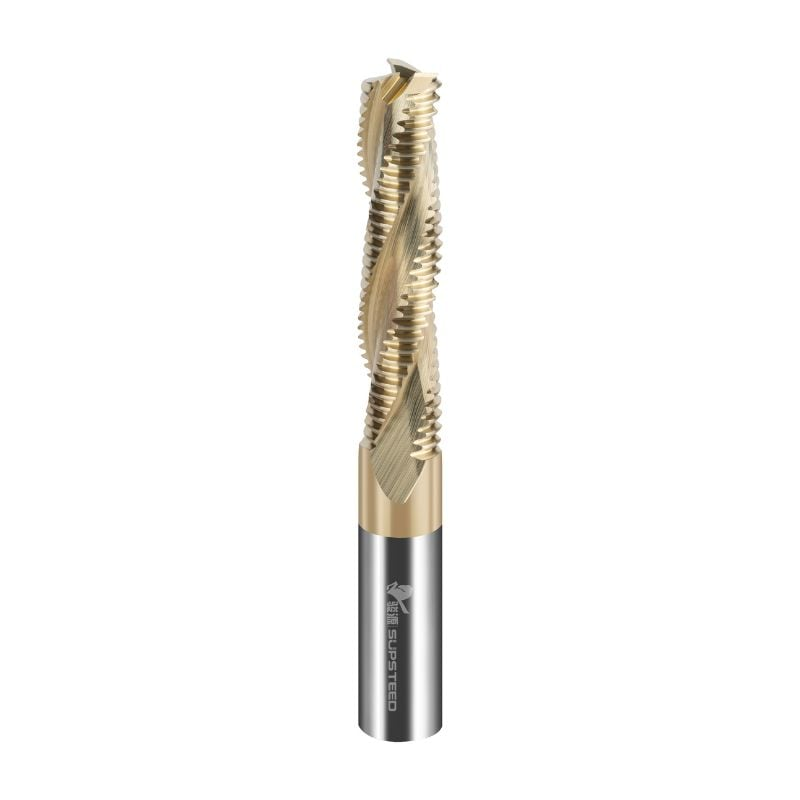
When the primary objective is raw material removal, standard solid flutes can sometimes generate chips that are too long and stringy, wrapping around the tool holder. To combat this, manufacturers developed 3 flute carbide end mills with serrated or corncob profiles specifically for roughing.
These roughing geometries feature notches ground into the cutting edges. As the tool rotates, these serrations break the large aluminum chips into much smaller, manageable pieces. Breaking the chips drastically reduces the cutting pressure and spindle load, allowing operators to push the machine even harder. While roughing end mills leave a visibly grooved surface finish, they are unparalleled for clearing bulk material quickly without chip packing. A standard solid flute tool is then used for the final finishing pass to achieve the required smooth surface.
Tool deflection is the enemy of precision machining. The amount a tool bends under load is proportional to the cube of its length. Therefore, selecting the correct Length of Cut (LOC) is a critical procurement decision. A common application requirement might involve utilizing a 1/2" diameter tool that requires a 2.5x diameter LOC to reach the bottom of a deep feature.
If you attempt this with a 2-flute tool, the thin core combined with the extended length will result in severe deflection, causing tapered walls and aggressive chatter. The relationship between LOC and core diameter dictates that you must maximize stiffness whenever reaching deep into a part. A 3-flute core provides the necessary structural stiffness that a 2-flute tool lacks at extended lengths. Always select the shortest possible LOC that can complete the job. If a long reach is unavoidable, the 3-flute geometry is mandatory to maintain dimensional stability.
Procurement teams must also weigh the benefits of solid carbide end mills against indexable carbide tooling. Solid carbide 3-flute end mills are ground from a single cylindrical blank. They offer unmatched precision, concentricity, and are available in very small diameters. They are mandatory for high-precision finishing, intricate pocketing, and high-speed dynamic milling toolpaths.
Indexable tooling, which uses replaceable carbide inserts screwed onto a steel body, becomes more cost-effective for heavy roughing on larger machines, typically starting at diameters of 3/4" or 1". While indexable tools excel at hogging out massive amounts of material, they cannot match the fine surface finish, tight corner radii, or high-RPM balance of a solid carbide 3-flute end mill. For most aluminum aerospace and automotive components, solid carbide remains the superior choice.
While 3-flute tools offer excellent chip evacuation, deep slotting remains a high-risk operation. When cutting a slot deeper than 1x the tool's diameter, the surrounding walls trap the chips. If the chips cannot escape, the tool will recut them, leading to instant chip packing and catastrophic tool breakage.
To mitigate this risk, operators must employ aggressive clearing strategies. High-pressure coolant is highly recommended to blast chips out of the slot. If coolant is unavailable, a continuous, high-velocity air blast is mandatory. Furthermore, programmers should transition away from traditional straight-line slotting and utilize adaptive clearing toolpaths. Trochoidal toolpaths take light radial cuts in a circular motion, keeping the tool load constant and providing ample space for chips to fly clear of the cutting zone.
Follow these best practices for deep slotting:
Heat management is the most critical factor in extending the life of solid carbide tooling. Recutting chips is the primary cause of premature tool failure in aluminum. When a tool recuts a hardened chip, it experiences severe thermal shock and abrasion, rapidly degrading the sharp cutting edge.
Mitigating heat requires strict adherence to proper chip thinning calculations. When taking light radial cuts, the actual chip thickness produced is less than the programmed feed per tooth. If the chip is too thin, the tool rubs against the material rather than shearing it, generating massive amounts of friction and heat. Programmers must calculate the radial chip thinning factor and increase the feed rate accordingly. Maintaining the optimal, thicker chip load ensures that the heat generated by the cutting action is transferred into the chip and carried away, rather than soaking into the carbide tool or distorting the workpiece.
Transitioning to 3-flute carbide end mills offers a massive upgrade in material removal rates, harmonic stability, and surface finish for aluminum and non-ferrous applications. To capitalize on these benefits, take the following actions:
A: Yes, they offer a 50% increase in feed rate potential and greater core rigidity while still providing adequate chip evacuation for aluminum. The added stiffness prevents deflection during heavy roughing, and the extra cutting edge allows for faster cycle times without sacrificing surface finish.
A: It is not recommended. Steel requires the higher core strength and distributed cutting forces of 4, 5, or 6-flute end mills to prevent tool breakage and premature wear. The large gullets of a 3-flute tool leave the core too weak to handle the massive lateral forces generated by ferrous materials.
A: A 35 to 45-degree high-helix angle is typically optimal for aluminum, as it efficiently shears the soft material and evacuates chips vertically out of the cut. A standard 32-degree helix is better suited for general-purpose rigidity but may struggle to clear chips in deep pockets.
A: Use a roughing end mill with serrated edges for aggressive material removal to break chips into smaller pieces and reduce spindle load. Use a standard solid flute for finishing passes to achieve a smooth surface. Combining both strategies yields the fastest and most accurate results.
A: Higher flute counts generally mean a thicker tool core. A 3-flute end mill has a thicker core than a 2-flute, making it stiffer and less prone to deflection under heavy loads, especially at extended lengths of cut. This stiffness is critical for maintaining dimensional accuracy on deep walls.
A: The asymmetrical nature of three flutes creates an uneven cutting frequency, which naturally disrupts the harmonic resonance that causes chatter in symmetrical 2 or 4-flute tools. This disruption allows for smoother cutting dynamics and superior surface finishes across various RPM ranges.
A: For aluminum, high-pressure coolant or a minimum quantity lubrication (MQL) system is preferred to prevent chip welding and manage heat. For plastics, a cold air blast is highly effective at clearing chips without introducing thermal shock or fluid contamination to the workpiece.