- All
- Product Name
- Product Keyword
- Product Model
- Product Summary
- Product Description
- Multi Field Search

Views: 0 Author: Site Editor Publish Time: 2026-08-10 Origin: Site

Manufacturing floors face constant pressure to reduce cycle times and maximize spindle uptime. Holding tight tolerances without escalating consumable costs is a daily challenge for machinists and programmers. Standard commodity end mills often hit their limits in demanding production environments. You experience premature tool wear, suboptimal material removal rates (MRR), and poor surface finishes. Frequent tool changeovers introduce hidden costs that destroy profit margins and disrupt workflow. High-performance tooling offers an engineered solution to these bottlenecks. These tools are designed for specific materials and advanced toolpaths. They leverage specialized carbide grades, variable geometries, and advanced coatings to push cutting limits. Upgrading your tooling strategy directly impacts your ability to sustain aggressive feed rates and maintain dimensional accuracy across long production runs.
Establishing the baseline for high-performance tooling requires looking beyond the basic shape of the cutter. A tool qualifies as high-performance based on consistency, predictability, and speed under heavy loads. Commodity tools work well for light duty or prototyping. Production environments demand tools that can sustain aggressive feed rates without catastrophic failure or rapid edge degradation. When you push a standard end mill hard, it chatters, deflects, and eventually snaps. High-performance variants absorb those forces and evacuate chips efficiently.
The foundation of any premium cutting tool is its material composition. Manufacturers utilize sub-micrograin carbide substrates to achieve superior transverse rupture strength (TRS). Standard carbide might use a 0.8-micron grain size, whereas high-performance tools utilize grains as small as 0.2 microns. This dense, fine-grained material, combined with a 10% to 12% cobalt binder, withstands extreme cutting forces without snapping. It provides the necessary toughness to handle interrupted cuts while maintaining a razor-sharp edge.
Geometry dictates how the tool behaves in the cut. Variable helix angles and unequal flute spacing disrupt harmonic frequencies. If a four-flute end mill has flutes spaced exactly 90 degrees apart, it creates a rhythmic impact against the material, leading to chatter. By offsetting the flutes—for example, at 88, 92, 89, and 91 degrees—the tool breaks that harmonic cycle. This engineered irregularity dampens vibrations during heavy roughing passes. Specialized edge preparations further enhance tool life. Techniques like applying a 0.001-inch hone or a K-land chamfer to the cutting edge protect it from micro-chipping under high feed rates.
Directional chip flow dictates surface finish and tool longevity. Engineered up-cut geometries maximize chip evacuation in deep slotting operations. They pull chips up and out of the cut, preventing recutting and heat buildup. This lifting action is excellent for clearing deep pockets but can cause fraying or tear-out on the top edge of laminated or fibrous materials.
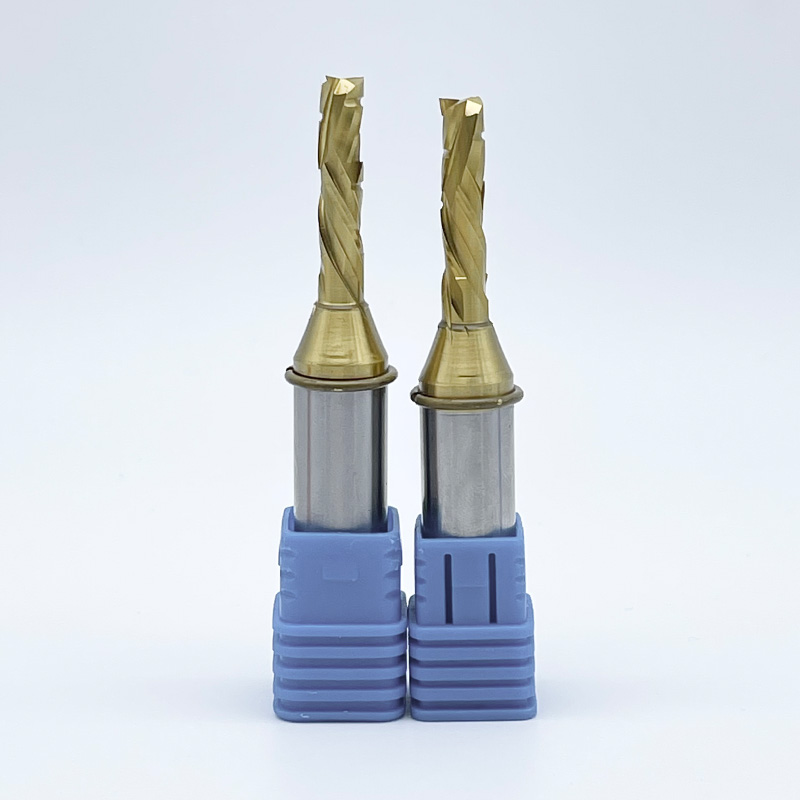
Down-cut profiles push chips downward into the cut. This downward pressure prevents delamination on the top surface of the workpiece, leaving a clean edge. It also helps hold thin sheet material down against the vacuum table or fixture. High-performance compression bits combine both geometries into a single tool. They feature an up-cut section at the tip and a down-cut section on the shank. This design achieves flawless top and bottom edge finishes simultaneously. When cutting 0.750-inch melamine, the operator programs the first pass deep enough to engage the down-cut portion on the top surface, shearing the laminate inward from both sides.
Terminology often overlaps between high-RPM CNC routers, rigid Vertical Machining Centers (VMCs), and traditional milling machines. While they share core cutting principles, the tooling requirements differ significantly. Upgrading to high performance router bits requires specific shank tolerances and strict balance requirements to handle high RPMs safely. A CNC router often spins at 18,000 to 24,000 RPM. Imbalanced tools at these speeds will destroy spindle bearings rapidly. Premium router bits are balanced to a G2.5 specification to prevent catastrophic vibration.
Chip evacuation strategies also differ across machine platforms. Routers typically rely on high spindle speeds and rapid feed rates in softer materials like wood, plastics, and aluminum. This demands specialized flute designs with larger gullets to clear high volumes of chips quickly. Traditional end mills used in VMCs often focus on rigidity and heat management for cutting harder alloys like steel and titanium at lower RPMs, utilizing thicker core diameters and higher flute counts.
Selecting the right tool requires mapping specific operational goals to the capabilities of the cutter. High-performance tools are engineered to solve distinct machining challenges across various materials and applications. You do not buy a premium tool just to run it at standard speeds and feeds.
Maximizing MRR is the fastest way to reduce cycle times. Engineered core diameters allow for deeper depths of cut and higher axial engagement. You can push higher feed rates without experiencing tool deflection. Thick cores provide the rigidity needed to plow through material aggressively, utilizing the entire flute length rather than just the bottom tip.
High-performance geometries facilitate efficient chip evacuation in deep pockets. They leverage radial chip thinning principles. When the radial engagement (step-over) is less than 50% of the cutter diameter, the actual chip thickness decreases. Programmers must increase the feed rate significantly to maintain the target chip load. Specialized roughing profiles, often called hoggers, feature serrated edges. These serrations rapidly break up chips into smaller, manageable pieces. This action significantly reduces spindle load, prevents chip packing in deep cavities, and allows for feed rates that would stall a standard end mill.
Achieving a mirror finish directly off the machine eliminates costly secondary operations like benching and hand polishing. High-flute-count end mills achieve superior surface finishes by reducing the chip load per tooth. A 7-flute end mill allows for much faster feed rates while maintaining a tight surface finish requirement compared to a 3-flute tool.
Harmonic dampening features prevent witness marks and chatter on thin-walled components. Variable pitch designs break up the rhythmic impact of the flutes against the material. You achieve dimensional accuracy and aesthetic perfection in a single pass. Some finishing tools also incorporate a slight wiper flat on the bottom edge, which acts like a trowel to smooth the floor of a pocket as the tool feeds across it.
Standard tools fail rapidly when cutting ferrous metals, high-temp alloys like Inconel or Hastelloy, and hardened steels up to 65 HRc. Deploying high-performance routing end mills is mandatory in these demanding applications. They utilize specialized carbide grades that resist deformation under extreme stress. Machining Inconel requires maintaining a constant chip load; if the tool rubs instead of cuts, the material work-hardens instantly, destroying the cutting edge.
Specific coatings manage the intense heat generation at the shear zone. Coatings like Aluminum Titanium Nitride (AlTiN) create a thermal barrier that protects the carbide substrate. As temperatures rise above 800 degrees Celsius, the coating forms an aluminum oxide layer that reflects heat into the chip rather than the tool. This allows for dry machining of hardened steels, extending tool life by preventing the thermal shock associated with coolant.
Machining aluminum, brass, carbon fiber, and fiberglass presents unique challenges. Specialized tools are required to handle the distinct properties of these materials. Polished flutes are essential to prevent built-up edge (BUE) in gummy materials. Aluminum tends to melt and weld to the cutting edge without proper flute polishing and sharp rake angles. Zirconium Nitride (ZrN) coatings are frequently applied to aluminum-cutting tools to provide a slick surface that repels the material.
Composite materials like carbon fiber reinforced polymer (CFRP) are highly abrasive. They rapidly wear down standard carbide edges, turning a sharp tool into a blunt instrument in minutes. High-performance tools for composites often feature Chemical Vapor Deposition (CVD) diamond coatings or specialized geometries like compression routers that shear the tough fibers without causing delamination or fraying. Proper tool selection ensures clean cuts and prevents structural damage to the composite matrix.
Choosing the correct tool involves evaluating technical specifications against your specific machining environment. You must match the tool's geometry and coating to the material, while ensuring your machine can support the tool's requirements. A mismatch here results in broken tools and scrapped parts.
Flute count dictates chip clearance capacity and finish quality. Fewer flutes provide larger gullets for high-volume chip clearance. More flutes increase core strength and improve surface finish but reduce chip clearance space. You must balance these factors based on the application.
Flute Count Selection Guide
| Flute Count | Primary Application | Target Materials | Key Benefit |
|---|---|---|---|
| 1 to 2 Flutes | High-speed roughing, slotting | Aluminum, Plastics, Wood | Maximum chip evacuation, prevents melting |
| 3 Flutes | General purpose non-ferrous | Aluminum, Brass, Soft Alloys | Balance of chip clearance and finish |
| 4 to 5 Flutes | Roughing and finishing ferrous | Carbon Steel, Stainless Steel | High core strength, good surface finish |
| 6 to 9+ Flutes | High-speed finishing, hard milling | Hardened Steels, Titanium, Inconel | Superior finish, high feed rates at low step-overs |
Evaluate industry-standard coatings based on operating temperatures and material abrasiveness. Titanium Aluminum Nitride (TiAlN) and AlTiN perform exceptionally well in high-heat applications. They thrive in environments where heat is generated, making them ideal for cutting steel and high-temp alloys.
Coating Specifications and Thermal Limits
| Coating Type | Microhardness (HV) | Max Operating Temp | Primary Application |
|---|---|---|---|
| TiN (Titanium Nitride) | 2,400 | 600°C | General purpose, low-carbon steels |
| TiCN (Titanium Carbonitride) | 3,000 | 400°C | Abrasive materials, cast iron, brass |
| AlTiN (Aluminum Titanium Nitride) | 3,800 | 900°C | Hardened steels, dry machining, Inconel |
| CVD Diamond | 10,000 | 600°C | Carbon fiber, graphite, highly abrasive composites |
Consider the trade-offs between running coolant versus dry machining. Advanced coatings often perform better dry. Coolant can cause thermal shock. When a carbide tool heats up in the cut and is suddenly blasted with cold coolant, micro-cracks form along the cutting edge, leading to premature edge failure. Air blasts are often preferred to clear chips without inducing thermal shock.
High-performance mills require rigid setups to function correctly. You need high-quality tool holders like shrink fit, hydraulic chucks, or high-precision milling chucks. Standard ER collets often lack the gripping force and concentricity required for aggressive toolpaths. A shrink-fit holder provides up to 10,000 pounds of gripping force evenly around the shank, preventing tool pull-out during heavy roughing.
Low runout is non-negotiable. Putting a premium tool in a loose or aging spindle negates the tool's benefits immediately. Excessive runout causes uneven chip loads. If a four-flute tool has 0.002 inches of runout, only one or two flutes are doing all the cutting. This leads to rapid wear on one side of the tool and eventual breakage. Address machine hardware limitations, check drawbar pressure, and inspect spindle tapers before investing heavily in premium cutting tools.
Justifying the purchase of premium tooling requires looking beyond the initial invoice. You must analyze the financial impact on the entire production process. The goal is to reduce the cost to produce each individual part, factoring in machine time, labor, and tool longevity.
Break down the math of Cost-Per-Part. A high-performance tool might cost $150 upfront, while a commodity end mill costs $50. If the standard tool takes 10 minutes to machine a part and lasts for 50 parts, you are spending significant machine time and changing tools frequently. If the $150 premium tool utilizes HEM toolpaths to cut the cycle time down to 6 minutes and lasts for 200 parts, the math shifts dramatically.
At a standard shop rate of $100 per hour, saving 4 minutes per part saves $6.66 in machine time per cycle. Over 200 parts, that is over $1,300 in saved machine time, completely dwarfing the extra $100 spent on the premium tool. Completing jobs faster effectively increases overall shop capacity. You boost throughput and can take on more work without the need to invest in additional CNC machinery or expand facility space. Maximizing the output of existing equipment is the most efficient way to scale operations.
Predictable tool life is critical in lights-out manufacturing. Unattended machining environments rely on tools that do not fail prematurely. A broken tool during a night shift ruins the part and halts production until morning, destroying profitability. Premium carbide and coatings provide the consistency needed to let machines run unattended with confidence.
Factor in the labor savings from reduced tool changeovers. Every time an operator stops the machine to change a worn tool, you lose valuable production time. The operator must remove the tool, clean the collet, insert the new tool, touch it off on the tool setter, and adjust wear offsets. Fewer offset adjustments and tool changes mean operators can focus on higher-value tasks like setup, programming, and quality control.
Integrating high-performance tools on the shop floor introduces new variables. You must adapt your processes to handle the increased speeds and forces. Failing to adjust can lead to costly mistakes, scrapped parts, and damaged equipment.
High feed rates amplify the consequences of programming errors. A slight miscalculation in tool engagement can cause an immediate crash. Excessive runout leads to catastrophic tool breakage and scrapped parts. The rigid nature of sub-micrograin carbide makes it less forgiving of vibration and poor setups compared to high-speed steel (HSS).
Implement strict toolholder maintenance to mitigate these risks. Follow these exact steps to ensure proper setup:
Traditional step-over roughing toolpaths will destroy high-performance end mills. Standard offset toolpaths cause inconsistent radial engagement. When the tool drives into a corner, the engagement angle spikes, overloading the cutter and causing immediate failure. Premium tools require consistent cutting forces to survive.
Mandate the use of modern CAM software. Generate trochoidal or High-Efficiency Milling (HEM) toolpaths. These strategies maintain a constant chip load by dynamically adjusting the feed rate and engagement angle. Instead of burying the tool in a corner, the software generates circular, peeling motions. This protects the tool, reduces heat generation, and allows you to utilize the full flute length of the cutter, spreading the wear evenly across the carbide.
Take these actionable steps to optimize your milling operations:
A: High-performance end mills feature variable geometries, specialized sub-micrograin carbide grades, and application-specific coatings. They are designed to sustain higher material removal rates, dampen vibrations, and withstand extreme heat compared to standard commodity tools.
A: Yes, but success depends on machine rigidity and spindle capabilities. High-performance tools require rigid workholding, low spindle runout, and high-precision tool holders. Using them on loose or aging machines will lead to premature tool failure and negate their benefits.
A: Abrasive composites like carbon fiber, work-hardening alloys such as titanium and Inconel, hardened steels, and gummy non-ferrous metals like aluminum benefit significantly. These materials cause rapid wear, heat buildup, or built-up edge on standard tools.
A: Choose 1 to 3 flutes for non-ferrous materials like aluminum and plastics to maximize chip clearance. Select 4 to 9+ flutes for ferrous metals, hard alloys, and finishing passes where core strength and surface finish are the priority.
A: Up-cut tools pull chips upward, ideal for deep slotting but may fray top edges. Down-cut tools push chips downward, preventing top-surface delamination. Compression tools combine both, pushing chips toward the center to achieve clean top and bottom edges simultaneously.
A: Premature breakage is usually caused by excessive spindle runout, incorrect chip loads, lack of rigid workholding, or using traditional offset toolpaths instead of constant-engagement HEM toolpaths. Thermal shock from improper coolant use can also crack the carbide.
A: Yes. To maximize tool life and prevent runout, use high-precision collets, milling chucks, hydraulic chucks, or shrink-fit holders. Standard or worn ER collets often lack the gripping force and concentricity needed for high-feed machining.