- All
- Product Name
- Product Keyword
- Product Model
- Product Summary
- Product Description
- Multi Field Search

Views: 0 Author: Site Editor Publish Time: 2026-11-10 Origin: Site

Machining hardened materials demands the right cutting tool. Ordinary cutters may wear quickly or lose accuracy during demanding jobs. An HRC62 end mill can suit selected hardened steel, mold, and precision milling applications. However, its performance depends on carbide quality, tool geometry, and cutting conditions. This guide explores suitable machining jobs, material compatibility, and key selection factors. It also explains how to choose the right tool for your production needs.
An HRC62 end mill can serve several demanding machining applications. Its suitability depends on the actual tool construction and workpiece material. The following jobs are worth evaluating.
Hardened steel components often require stable cutting edges. Their high hardness can accelerate tool wear. Ordinary milling tools may also suffer edge chipping under heavy loads.
An HRC62 end mill may suit selected hardened steel machining operations. It can support precision milling when its carbide substrate and cutting geometry match the application. Wear resistance becomes especially important during repeated machining. For specific hardened steel applications, explore our HRC62 carbide end mill options and review their technical specifications.
Typical jobs include hardened mechanical parts, precision steel inserts, and industrial tooling components. Engineers should confirm workpiece hardness before selecting the cutter. They should also check the recommended machining range.
Mold manufacturing often involves complex cavities and detailed profiles. These features require accurate material removal and consistent surface quality. Tool wear can affect both dimensions and finishing results.
An HRC62 end mill may suit selected mold finishing operations. It can help machine hardened mold components when the tool grade matches the steel. Corner-radius designs can also support machining around internal transitions.
Typical applications include mold inserts, die components, and precision cavity features. Tool geometry should match the cavity depth and profile. Long-reach designs may help access narrow areas.
Precision components often have strict dimensional requirements. Small changes in cutting-edge condition can affect final measurements. Consistent tool performance therefore matters during repeated production.
An HRC62 end mill may suit precision grooves, shoulders, and detailed profiles. Its performance depends on edge quality and machining stability. A suitable tool can help maintain consistent cutting results.
Manufacturers should also consider tool runout and machine rigidity. Excessive vibration can reduce accuracy. Correct tool selection must work alongside a stable machining setup.
Stainless steel machining creates several cutting challenges. Some grades generate high cutting temperatures. Certain materials also experience work hardening during cutting.
An HRC62 end mill may be suitable for selected stainless steel applications. However, the hardness rating alone cannot confirm compatibility. Carbide grade, coating, flute geometry, and cutting conditions remain important.
Manufacturers should evaluate chip evacuation and thermal management. Poor chip removal can cause recutting. This may increase tool wear and damage the machined surface.
Tungsten steel products can involve demanding machining requirements. Their actual composition and hardness vary by application. Buyers should identify the exact workpiece material before selecting a cutter.
A suitable HRC62 end mill may handle certain high-hardness steel applications. Its cutting-edge strength and substrate properties influence performance. The manufacturer's application limits should guide selection.
Cemented carbide requires separate consideration. It is extremely hard and abrasive. Conventional end milling may not suit every carbide workpiece. Specialized grinding or other processes may be more appropriate.
Some components contain narrow cavities and deep profiles. Standard-length tools may not reach these features. Specialized neck designs can provide better access.
Long-neck end mills can help machine difficult internal areas. However, longer tool reach increases deflection and vibration risks. Engineers should select the shortest practical tool length.
Corner-radius geometry can also support complex profile machining. It reduces sharp corner loading under suitable conditions. The actual benefit depends on the workpiece and cutting strategy.
Small-batch production often involves frequent setup changes. Manufacturers need predictable cutting behavior across different jobs. Tool consistency can reduce adjustment requirements.
An HRC62 end mill may suit selected precision production tasks. Its value depends on tool life and machining accuracy. Buyers should compare actual performance rather than relying on hardness labels.
Repeated machining tests can reveal useful differences. Check dimensional consistency and surface quality. Also record tool wear under comparable conditions.
Tip: Before choosing an HRC62 end mill, confirm the workpiece material, hardness, and machining operation. These details provide a better starting point than the tool rating alone.
Material compatibility is one of the most important selection factors. Different metals create different cutting forces and temperatures. An HRC62 end mill should match the actual workpiece properties.
Hardened carbon steel is common in industrial tooling. Alloy steel also appears in precision mechanical components. Both materials require suitable cutting-edge strength.
An HRC62 end mill may machine selected hardened steel grades. The actual result depends on workpiece hardness and carbide quality. Higher cutting resistance requires careful parameter control.
Engineers should check material certificates and hardness measurements. They should also confirm the cutter manufacturer's recommendations. This reduces the risk of premature edge failure.
Stainless steel is used in many industrial environments. Its machining behavior varies by grade. Austenitic stainless steel, for example, can create significant heat and work hardening.
A suitable carbide end mill can machine selected stainless steel components. Coating and flute geometry influence its performance. Effective chip removal also helps maintain stable cutting.
Heat-resistant alloys require additional evaluation. Their cutting temperatures and material strength can create demanding conditions. Buyers should request application-specific tool recommendations.
Pre-hardened mold steel is widely used in mold manufacturing. It can reduce additional heat-treatment requirements. However, its hardness still affects cutting tool selection.
An HRC62 end mill may suit selected finishing operations. Tool geometry should match the cavity shape. Corner-radius cutters can help machine transitions and curved profiles.
Manufacturers should distinguish roughing from finishing requirements. Roughing creates higher cutting loads. Finishing places greater emphasis on surface quality and dimensional accuracy.
Tungsten steel generally refers to tungsten-alloy tool steels in commercial contexts. However, suppliers may use the term differently. Buyers should confirm the exact material designation.
Cemented carbide is different from conventional tungsten steel. It contains hard carbide particles and a metallic binder. Its extreme hardness may exceed the practical range of conventional end mills.
Specialized grinding may provide a better solution for cemented carbide. The process depends on component geometry and material properties. Engineers should confirm the appropriate manufacturing method first.
Note: Never select a cutting tool from a material name alone. Confirm the workpiece grade, hardness, and heat-treatment condition.
The machining performance of an HRC62 end mill depends on its complete design. Hardness is only one part of the equation. Substrate quality, flute structure, and tool geometry also matter.
Cutting-edge hardness influences resistance to surface wear. A suitable carbide grade can maintain its edge under demanding conditions. This becomes important during repeated machining operations.
However, hardness and toughness are different properties. A very hard cutting edge may become more vulnerable to chipping. Interrupted cutting therefore requires careful grade selection.
Manufacturers should evaluate both properties together. Carbide grain size and binder content provide useful information. Actual machining tests remain important for confirming performance.
Flute design influences chip formation and removal. Two-flute tools generally provide more chip space. Four-flute designs offer additional cutting edges and different load distribution.
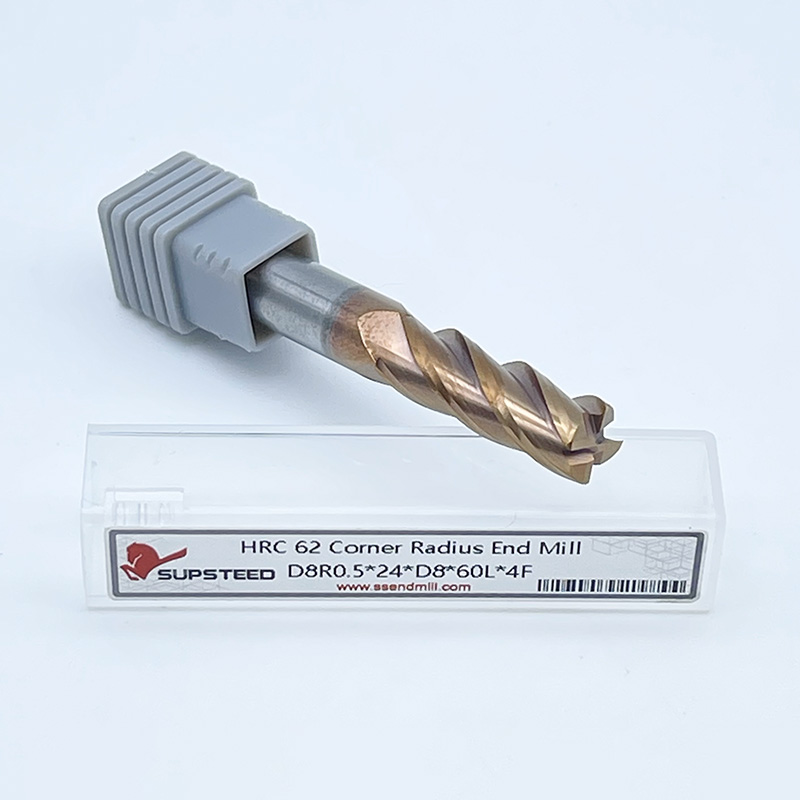
The supplied Supsteed product provides an example of a four-flute HRC62 carbide end mill. Its listing identifies stainless steel and tungsten steel applications. This configuration offers a reference for discussing industrial milling requirements.
However, four flutes are not automatically better. Chip space becomes important during slotting. The correct configuration depends on engagement, feed rate, and material properties.
Corner-radius end mills feature rounded cutting corners. This geometry can reduce stress concentration near sharp edges. It may also improve edge strength during suitable machining operations.
Long-neck designs provide access to deep cavities. They are useful when standard tools cannot reach certain profiles. However, increased reach can reduce overall tool rigidity.
The supplied SC-HJS product illustrates a specialized geometry. Its listing describes a concave bull-nose profile and 3 mm corner radius. It also features a flared long-neck design for specific machining requirements. For curved surfaces and detailed profiles, HRC65 ball nose end mills offer another tool configuration worth evaluating.
For mold applications, geometry should follow the component drawing. Tool reach, corner radius, and cutting diameter must match. This helps avoid unnecessary interference and tool deflection.
Surface finish depends on several machining factors. Tool wear can change the cutting edge. Vibration can also create visible surface marks.
A suitable HRC62 end mill can support precision machining. However, its hardness rating does not guarantee a specific finish. Tool runout and cutting parameters remain important.
Manufacturers should inspect finished components regularly. Check dimensional variation and surface roughness. These results provide practical evidence of tool performance.
Tip: Compare cutting performance under identical machining conditions. Record tool life, surface finish, and dimensional variation for reliable evaluation.
Choosing between an HRC62 end mill and a standard carbide end mill requires more than comparing product labels. Buyers should evaluate material properties and application requirements.
HRC62 is a hardness designation shown in certain product specifications. It should not automatically represent carbide substrate hardness. The manufacturer must clarify its measurement method and tested material.
Standard carbide end mills also have different material grades. Their hardness, toughness, and wear resistance vary. These properties influence their suitable machining applications.
Buyers should request complete technical specifications. Confirm the hardness scale and test method. Avoid comparing unrelated hardness values directly.
Wear resistance affects how well a cutting edge maintains its condition. Carbide composition and coating influence this behavior. Tool geometry also affects cutting loads.
An HRC62 product may target demanding machining applications. However, its actual wear resistance requires technical verification. A standard carbide cutter may perform better under other conditions.
Cutting stability depends on more than hardness. Machine rigidity, toolholder accuracy, and chip evacuation matter. Engineers should evaluate the complete machining system.
An HRC62 end mill may suit selected hardened steel and mold applications. It can also serve precision machining tasks. The actual suitability depends on its construction.
Standard carbide end mills often cover broader machining requirements. They may offer better value for general milling. There is no universal winner between these tool categories.
The following table highlights the main selection differences.
Evaluation Factor | HRC62 End Mill | Standard Carbide End Mill |
|---|---|---|
Hardness positioning | HRC62 product designation | Varies by grade |
Main application | Selected demanding jobs | General machining |
Wear resistance | Requires verification | Depends on substrate |
Tool geometry | Application-specific | Application-specific |
Material compatibility | Confirm workpiece hardness | Confirm workpiece hardness |
Selection basis | Actual machining conditions | Actual machining conditions |
Note: A higher hardness designation does not automatically mean longer tool life. Compare substrate composition and actual machining results.
Product specifications help buyers determine whether a cutter suits their production requirements. An HRC62 end mill should be evaluated through its material, geometry, and coating.
The carbide substrate forms the tool's structural foundation. Its composition affects hardness and toughness. Grain structure also influences cutting-edge performance.
Fine-grain carbide is commonly used in precision cutting tools. However, the correct grade depends on the machining application. Buyers should not assume all carbide substrates perform equally.
Ask suppliers for material specifications and technical data. Review hardness, transverse rupture strength, and grain size. These details support more meaningful product comparisons.
Flute number affects chip space and cutting engagement. Two-flute, three-flute, and four-flute tools serve different machining conditions. Each configuration has specific advantages.
Cutting diameter and core structure also matter. A larger core can improve tool strength. However, it may reduce available chip space.
Buyers should consider the complete tool geometry. Check flute length, helix angle, and cutting-edge design. Match these features to the intended material and operation. You can compare different end mill configurations to find suitable flute designs, cutting diameters, and tool geometries.
Coatings can improve wear resistance and thermal performance. Their effectiveness depends on coating composition and application. Not every coating suits every workpiece material.
Common options include TiAlN, AlTiN, and AlCrN. Their properties vary by formulation and manufacturing process. Buyers should request application-specific recommendations.
Uncoated carbide tools may also suit certain operations. Coating selection should consider cutting speed and lubrication. Actual machining tests provide the strongest evidence.
Tool length affects rigidity and accessibility. Longer tools can reach deeper cavities. However, excessive overhang increases vibration risks.
Corner configuration also influences machining results. Flat end mills suit shoulders and slots. Corner-radius tools support selected curved transitions and cavity profiles.
For specialized applications, buyers can explore different end mill configurations. Compare dimensions and cutting geometry before ordering.
Tip: Request a technical drawing before purchasing customized tools. Confirm cutting diameter, flute length, shank size, and corner radius.
The right selection process starts with the workpiece. Engineers should then consider tool geometry and machining conditions. This approach reduces unnecessary trial and error.
First, identify the exact workpiece material. Check its grade and heat-treatment condition. Then measure its actual hardness.
An HRC62 end mill may suit selected hardened materials. However, its application range depends on verified tool specifications. Do not assume the rating represents maximum workpiece compatibility.
Ask suppliers for recommended hardness ranges. Request supporting machining data when available. This helps prevent unsuitable tool selection.
Tool geometry should match the component design. Flat end mills handle many general milling operations. Corner-radius tools suit selected profiles and transitions.
Long-neck tools can reach narrow cavities. However, their extended length requires careful setup. Use the shortest practical tool whenever possible.
You can also compare specialized ball nose end mill designs. These tools may suit curved surfaces and three-dimensional profiles. Confirm their hardness and application specifications before selection.
Cutting parameters directly affect tool performance. Spindle speed influences cutting temperature. Feed rate affects chip thickness and cutting loads.
Radial engagement and axial depth also matter. Excessive engagement may increase tool stress. Suitable toolpaths can help maintain stable cutting conditions.
Machine rigidity and toolholder accuracy deserve equal attention. Excessive runout can damage cutting edges. Proper coolant delivery also supports effective chip removal.
Product descriptions cannot replace practical testing. Buyers should request samples when possible. They should also obtain technical drawings and specifications.
Compare tools under similar machining conditions. Record tool wear and surface roughness. Check dimensional consistency across repeated operations.
For bulk purchasing, review inspection documentation. Confirm dimensional tolerances and material information. These records support more reliable supplier evaluation.
Tip: Industrial buyers should request substrate specifications and machining test results. An HRC62 label alone cannot establish cutting performance.
An HRC62 end mill suits selected hardened steel, mold making, and precision milling jobs. Its performance depends on carbide quality, coating, geometry, and cutting conditions. Supsteed Precision Tools Co., Ltd. provides end mill solutions for demanding machining applications. Its product options help manufacturers match cutting tools to specific production needs.
A: Selected hardened steel, mold finishing, and precision milling jobs.
A: Yes, depending on carbide quality, coating, and cutting conditions.
A: It can machine selected hardened mold components and cavities.
A: No. Substrate quality, geometry, and machining conditions also matter.
A: Check workpiece hardness, carbide specifications, coating, and tool geometry.