- All
- Product Name
- Product Keyword
- Product Model
- Product Summary
- Product Description
- Multi Field Search

Views: 0 Author: Site Editor Publish Time: 2026-08-13 Origin: Site
Defaulting to general-purpose tooling hides production costs directly inside your machining operations. While the initial purchase order looks favorable, the reality on the shop floor tells a different story. Lost cycle time, excessive machine downtime for tool changeovers, and compromised part quality rapidly erode upfront savings. Machinists frequently slow down feed rates or take shallower cuts just to keep a standard tool alive. You sacrifice valuable spindle utilization in the process.
The core problem lies in the tension between minimizing upfront tooling procurement costs and maximizing machine up-time, tool longevity, and part throughput. Every minute a CNC machine sits idle while an operator swaps out a broken standard tool is a minute of lost production. To solve this, shops need a systematic evaluation framework. By analyzing material properties, machine rigidity, and production volume, you can determine exactly when standard tools fail and advanced geometries become necessary.
General-purpose end mills feature standard architectural traits designed for broad utility rather than specialized efficiency. They typically utilize even flute spacing, standard helix angles hovering around 30 degrees, and conventional edge preparations. This uniform geometry provides predictable cutting action across a wide variety of basic milling tasks. Tool manufacturers design these cutters to be the versatile workhorses of a machine shop. They handle simple slotting, profiling, and plunging operations without requiring complex CAM programming or highly specialized machining environments.
High Speed Steel (HSS) and standard micro-grain carbide dominate the general-purpose category. HSS remains highly relevant for milling both ferrous and nonferrous materials, particularly on machines lacking the speed or rigidity required for advanced carbide tools. HSS tools absorb shock and vibration much better than rigid carbide. This makes them forgiving in less-than-ideal setups, such as manual knee mills or older CNC machines with worn box ways. Standard micro-grain carbide offers a step up in wear resistance and heat tolerance. It provides a middle ground for shops that need better longevity than HSS but do not require complex geometries.
The optimal use cases for general-purpose tools center around environments where cycle time optimization takes a backseat to versatility. Prototyping departments, high-mix/low-volume job shops, and maintenance facilities benefit heavily from these tools. They excel when cutting softer materials like 6061 aluminum, brass, plastics, and 1018 mild steel. Older or less rigid machinery pairs perfectly with general-purpose tools. These machines physically cannot generate the forces or spindle speeds necessary to push premium tooling to its limits.
General-purpose end mills carry strict limitations. They struggle with aggressive feed rates and heavy depths of cut. Their uniform flute spacing generates harmonic vibrations during heavy engagement, leading to chatter. Multi-directional cutting efficiency remains low, meaning they clear chips poorly during complex, high-speed toolpaths. Thermal resistance is another weak point. Prolonged engagement in tough materials generates excessive heat that rapidly breaks down standard cutting edges, leading to catastrophic tool failure.
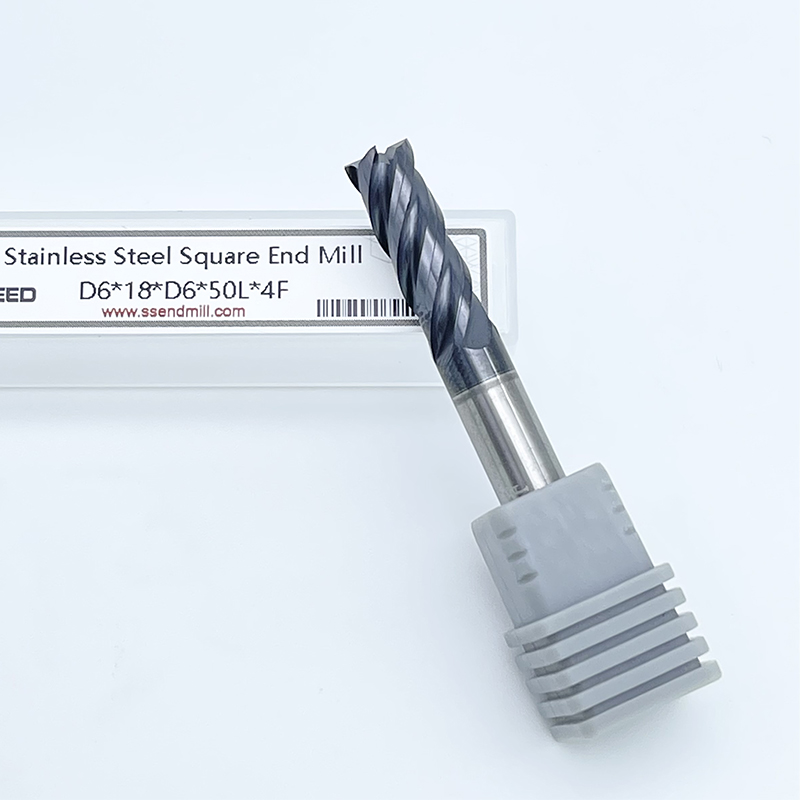
Advanced geometric features separate premium tools from their standard counterparts. Engineers design these cutters with reinforced cores to withstand immense lateral forces. A thicker core web prevents tool deflection during heavy radial engagement. Eccentric relief on the cutting edges provides superior edge strength while reducing friction directly behind the cut. Incorporating variable helix end mills into the design breaks up harmonic frequencies. By altering the angle of each flute, the tool prevents vibrations from compounding. This allows for aggressive material removal without inducing chatter.
These high-performance geometries heavily optimize multi-directional cutting. Standard geometries often pack with chips when pushed through dynamic milling toolpaths. Premium tools utilize specialized flute gullets and variable pitch spacing to ensure superior chip evacuation. This allows the tool to maintain continuous engagement with the workpiece. You can take deep axial cuts and light radial step-overs efficiently. The result is a massive increase in work efficiency and material removal rates compared to standard geometries.
Specialized, high-temperature coatings play a major role in premium tooling performance. Coatings like Aluminum Titanium Nitride (AlTiN), Titanium Carbonitride (TiCN), and diamond-like carbon create a thermal barrier between the tool and the workpiece. These coatings prevent built-up edge (BUE). BUE occurs when workpiece material welds to the cutting edge, effectively ruining the tool geometry. Advanced coatings withstand extreme heat. Machinists can run these tools dry or with minimal air blast, relying on the chip to carry the heat away from the cutting zone.
Material-specific edge preparation further defines the engineering difference. Manufacturers engineer specific edge hones or chamfers tailored to exact alloy groups. Tools designed for aerospace alloys feature sharp, highly polished edges to shear through gummy materials without tearing. Tools built for hardened tool steels feature heavily honed, reinforced edges designed to withstand massive compressive forces without chipping. This targeted engineering ensures maximum tool life for specific applications.
General-purpose tools reach their physical breaking points rapidly when pushed beyond their intended parameters. Tool deflection is the most common failure mode. When cutting forces exceed the core strength of a standard end mill, the tool bends away from the workpiece. Deflection follows a cubic function based on length. If a tool is twice as long, it deflects eight times as much under the same load. This results in tapered walls, out-of-tolerance dimensions, and eventually, tool breakage.
Premature edge chipping occurs when standard carbide encounters hard spots, scale, or interrupted cuts on the workpiece material. Rapid flank wear is inevitable when standard tools attempt to cut work-hardening materials like 304 or 316 stainless steel. If a standard tool rubs rather than cuts, it generates friction. This friction instantly work-hardens the surface of the stainless steel, sometimes pushing it past 45 HRc. The next pass of the end mill hits this hardened layer and destroys the cutting edge.
Chatter and harmonic vibrations severely impact part quality and machine health. When standard tools vibrate, they leave terrible surface finishes characterized by visible chatter marks. This immediately increases scrap rates or forces shops into time-consuming secondary polishing operations. Beyond the workpiece, continuous harmonic vibration transfers directly into the machine spindle. Over time, this constant pounding destroys spindle bearings. Replacing a spindle cartridge takes the machine down for days and incurs heavy repair bills.
The hidden operational costs of failing general-purpose tools quickly negate their low purchase price. Frequent tool changes disrupt the manufacturing process. Every time an operator stops the machine to replace a worn standard tool, production halts. Operator intervention time increases as machinists constantly monitor the cut, adjust wear offsets, and clear jammed chips. This machine downtime destroys profitability. Cheaper tools often cost the shop significantly more money in lost productivity.
Evaluating tool requirements begins with the workpiece material. Exotic alloys, superalloys like Inconel 718, titanium (Ti-6Al-4V), and hardened steels exceeding 45 HRc demand specialized cutting tools. These materials possess high tensile strength and low thermal conductivity. The heat generated during the cut stays in the tool rather than evacuating with the chip. Standard geometries simply cannot survive this environment. You must match the tool's substrate, coating, and edge preparation directly to the specific metallurgical properties of the difficult-to-machine alloy.
Standard carbide or High Speed Steel struggles massively with thermal shock. Thermal shock occurs when standard tools heat up in the cut and rapidly cool via flood coolant. This rapid temperature fluctuation causes micro-fractures in the carbide substrate, leading to edge failure. High-performance alternatives withstand these extreme speeds and feeds by utilizing advanced substrates and heat-resistant coatings. These coatings thrive in high-temperature cutting zones, often requiring the heat to oxidize the coating and form a protective barrier.
Material categories that dictate premium tooling include:
A rigorous cost-per-part analysis framework dictates tooling selection in production environments. You must weigh the upfront tool cost against increased feeds, speeds, and material removal rates (MRR). A premium tool might have a higher initial investment, but if it removes material four times faster and lasts five times longer, the cost-per-part drops significantly. Scalability relies on pushing the machine to its limits. Only premium geometries allow you to maximize the MRR without sacrificing process stability.
Machine up-time drives profitability in continuous-run, high-volume environments. Reducing tool changeovers directly impacts the bottom line. If a standard tool requires changing every 50 parts, but a premium tool lasts for 300 parts, you eliminate five machine stoppages. In a lights-out manufacturing setup, predictable tool life is mandatory. High performance end mills provide the reliability needed to let machines run unattended, maximizing throughput and reducing labor dependency.
Executing High-Efficiency Milling (HEM) and dynamic milling toolpaths necessitates premium tooling. These modern CAM strategies rely on taking deep axial cuts (often the entire length of the flute) with very light radial step-overs (typically 5% to 15% of the tool diameter). This approach manages heat, utilizes chip thinning, and distributes wear evenly across the entire cutting edge. HEM requires specialized flutes to manage the massive volume of chips generated. Standard tools will pack with chips and snap in the pocket. High-performance geometries evacuate chips flawlessly at extreme feed rates.
High-performance tooling achieves tight tolerances directly off the machine. The reinforced core and specialized edge preparations minimize deflection. This ensures the tool cuts exactly where the CAM software dictates. This precision often eliminates the need for secondary finishing or grinding operations. When a single tool can rough aggressively and then take a light finishing pass to hold a tight tolerance, you streamline the entire manufacturing process and reduce part handling.
Variable geometries eliminate harmonic chatter to produce superior, mirror-like surface finishes. By breaking up the rhythmic impact of the flutes against the workpiece, the tool glides smoothly through the material. This is particularly important when machining thin-walled components or deep pockets where vibration naturally amplifies. The resulting surface finish meets strict aerospace or medical requirements without requiring manual polishing. You save hours of post-processing labor.
A machinist reality check is necessary before upgrading tooling. Older or less rigid machines physically require HSS or general-purpose tools. Box-way machines from decades past might have immense torque but lack the spindle RPM and structural rigidity required for modern carbide. A lack of RPM and rigidity causes premium solid carbide to chip rather than cut. Carbide requires a rigid environment. Any play in the spindle bearings or looseness in the machine axes will instantly shatter a brittle, high-performance carbide edge.
You must outline the spindle RPM, torque curves, and horsepower requirements necessary to utilize advanced coatings effectively. Many premium coatings, like AlTiN, require high heat to activate their protective properties. If your machine cannot spin fast enough to generate that heat, the coating provides no benefit, and the tool performs poorly. Ensure your machine's horsepower and torque capabilities align with the aggressive feed rates required to make premium tooling financially viable.
Minimizing Overall Length (OAL) is critically important. The golden rule of milling is to always use the shortest possible tool and the largest possible diameter. Tool deflection increases exponentially with length. To maximize rigidity and prevent deflection, select stub-length tools whenever the part geometry allows. This simple choice drastically improves tool life and part accuracy regardless of the tool's price point.
Upgrading toolholding is absolutely necessary to match the runout precision of premium end mills. Putting a high-performance tool in an old, worn-out ER collet chuck defeats the purpose of the investment. Standard ER collets often have 0.0005 inches of runout. If your chip load is 0.001 inches, a half-thousandth of runout means one flute takes 150% of the load while the opposite flute takes 50%. This causes rapid, uneven wear and premature failure.
Follow these steps to optimize toolholding for premium end mills:
Establishing a mathematical framework for calculating return on investment requires looking beyond the purchase price. The formula involves calculating the value of tool life extension, adding the value of cycle time reduction, adding the financial benefit of increased machine up-time, and subtracting the initial premium cost of the tool. If the resulting number is positive, the premium tool is the correct choice. This data-driven approach removes emotion and habit from the tooling selection process.
Consider Scenario A: A high mix, low volume job shop dealing with variable materials on older machinery. In this environment, the evaluation heavily leans toward general-purpose HSS or standard carbide. The shop rarely runs enough of the same part to realize cycle time savings. The older machinery cannot push premium tools to their potential. Versatility and low upfront costs take priority over extreme material removal rates.
Contrast this with Scenario B: A low mix, high volume production facility running continuous shifts on rigid, modern CNC machining centers. Here, the evaluation strongly favors high-performance tooling. Saving just thirty seconds per part across a ten-thousand-part run frees up weeks of machine capacity. The predictable tool life allows for lights-out manufacturing. The rigid machines perfectly support the aggressive parameters required by advanced geometries.
Tooling Selection Comparison
| Feature / Scenario | General Purpose End Mills | High Performance End Mills |
|---|---|---|
| Primary Material Focus | Aluminum, Mild Steel, Plastics | Titanium, Inconel, Hardened Steels |
| Machine Requirement | Forgiving on older/loose setups | Requires high rigidity and RPM |
| Production Volume | Low volume, Prototyping, High Mix | High volume, Continuous production |
| Cutting Strategy | Traditional slotting and profiling | Dynamic milling, High-Efficiency Milling |
| Vibration Control | Prone to harmonic chatter | Variable geometries eliminate chatter |
| Initial Procurement Cost | Low | Premium |
Audit your current machine rigidity and spindle condition using a dial indicator to ensure your equipment can support advanced carbide tooling.
Calculate your baseline cost-per-part on a high-volume job by factoring in current cycle times, tool changeover frequency, and scrap rates.
Upgrade your toolholding to shrink-fit or hydraulic chucks to guarantee runout remains below 0.0001 inches before testing new cutters.
Program a dynamic milling toolpath with a 10% radial step-over to properly test the chip evacuation capabilities of a premium cutter.
Run a controlled A/B test using a variable helix end mill and document the exact number of parts completed before flank wear exceeds 0.005 inches.
A: The primary advantage is the disruption of harmonic frequencies. By altering the angle of each flute, the tool prevents vibrations from compounding during the cut. This drastically reduces chatter, allows for heavier depths of cut, improves surface finish, and significantly extends the life of the cutting edge.
A: Generally, no. Premium solid carbide requires a highly rigid environment to function correctly. Older machines often lack the spindle RPM, structural stiffness, and tight bearing tolerances needed. In loose setups, the brittle carbide will chip and fail prematurely rather than cutting efficiently.
A: Calculate ROI by adding the financial value of extended tool life, the value of cycle time reduction, and the value of increased machine up-time. Subtract the initial premium cost of the tool from this total to find your true return. Do not rely solely on the purchase price.
A: No, HSS remains highly relevant. It is excellent for absorbing shock in less rigid setups, machining softer materials, and handling prototyping or maintenance tasks. HSS provides a cost-effective, forgiving solution when extreme speeds, feeds, and cycle time optimization are not the primary goals.
A: Premature chipping usually stems from a lack of rigidity. This can be caused by excessive tool runout from poor toolholders, inadequate workholding, or loose machine spindle bearings. Using a tool with too much overall length causes deflection, which leads directly to micro-chipping on the cutting edge.
A: The optimal OAL is always the shortest length possible that still clears the workpiece geometry. You should pair the shortest necessary flute length with the largest possible tool diameter. Minimizing the distance from the spindle nose to the cutting tip exponentially increases rigidity and prevents deflection.