- All
- Product Name
- Product Keyword
- Product Model
- Product Summary
- Product Description
- Multi Field Search

Views: 0 Author: Site Editor Publish Time: 2026-08-13 Origin: Site
Machinists constantly face a tooling dilemma in precision manufacturing. Defaulting to the hardest cutting tool does not guarantee the lowest cost per part or the best surface finish. Many shops prematurely dismiss High-Speed Steel (HSS) as outdated technology, opting instead for carbide. However, selecting carbide without the requisite machine rigidity often leads to catastrophic tool breakage rather than increased efficiency. Running brittle tools in non-rigid setups causes immediate failure. Conversely, running soft tools in high-speed applications bottlenecks production and increases thermal deformation. You must match the tool material to your specific machining environment. We establish an evidence-based framework to evaluate carbide vs hss end mills. You will learn how to assess machine capabilities, workpiece material, setup rigidity, and overall economic return to make the right tooling choice.
You must define the physical limitations of both tooling materials to establish baseline success criteria for tool selection. You cannot optimize your milling process without understanding the underlying metallurgy. Tool failure often stems from a fundamental mismatch between the tool's physical properties and the cutting environment. When you push a tool beyond its metallurgical limits, you ruin the workpiece and waste machine time.
HSS consists of a complex metallurgical blend. Manufacturers alloy iron with specific elements like tungsten, molybdenum, chromium, and vanadium. This specific composition creates a tool material known for exceptional toughness. In machining, toughness refers directly to forgiveness. HSS can flex slightly under heavy cutting loads. It tolerates minor spindle runout and absorbs shock without micro-fracturing. This makes it highly effective for less rigid setups, older machinery, and manual milling operations where feed rates fluctuate.
The addition of vanadium increases wear resistance, while molybdenum improves strength at higher temperatures. Common grades like M2 provide a solid baseline for general-purpose milling. However, HSS has a distinct vulnerability. It possesses lower red-hardness compared to carbide. Red-hardness defines a material's ability to maintain a sharp cutting edge when heated to a dull red color. HSS softens and loses its sharp cutting edge at elevated temperatures. You must manage heat generation carefully when using HSS to prevent rapid tool degradation. If the chip turns blue, your HSS tool is likely burning.
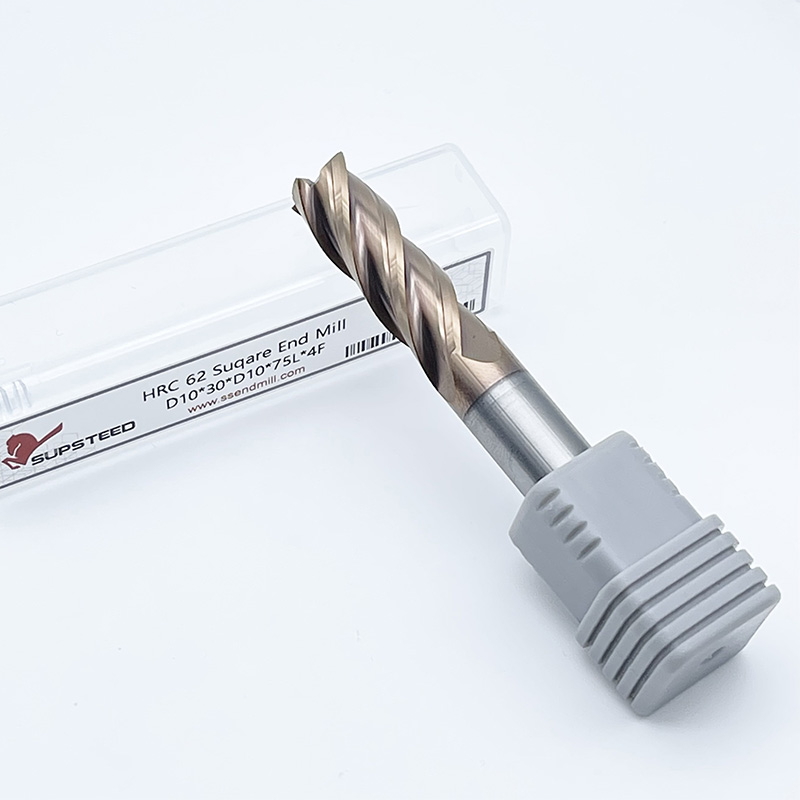
Cemented carbide features a fundamentally different structural composition. Manufacturers bond microscopic tungsten carbide particles together using a cobalt binder under extreme heat and pressure. This creates an exceptionally hard cutting tool. Modern solid carbide end mills excel in high red-hardness. They maintain razor-sharp cutting edges even at extreme machining temperatures. This thermal stability allows for highly aggressive cutting parameters and dry machining techniques.
The cobalt binder percentage dictates the balance between hardness and toughness. Lower cobalt content yields harder, more wear-resistant tools suitable for hardened steels. Higher cobalt content provides slight increases in shock resistance for roughing applications. Yet, this extreme overall stiffness creates a significant vulnerability. Carbide is inherently brittle. It remains highly susceptible to chipping under vibration, chatter, or spindle runout. You must provide a highly rigid environment to prevent premature tool failure. Any sudden shock load, such as dropping the tool or hitting a hard spot in a casting, will shatter the cutting edge instantly.
We map tool properties directly to machining outcomes and operational constraints. This framework helps you select the optimal end mill for your specific shop floor conditions. Evaluating these core dimensions prevents costly tooling mistakes and maximizes your spindle uptime.
Spindle speed requirements dictate tool selection heavily. Carbide requires high surface footage (SFM) to function optimally. It needs speed to generate the heat required to plasticize the metal chip in the shear zone. Running solid carbide tools at low RPMs causes immediate problems. For example, using them on a 3-axis knee mill maxing out at 3,000 RPM leads to rubbing. This creates a built-up edge and causes premature failure. The tool pushes the material rather than shearing it cleanly.
You must evaluate your machine rigidity honestly. CNC machining centers utilize linear guideways, heavy cast iron bases, and precision ball screws. These robust platforms support carbide perfectly by dampening vibration. Lighter machines, hobbyist conversions, or manual mills often have inherent backlash in their lead screws. These less stable setups necessitate the forgiveness of HSS. HSS will absorb the micro-vibrations that would otherwise destroy a carbide tool. If your machine table shakes during a heavy cut, carbide is the wrong choice.
Baseline SFM capabilities differ drastically between the two materials. Carbide allows for cutting speeds two to three times faster than HSS under optimal conditions. For instance, you might cut mild steel at 100 SFM with HSS, but you can easily push carbide to 300 or 400 SFM in the same material. This speed advantage directly impacts production efficiency. Higher cutting speeds generate a superior Material Removal Rate (MRR). You can push feed rates significantly higher without exceeding the tool's thermal limits.
A higher MRR reduces cycle times significantly. When you correlate reduced cycle times with standard machine hour rates, carbide often proves more efficient for production runs. Shaving minutes off a cycle time across hundreds of parts justifies the higher initial tool investment. You must calculate the MRR to understand the true throughput potential of your milling operation. MRR equals the radial depth of cut multiplied by the axial depth of cut, multiplied by the feed rate in inches per minute.
The Young's Modulus difference explains tool deflection behavior accurately. Carbide is roughly three times stiffer than HSS. This extreme stiffness minimizes tool deflection during heavy roughing cuts or deep slotting operations. When a tool deflects, it bends away from the workpiece, leaving excess material behind and creating tapered walls.
Reduced deflection leads to tighter dimensional tolerances straight off the machine. It also produces superior surface finishes, especially on long-reach applications where tool stick-out is significant. When you need precise vertical walls without taper, carbide outperforms HSS consistently. HSS will bend under heavy side loads, causing dimensional inaccuracies that require additional spring passes to correct. A spring pass is a secondary finishing pass taken with zero additional radial engagement to clean up the deflection left by the previous cut.
Heat generation and dissipation strategies vary by tool material. Carbide thrives in high-heat environments. It often performs better dry when cutting certain materials like steel or cast iron. Using a high-pressure air blast clears chips without causing thermal shock. Intermittent coolant splashing on a hot carbide edge causes rapid micro-fracturing. The extreme temperature fluctuation shatters the carbide matrix, leading to premature edge failure.
Conversely, HSS relies heavily on continuous flood coolant. Copious coolant prevents edge degradation and stops thermal deformation. You must keep HSS tools cool to maintain their cutting geometry. If HSS overheats, the cutting edge burns, turns blue, and rounds over instantly. Proper coolant application flushes chips and lubricates the cut, extending the life of the HSS tool. You should aim coolant nozzles directly at the cutting zone to ensure maximum heat extraction.
Tooling Material Comparison Summary
| Feature | High-Speed Steel (HSS) | Solid Carbide |
|---|---|---|
| Toughness & Shock Absorption | Excellent | Poor (Brittle) |
| Heat Resistance | Low to Moderate | Extremely High |
| Cutting Speed (SFM) | Baseline | 2x to 3x Faster |
| Deflection Resistance | Moderate | High (3x Stiffer) |
| Ideal Machine Setup | Manual Mills, Low Rigidity | CNC Centers, High Rigidity |
Practical guidelines help you pair end mills with specific machining scenarios. Different materials demand different cutting strategies and tool geometries. You must tailor your approach to the workpiece material to achieve optimal results. Using a general-purpose tool for a specialized material often results in poor surface finish and rapid tool wear.
Machining aluminum presents the constant risk of built-up edge (BUE) and galling. Soft, gummy material welds to the cutting tool easily under heat and pressure. Polished, high-flute-volume solid carbide tools dominate high-speed aluminum machining. They feature sharp cutting edges and deep flutes that evacuate chips rapidly. The polished surface prevents aluminum from adhering to the tool. Machinists typically use 2-flute or 3-flute geometries for aluminum to maximize chip clearance.
However, HSS remains highly viable for low-RPM manual milling in aluminum. If your machine cannot reach the high RPMs required for carbide to shear aluminum cleanly, HSS provides a reliable alternative. A sharp HSS end mill will cut aluminum effectively at lower speeds, provided you use adequate cutting fluid to prevent galling. WD-40 or specialized aluminum cutting fluids work well to keep the HSS edge clean during manual operations.
Materials above 40 HRC demand specialized tooling. You need carbide's superior heat resistance and extreme hardness to penetrate these tough metals. HSS simply cannot withstand the abrasive nature and high shear strength of hardened steels like 4140 or D2 tool steel. It will dull within seconds of engaging the material, generating massive amounts of heat and potentially work-hardening the workpiece further.
Advanced coatings enhance carbide tools further for these applications. Coatings like Titanium Aluminum Nitride (TiAlN) and Aluminum Titanium Nitride (AlTiN) protect the carbide substrate. They provide vital thermal barriers necessary for machining exotic alloys and titanium (e.g., Ti-6Al-4V). These coatings oxidize at high temperatures, forming a protective ceramic layer that extends tool life significantly. You should run these coated tools dry with air blast in steel to allow the coating to reach its activation temperature.
Machining stainless steel like 304 or 316 on limited-RPM machines creates a specific dilemma. You face a delicate balancing act. Stainless steel work-hardens rapidly if the tool rubs instead of cutting. Carbide prevents the tool from dulling against these work-hardened surfaces. It shears the material cleanly before it can harden. You must maintain a consistent feed per tooth to ensure the tool stays under the work-hardened layer.
However, if the machine lacks rigidity, the tough nature of stainless steel will cause the carbide to chip. Cobalt-HSS (M42) serves as the optimal middle-ground here. It prevents chipping while resisting heat much better than standard HSS. Cobalt end mills can penetrate the work-hardened layer without shattering, making them ideal for less rigid setups cutting tough alloys. They offer a practical solution for job shops dealing with stainless steel on older knee mills.
Interrupted cutting involves sudden, repetitive impacts on the cutting edge. Machining over cross-holes, cutting keyways, or facing rough castings create these challenging conditions. The tool enters and exits the cut repeatedly, experiencing severe shock loads with each engagement. This constant hammering destroys brittle cutting edges quickly.
The shock-absorbing properties of HSS often outperform brittle carbide in these specific scenarios. Powdered metal (PM) HSS also excels here. PM HSS offers a finer grain structure, bridging the gap between standard HSS toughness and carbide wear resistance. These tough materials prevent sudden catastrophic tool failure under heavy vibration, ensuring process reliability in unpredictable cuts. When machining a welded assembly or a casting with sand inclusions, HSS provides the durability required to finish the job.
Recommended Starting Parameters by Material
| Material Type | Tool Material | Coolant Strategy | Coating Recommendation |
|---|---|---|---|
| Aluminum (6061) | Carbide (3-Flute) | Flood Coolant / MQL | ZrN or Uncoated Polished |
| Mild Steel (1018) | Carbide (4-Flute) | Air Blast (Dry) | TiAlN |
| Stainless Steel (304) | Cobalt-HSS (M42) | Heavy Flood Coolant | TiN or Uncoated |
| Hardened Steel (45 HRC) | Carbide (Multi-Flute) | Air Blast (Dry) | AlTiN |
You must move beyond the initial purchase order to evaluate total lifecycle costs accurately. A cheaper tool does not always save money in the long run. Economic evaluation requires analyzing the entire production process, including machine uptime, operator intervention, and scrap rates.
Upfront acquisition costs differ significantly. HSS is significantly cheaper than carbide. This lowers the financial barrier to entry for job shops, maintenance departments, and prototyping runs. When you only need to make one or two parts, investing in expensive carbide may not make sense. You can purchase several HSS end mills for the price of a single high-performance carbide tool.
However, you must utilize a calculation framework to find true value in production environments. Factor in cycle time reduction, machine hourly rate, and total tool life. Carbide's higher initial cost almost always yields a lower cost per part in high-volume runs. The increased MRR pays for the tool rapidly by freeing up valuable machine time for other jobs. If a carbide tool cuts a 10-minute cycle down to 3 minutes, the machine burden rate savings will cover the tool cost within the first shift.
Wear curves dictate how often you must change tools. Carbide holds its edge much longer than HSS under optimal conditions. It resists abrasive wear and thermal degradation, allowing it to cut hundreds of parts before dulling. This reduces machine downtime associated with tool changes and offset adjustments. Consistent tool life allows for lights-out manufacturing and unattended machining.
You must also consider the logistics of regrinding. You can regrind and recoat solid carbide tools multiple times. This restores the original geometry and extends their lifecycle, significantly improving ROI. Tool grinding houses can re-establish the primary and secondary relief angles perfectly. Conversely, shops often replace cheaper HSS tools outright. The labor and shipping costs of regrinding standard HSS rarely justify the effort compared to buying a new tool off the shelf.
Documenting the realities of tool adoption helps prevent common failure modes. You must manage risks proactively on the shop floor to maximize tool life and maintain part quality. Ignoring these variables leads to scrapped parts and broken tooling.
Several factors cause carbide to shatter unexpectedly. Excessive runout in the tool holder creates uneven chip loads, forcing one flute to do all the work. Thermal shock from intermittent coolant micro-fractures the cutting edge rapidly. Lack of workholding rigidity allows the part to vibrate, acting like a hammer against the brittle carbide. Manual feeding inconsistencies create sudden spikes in tool pressure that exceed the material's structural limits.
You must mitigate these risks aggressively using standard shop procedures:
HSS tools fail differently than carbide. Pushing SFM too high burns the cutting edge instantly, destroying the tool's geometry. Inadequate coolant flow fails to remove heat from the cutting zone, leading to thermal deformation. Cutting highly abrasive or work-hardening materials dulls HSS rapidly, causing it to rub and generate even more heat. Once the edge rounds over, cutting forces spike, pushing the part out of tolerance.
You can mitigate these issues easily through disciplined machining practices. Strictly adhere to manufacturer feeds and speeds for HSS. Ensure continuous, high-volume flood coolant hits the cutting zone directly to flush chips and extract heat. Check your coolant concentration regularly with a refractometer to ensure adequate lubricity. Transition to Cobalt-HSS for marginal upgrades in heat resistance without sacrificing the inherent toughness required for your specific setup.
Solid carbide end mills remain the undisputed choice for rigid CNC production environments focused on maximizing MRR and minimizing cycle times. Conversely, HSS remains highly relevant for low-RPM machines, unstable setups, and budget-constrained prototyping. You should base your tooling decision on a three-point matrix. Evaluate your machine's maximum RPM, your setup rigidity, and the workpiece hardness before selecting a tool.
Next steps for optimizing your tooling selection:
A: Yes, but it carries significant risk. Manual knee mills often lack the rigidity and high spindle speeds required for carbide. This leads to vibration, chatter, and premature tool chipping. If you use carbide on a manual mill, keep setups extremely rigid, use short tool stick-outs, and avoid heavy interrupted cuts.
A: Under optimal conditions in a rigid CNC machine, you can run carbide two to three times faster than HSS. Carbide's superior heat resistance and hardness allow for significantly higher surface footage (SFM) and aggressive material removal rates without burning the cutting edge.
A: Cobalt end mills bridge the gap between standard HSS and carbide. They offer better heat and wear resistance than standard HSS while retaining more toughness than brittle carbide. They are excellent for machining work-hardening alloys on machines that lack the rigidity for solid carbide.
A: Chipping usually results from a lack of rigidity. Common culprits include excessive spindle runout, loose workholding, worn tool holders, or machine backlash. Thermal shock from intermittent coolant application can also cause micro-fracturing along the cutting edge during heavy cuts.
A: Choose HSS when dealing with highly unstable setups, deep slotting applications prone to heavy vibration, or when performing severe interrupted cuts. HSS absorbs shock loads better than carbide, preventing sudden catastrophic tool breakage in less-than-ideal machining conditions.
A: Yes. Professional grinding services can regrind and recoat solid carbide tools multiple times. This restores the original cutting geometry and performance. Regrinding significantly lowers the overall lifecycle cost of expensive carbide tooling for high-volume production shops.