Please Choose Your Language
- All
- Product Name
- Product Keyword
- Product Model
- Product Summary
- Product Description
- Multi Field Search

Views: 0 Author: Site Editor Publish Time: 2026-09-16 Origin: Site

Walk onto any high-volume shop floor, and you will hear the same mantra: cycle time is money. Every second shaved off a cycle and every scrap part avoided directly boosts the bottom line. Pushing machines to their absolute limits often creates a fierce tug-of-war between material removal rates, tool degradation, and the final part quality. The secret to mastering this delicate balance lies entirely in your tooling setup. Specifically, this guide explores how to optimize your cutting strategy from aggressive roughing to precise finishing. Choosing the correct geometry and thermal coating is critical for managing heat and preventing premature wear. Adjusting feed rates requires a holistic approach to toolpaths and workpiece materials. High-quality finishing instruments help maintain strict industry tolerances, which prevents costly manual rework. Ultimately, investing in premium cutting technology drastically improves overall efficiency and lowers the true cost-per-part in continuous manufacturing runs.
The transition from rapid prototyping to mass manufacturing requires a fundamental shift in machining strategy. Prototyping prioritizes simply getting a single part made quickly. In contrast, mass production focuses heavily on predictable tool life, unattended machining capabilities, and relentless cycle time reduction. High-volume environments simply cannot tolerate unpredictable wear patterns. If a tool breaks during a lights-out unattended shift, the resulting crash destroys the workpiece. Worse yet, it can severely damage the spindle and halt production for hours. Consequently, specialized tooling engineered specifically for endurance serves as a strict baseline requirement for continuous, profitable manufacturing.
A common pitfall in manufacturing procurement is evaluating tooling costs based solely on the upfront purchase price. In reality, your cutting equipment heavily influences the overall cost-per-part through operational efficiency. Machine downtime for frequent tool swaps eats directly into profit margins. Elevated scrap rates due to dimensional inaccuracies and the labor required for manual deburring multiply those losses. Premium tooling acts as a strategic investment that pays massive dividends by enabling continuous production. When an end mill can reliably cut 500 parts instead of 200 before requiring a swap, machine uptime increases drastically. This amortizes your hourly machine rate over a much larger number of sellable components.
Recent manufacturing analyses reveal a massive shift in how modern machine shops approach high-volume orders. With the rapid expansion of the electric vehicle and aerospace sectors, shops are increasingly tasked with machining complex, heat-resistant superalloys like titanium and Inconel. This industry-wide trend forces manufacturers to abandon traditional, general-purpose cutting strategies. Instead, there is a surging demand for material-specific geometries and data-driven tool monitoring. Today's successful operations rely on predictive maintenance protocols, where tool life is tracked meticulously by software to swap out cutters right before they fail. This proactive approach guarantees process stability and reflects a broader industry movement toward zero-defect manufacturing.
The material removal rate stands as the primary driver of shop floor efficiency. Pushing feed rates higher moves the cutting edge through the metal faster, which slashes cycle times. However, this aggressive approach introduces intense physical stresses to the machining ecosystem. Higher feed rates increase the chip load, which is the exact thickness of the material removed by each cutting edge per revolution. While a thicker chip effectively helps carry heat away from the cutting zone, exceeding the structural limits of the cutter inevitably leads to deflection, edge chipping, and catastrophic failure.
The fundamental physics of metal cutting dictate that friction and plastic deformation generate extreme heat. When you push high feed rates, the thermal load at the cutting edge spikes dramatically. If this heat is not managed properly, it transfers directly into the tool substrate. For difficult-to-machine materials like hardened tool steels, excessive heat accelerates chemical wear and thermal cracking. Managing this thermal energy is crucial. The primary objective for any CNC programmer is to direct the heat into the evacuated chip rather than allowing it to soak into the workpiece or the cutting instrument.
There is a well-documented inverse relationship between aggressive material removal and the quality of the final surface. High feed rates inherently increase cutting forces. These forces often induce deflection and harmonic vibrations, commonly known on the shop floor as chatter. This vibration leaves visible, rhythmic marks on the machined surface and ruins your roughness average values. Balancing these forces requires meticulous adjustments to both spindle speeds and engagement angles to maintain a pristine, mirror-like finish.
Selecting the correct CNC milling cutter based on flute count is a critical troubleshooting step in high-volume production. A frequent mistake in many machine shops is attempting to machine soft non-ferrous metals, such as aluminum, with a standard four-flute end mill. Aluminum is highly ductile and produces large, stringy chips during the cutting process. A four-flute cutter lacks the necessary valley space to evacuate these massive chips efficiently. As a result, the chips pack tightly into the flutes, weld to the cutting edge due to friction-induced heat, and cause the tool to snap instantly. To prevent this scenario, two-flute or three-flute geometries are structurally required to provide adequate chip clearance.
Beyond flute count, the helix angle and pitch of the tool play a vital role in stabilizing the cutting process. Standard end mills often feature a uniform helix angle, which creates harmonic resonance during aggressive cuts and leads to severe chatter. To combat this, advanced tooling utilizes variable helix and variable pitch designs. By altering the angle and spacing of the cutting edges, the tool effectively breaks up harmonic frequencies. This subtle design modification significantly reduces vibration, allowing for deeper cuts and smoother finishes during extended unattended runs.
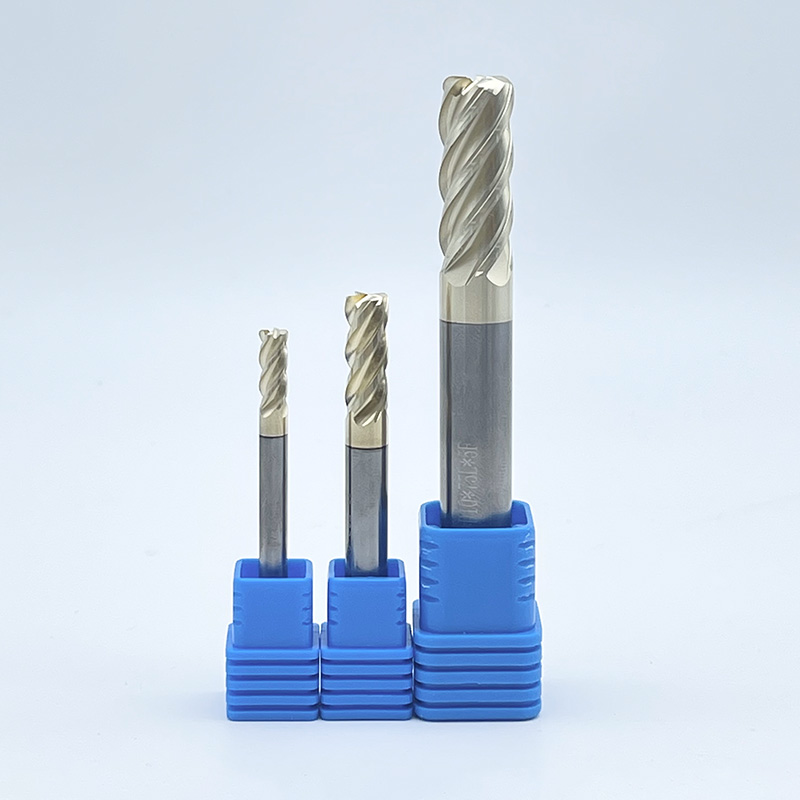
Tool geometry must be explicitly matched to the workpiece material to ensure optimal performance. Take titanium alloy machining as a prime example. Engineers often rely on specialized end mills featuring unequal flute spacing and variable helix angles. These specific design choices disrupt harmonic resonance, effectively eliminating chatter in tough aerospace alloys. Furthermore, incorporating a U-shaped groove design drastically improves chip evacuation, preventing the dreaded chip recutting scenario. When combined with a micro-grain solid carbide substrate, these specific parameters ensure the tool survives the brutal mechanical stress of high-volume manufacturing.
In mass production environments, solid carbide remains the undisputed industry standard for rotary cutting tools. Compared to traditional high-speed steel, a high-quality carbide cutter offers superior hardness and rigidity. This allows the instrument to maintain a razor-sharp edge at significantly higher operating temperatures. Its natural resistance to thermal shock and ability to withstand the extreme mechanical stresses of heavy cutting make it indispensable for long-run production where dimensional stability is absolutely non-negotiable.
Tooling Material | Heat Resistance | Wear Life | Ideal Application |
|---|---|---|---|
General Purpose High-Speed Steel | Low | Short | Low-volume prototyping, plastics, soft aluminum. |
Standard Solid Carbide | High | Medium | General steel machining, medium production runs. |
Premium Coated Carbide | Extreme | Long | High-volume aerospace alloys, hardened steels, lights-out manufacturing. |
The bare carbide substrate is rarely used in high-volume steel or alloy machining. Instead, it relies on advanced chemical or physical vapor deposition coatings. These microscopic layers act as a formidable thermal barrier. For instance, Aluminum Titanium Nitride coatings excel in high-heat applications. Under extreme temperatures, the aluminum in the coating oxidizes to form a protective layer of aluminum oxide, shielding the substrate and directing heat into the chip.
Managing heat does not always mean flooding the machine enclosure with coolant. For certain hard materials, flood coolant causes rapid temperature fluctuations, leading to thermal cracking of the cutting edge. Minimum quantity lubrication delivers a precise aerosol of oil, reducing friction without subjecting the tool to thermal shock. Additionally, a concentrated air blast is often the best choice for dry machining with coated tools, as it clears chips away to prevent recutting while allowing the coating to reach its optimal, heat-activated operating temperature.
High-speed machining is a modern methodology that sharply contrasts with traditional heavy roughing. Instead of taking slow, deep, and wide cuts, this strategy utilizes remarkably light radial depths of cut combined with extremely high feed rates and spindle speeds. This strategic approach thins the chip, reduces the buildup of heat in the tool, and significantly lowers the radial cutting forces that typically cause part deflection.
Implementing this aggressive strategy requires specialized high speed milling tools engineered specifically for rigorous conditions. Because spindle speeds can easily exceed 20,000 revolutions per minute, the tools must be symmetrically balanced to prevent runout and premature spindle bearing damage. High-speed applications demand highly rigid tool holding systems, such as shrink-fit or hydraulic chucks, to ensure perfect concentricity. Standard collet chucks often lack the gripping force and precision required to prevent micro-vibrations at these elevated rotational speeds.
The physical tool represents only half of the equation; the programmed toolpath dictates the actual execution. Modern computer-aided manufacturing software utilizes dynamic milling or trochoidal toolpaths to keep the tool engagement angle perfectly constant. By avoiding sharp inside corners where tool engagement traditionally spikes, the thermal and mechanical load on the cutter remains incredibly stable. This constant engagement extends tool life and maximizes output by allowing the machine to safely maintain peak feed rates throughout the entire cycle.
Attempting to combine roughing and finishing into a single operation with one tool is a fundamentally flawed strategy in high-volume manufacturing. Roughing generates immense heat and mechanical stress, which inevitably causes micro-wear on the cutting edge. If that same worn edge is then used for the final pass, the surface finish and dimensional accuracy will inherently suffer. Best practices dictate strictly separating these processes. Use a dedicated roughing tool to remove bulk material violently and quickly, and a separate finishing tool to take the final, delicate pass.
Tools designed explicitly for finishing prioritize surface quality over sheer material removal. High-flute-count end mills, often featuring five to seven flutes or more, are commonly used for finishing metals. They allow for a lower feed per tooth while maintaining a high overall traverse rate, resulting in an exceptionally tight surface finish pattern. To achieve mirror-like finishes without secondary polishing operations, manufacturers frequently deploy surface finishing tools equipped with unique wiper geometries engineered to flatten the microscopic peaks left by standard milling.
High-volume sectors like automotive and aerospace operate under stringent quality management systems. These uncompromising standards mandate rigorous defect prevention rather than mere defect detection after the fact. In CNC machining, the process capability index relies heavily on completely predictable tool wear. If a tool wears inconsistently, the dimensions of the machined parts will drift out of the acceptable tolerance band, violating quality compliance. Therefore, consistent tooling forms the absolute bedrock of a stable, compliant manufacturing process.
To align seamlessly with these modern industry standards, progressive CNC operations integrate sophisticated tool monitoring systems. By establishing a reliable baseline using high-quality tools, programmers can confidently set accurate tool life limits within the machine controller. For example, if empirical data demonstrates a specific tool begins to lose tolerance after exactly 300 minutes in a tough alloy, the controller is programmed to automatically swap to a redundant sister tool at 290 minutes. This data-driven, proactive approach prevents out-of-tolerance parts from ever reaching the inspection room.
High-volume CNC machining demands absolute consistency across every single production run. You need equipment that performs predictably under heavy, continuous industrial stress. Finding the right supplier is just as critical as writing the perfect program. Tool failures disrupt tight schedules and ruin expensive raw materials. Therefore, evaluating tool manufacturers requires a strict, data-driven approach. Consistency in carbide blanks is the very first metric to check; micro-grain structure variations cause unpredictable and sudden wear. Always look for vendors that use advanced coating methods and maintain strict tolerance controls on edge preparation. Proper edge honing prevents micro-chipping during initial material engagement.
A standardized tool crib simplifies manufacturing processes significantly, reducing the time programmers spend adjusting complex machine toolpaths. Using a consistent geometry minimizes machining variables, allowing operators to swap tools without drastically altering machine offsets. This level of consistency is crucial for maintaining tight industry tolerances. Furthermore, inventory management becomes much more efficient and cost-effective. Fewer unique part numbers mean less capital tied up in the vending machine, and you avoid the risk of stocking obsolete cutters. Standardizing your setup allows for better predictive maintenance on the shop floor, driving unparalleled machining productivity across all shifts.
Balancing feed rate, heat, and surface finish requires a careful, deliberate strategy rather than guesswork. It always starts with selecting the proper cutting equipment tailored to your specific application. By investing in premium solid carbide cutters, utilizing high-speed techniques for roughing, and applying dedicated finishing tools, manufacturers achieve unprecedented efficiency. Take the time to audit your current tool crib to identify weak points. Ready to upgrade your shop floor? Visit SSENDMILL to explore our complete range of high-performance cutting solutions tailored for your toughest materials, and consult our tooling experts to optimize your next high-volume production run for maximum profitability.
Rapid tool wear usually stems from excessive heat generation. Intense friction between the tool and workpiece breaks down the cutting edge prematurely. Improper feed rates and spindle speeds are common culprits, as pushing a tool beyond its thermal limit causes rapid failure. Additionally, using the wrong coating for your material accelerates wear. Upgrading to a specialized cutter with the correct geometry and thermal coating significantly improves overall lifespan.
It is generally not recommended for high-volume aluminum machining. Aluminum is soft and produces large, continuous stringy metal chips. A four-flute cutter lacks the necessary valley space between flutes to evacuate these chips properly. This limited space leads directly to chip packing, which causes excessive heat buildup, built-up edge, and eventual tool breakage. You should stick to two-flute or three-flute designs, which provide ample room to clear chips efficiently.
These techniques are designed to take much lighter, faster cuts, which significantly reduces the cutting forces exerted on the part. Lower cutting forces mean less tool deflection during the process, and deflection is a primary cause of poor dimensional accuracy. High speeds also minimize chatter and harmful harmonic machine vibrations that leave visible marks on the final machined surface. By maintaining a highly stable cut, you achieve a smoother finish, often eliminating the need for expensive secondary polishing operations.
Utilizing advanced thermal coatings is highly effective for dry machining. Coatings like Aluminum Titanium Nitride thrive in high-temperature metal cutting environments, acting as a robust thermal barrier for the carbide substrate and forcing the generated heat into the metal chip instead. Combining these thermal coatings with a strong air blast is ideal, as the air clears hot chips away from the active cutting zone to prevent recutting. Alternatively, minimum quantity lubrication provides necessary lubrication via a precise aerosol mist without subjecting the tool to the thermal shock often caused by flood coolant.
Absolutely. While it does require adding an extra tool change to your programs, dedicated finishing tools ensure tight tolerances are met consistently. They prevent the dimensional variations that cause parts to fail final inspection. This consistency drastically reduces scrap rates and costly manual rework, which directly lowers the overall cost per part. Using one tool for both roughing and finishing ruins both processes, so separating them is a proven strategy for maximizing long-term profitability.
Unequal flute spacing, also known as variable pitch, disrupts the harmonic frequencies generated during metal cutting. When flutes are spaced evenly, the rhythmic impact of the cutting edges hitting the material creates resonance, leading to severe chatter. By varying the distance between each cutting edge, the tool breaks up this rhythm. This eliminates vibrations, resulting in a much smoother surface finish and extending the life of the tool and the machine spindle.
Preventing built-up edge requires a combination of sharp tool geometry and highly polished flutes. Soft alloys like aluminum tend to melt and weld to the cutting edge due to friction. Using a tool with a high rake angle and mirror-polished flute valleys reduces friction and allows chips to slide away effortlessly. Additionally, applying minimum quantity lubrication or a targeted coolant blast provides the necessary lubricity to stop material adhesion before it starts.