- All
- Product Name
- Product Keyword
- Product Model
- Product Summary
- Product Description
- Multi Field Search

Views: 0 Author: Site Editor Publish Time: 2026-08-15 Origin: Site
Machining work-hardening alloys like 304, 316, and 17-4 PH destroys standard cutting tools. You lose spindle time, scrap expensive parts, and burn through tooling budgets. Stainless steel presents specific metallurgical hurdles on the shop floor. It has terrible thermal conductivity. The heat from the cut stays in the tool instead of leaving with the chip. Austenitic grades also work-harden instantly if you rub the material instead of shearing it cleanly. They are gummy, causing built-up edge (BUE) that welds to the flute and snaps the tool mid-cycle. General-purpose cutters cannot handle this environment. Profitable stainless machining demands application-specific geometries, advanced coatings, and rigid setups. We built this guide to help you evaluate and select the exact tooling needed for your specific production runs. You will learn how to match flute counts, helix angles, and coatings to your exact material grade and toolpath strategy.
Predictable tool life drives shop floor profitability. You need strict dimensional accuracy and a clean surface finish right off the machine. Unpredictability kills margins. When a cutter fails halfway through a block of 316L, it leaves a hardened surface. That hardened layer will destroy your replacement tool on the very next pass. We measure success by how consistently a tool reaches its expected life without sudden catastrophic failure. You achieve this by using tools engineered to fight work hardening, thermal overload, and material adhesion.
Strain hardening happens when mechanical stress alters the metal's crystalline structure. Austenitic stainless steels do this aggressively. If your tool rubs the material instead of taking a clean bite, the surface hardens instantly. You essentially create a layer of armor. Insufficient feed rates, worn edges, or incorrect relief angles cause this rubbing. You must maintain a sharp cutting edge. You also need an aggressive chip load. The goal is to continuously cut beneath the work-hardened zone left by the previous pass.
Aluminum and carbon steel transfer cutting heat into the chips. Stainless steel acts like a thermal insulator. It refuses to absorb heat. This forces the thermal load directly into the cutting edge. Localized extreme heat degrades standard substrates fast. You get plastic deformation at the edge and rapid flank wear. Specialized tooling handles this thermal load using high-heat-resistant substrates and advanced physical vapor deposition (PVD) coatings. The geometry also plays a role by evacuating chips fast before heat builds up in the pocket.
The 300-series stainless steels are notoriously gummy. High pressure and high heat cause microscopic workpiece particles to pressure-weld to the rake face. We call this Built-Up Edge (BUE). BUE changes the effective geometry of your tool. It dulls the edge and spikes cutting forces. Eventually, that welded material breaks off. When it does, it usually takes a microscopic chunk of the carbide edge with it. You prevent BUE by using high-lubricity coatings and polished flutes that stop material from sticking in the first place.
Your substrate material dictates performance limits. High-Speed Steel (HSS) lacks the red hardness needed for stainless steel thermal loads. HSS deforms and dulls too fast for modern CNC production. Cobalt (M42) handles heat slightly better than HSS and offers toughness for sloppy setups. However, cobalt still lacks the wear resistance needed for long runs. Solid carbide stands alone as the only substrate capable of handling high-speed stainless machining.
In CNC applications, carbide end mills for stainless steel are the mandatory industry standard. Solid carbide delivers exceptional transverse rupture strength and extreme wear resistance. It maintains structural integrity at high temperatures. This rigidity stops tool deflection during heavy cuts, keeping your parts in tolerance. Carbide substrates also let you push Surface Feet per Minute (SFM) much higher. This drastically cuts cycle times compared to high-speed steel.
Buying tools based on upfront price inflates your manufacturing expenses. Solid carbide costs more initially than cobalt. But the massive jump in Material Removal Rates (MRR) offsets that investment fast. A premium carbide tool runs at three to five times the feed rate of a cobalt tool. It also stays in the cut longer. You must calculate the cost-per-part. Factor in shorter cycle times, fewer tool changes, and lower scrap rates. High-performance carbide consistently wins this calculation.
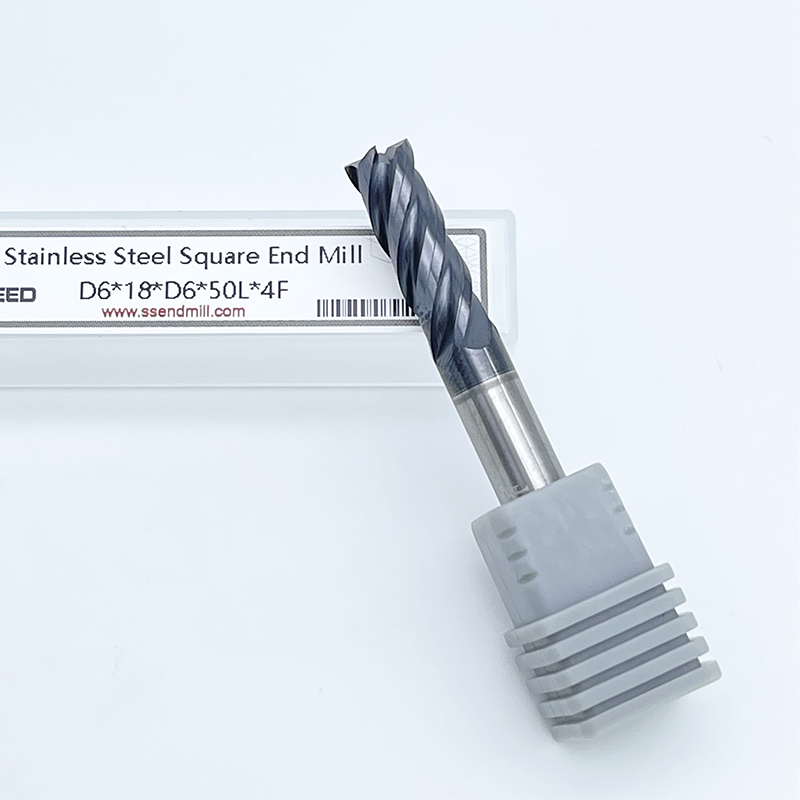
Flute count dictates core strength and chip evacuation space. Traditional 2-flute or 3-flute designs lack the core rigidity to stop deflection in stainless. The sweet spot for roughing and profiling is 4 to 5 flutes.
Flute Count Comparison for Stainless Applications
| Flute Count | Primary Application | Core Strength | Chip Evacuation | Feed Rate Potential |
|---|---|---|---|---|
| 4 Flutes | Heavy roughing, full slotting | High | Excellent | Moderate |
| 5 Flutes | HEM, dynamic milling, profiling | Very High | Good | High |
| 6+ Flutes | Light finishing passes only | Maximum | Poor | Very High |
Your toolpath strategy dictates the geometry you need. Heavy slotting requires specialized end geometries and large flute valleys to pull chips out of the enclosed cut. Aggressive side milling in 304SS demands maximum rigidity. Tools built for side milling have thicker cores and specific radial reliefs. This helps them handle high lateral cutting forces without deflecting or snapping.
Machining tough alloys often causes chatter. Chatter is a self-exciting vibration that wrecks surface finish, micro-chips the edge, and accelerates wear. Standard tools have equally spaced flutes and a constant helix angle. This creates a rhythmic impact against the metal, setting up a resonant frequency.
Variable pitch means unequal spacing between cutting edges. Variable helix means changing the helix angle along the flute length. These designs disrupt the rhythmic impact. They alter the timing of each edge entering the material. This dampens harmonics and kills chatter. You get lower tool pressure, less work hardening, and the ability to take deeper axial cuts.
The sharp 90-degree corner is the weakest point on any cutter. In high-shear applications, sharp corners micro-fracture under heavy loads. Once a corner chips, the tool dies fast. Using tools with a corner radius reinforces the edge. The radius spreads cutting forces over a larger area. This stops chipping and extends tool life during heavy roughing.
Uncoated carbide degrades rapidly in stainless steel. Intense heat causes thermal cracking. The lack of lubricity leads to immediate material welding. Advanced Physical Vapor Deposition (PVD) coatings act as a thermal barrier and a dry lubricant. They change how the tool interacts with the metal.
TiAlN works very well for general stainless machining. Its main advantage is a high oxidation temperature. As cutting temperatures rise, the aluminum in the coating migrates to the surface. It forms a microscopic layer of aluminum oxide. This ceramic layer reflects heat back into the chip, protecting the carbide. TiAlN excels in tougher, less gummy martensitic grades like 416 or 17-4 PH.
AlCrN is the premium choice for extreme heat resistance and high lubricity. Adding chromium lowers the coefficient of friction compared to TiAlN. High lubricity is mandatory for gummy austenitic grades like 304 and 316L. AlCrN provides a slick surface that stops chips from welding to the rake face. This eliminates Built-Up Edge (BUE). It also handles higher thermal loads, making it perfect for aggressive HEM parameters.
Top manufacturers engineer stainless-specific lines by tweaking micro-geometries. They use sub-micron carbide grain structures to balance hardness and toughness. They apply eccentric relief angles to provide a strong edge while minimizing rubbing. Look past the brand name. Analyze the specific rake angles and core diameters.
Stainless steels behave differently. Austenitic grades are gummy. They need higher rake angles to shear the material cleanly. This stops the metal from tearing or folding over the edge. Martensitic or precipitation-hardened steels are harder and less gummy. Tools optimized for these harder grades use slightly lower rake angles and thicker cores to handle higher cutting forces.
Many brands sell high-performance tools for all steels. These work fine in mild steel but often fail in stainless. Material-specific tools are engineered for the exact shear angles and thermal properties of stainless alloys. Using a tool built specifically for the SUS material group gives you the right balance of edge sharpness and structural strength.
Match your tooling to your production environment. For long-run, lights-out manufacturing, process reliability is everything. You need premium tools with advanced AlCrN coatings and variable geometries to stop mid-cycle failures. For a job shop doing short-run prototyping, mid-tier performance tools offer a good balance of capability and cost. Just make sure they still have variable pitch designs and corner radii.
Buying the best end mills for stainless steel means nothing if your setup is sloppy. A premium cutter fails just as fast as a cheap one if your speeds, feeds, coolant, or tool holding are wrong. You must optimize the process around the tool.
Running too slow guarantees work hardening. You must calculate aggressive chip loads. The cutting edge needs to penetrate below the work-hardened layer left by the previous pass. High-Efficiency Milling (HEM) strategies pair a low radial depth of cut with a high axial depth of cut. This lets you push Surface Feet per Minute (SFM) much higher. HEM uses the entire flute length, spreads wear evenly, and uses radial chip thinning to maintain high feed rates safely. For example, when roughing 304 stainless with a 1/2-inch 5-flute AlCrN coated tool using HEM, you might start at 350 SFM with a 0.003 IPT chip load, utilizing a 10% radial stepover. If you switch to a traditional slotting toolpath with a 100% radial engagement, that SFM must drop drastically to around 150 SFM to survive the heat generation.
Recutting chips in stainless steel destroys tools. The chips are work-hardened and abrasive. Standard flood coolant lacks the pressure to blast chips out of deep pockets. High-Pressure Coolant (HPC) is highly recommended. It clears chips from the cutting zone instantly. Watch out for thermal shock, though. Inconsistent coolant application causes rapid heating and cooling of the carbide, leading to micro-cracking. If you lack HPC, an air blast combined with Minimum Quantity Lubrication (MQL) often works better than weak flood coolant.
Tool holder rigidity directly impacts tool life. Standard ER collets introduce excessive runout. Even 0.0005 inches of runout forces one flute to take a massive chip load. This causes uneven wear, chatter, and early failure. To get the most out of carbide tooling, use shrink fit holders, hydraulic chucks, or high-precision milling chucks. These provide maximum gripping force and near-zero runout.
Follow these steps to ensure a stable process before hitting cycle start:
Even with the right tool, things go wrong on the floor. Recognizing the wear pattern on your cutter tells you exactly what parameter to adjust.
Common Wear Patterns and Solutions
| Failure Mode | Visual Indicator | Root Cause | Corrective Action |
|---|---|---|---|
| Flank Wear | Even abrasion along the cutting edge clearance face. | Normal wear, but accelerated by excessive SFM. | Reduce cutting speed (SFM). Maintain feed rate. |
| Chipping | Micro-fractures along the cutting edge or corner. | Lack of rigidity, excessive feed, or sharp corners. | Add a corner radius. Check runout. Reduce IPT. |
| Built-Up Edge (BUE) | Workpiece material welded to the rake face. | Low lubricity, low cutting speed, or gummy material. | Increase SFM slightly. Switch to AlCrN coating. Improve coolant flow. |
| Thermal Cracking | Cracks running perpendicular to the cutting edge. | Thermal shock from inconsistent coolant application. | Switch to continuous high-pressure coolant or dry machining with air blast. |
Machining work-hardening alloys requires ditching general-purpose tooling. The best cutters for this job are premium solid carbide. They feature 4 to 5 flutes, variable pitch, variable helix geometries, and advanced coatings like AlCrN or TiAlN. Protecting the edge with a corner radius extends life during heavy roughing. Audit your machining environment before buying. Identify your exact stainless grade. Assess your machine's rigidity and tool holding capabilities.
Take these next steps to improve your process:
A: AlCrN (Aluminum Chromium Nitride) and TiAlN (Titanium Aluminum Nitride) are the top choices. AlCrN provides superior lubricity, making it ideal for gummy austenitic grades like 304 to prevent Built-Up Edge (BUE). TiAlN forms a protective oxide layer under high heat, making it excellent for harder martensitic grades.
A: A 4-flute tool offers the best balance of core strength and chip evacuation for traditional roughing and slotting. For High-Efficiency Milling (HEM) and profiling, a 5-flute tool is superior because it provides increased rigidity and allows for significantly higher feed rates.
A: Work hardening happens when the tool rubs the material instead of shearing it, altering the metal's crystalline structure. Stop it by maintaining sharp cutting edges, avoiding dwelling in the cut, and using an aggressive feed rate to constantly cut beneath the previously hardened layer.
A: Yes, but apply it correctly. High-pressure coolant clears abrasive chips and prevents recutting. However, inconsistent application causes thermal shock and micro-cracking in the carbide. If high pressure is unavailable, a strong air blast with Minimum Quantity Lubrication (MQL) is highly effective.
A: Gummy 304 requires higher rake angles to shear the material cleanly and high-lubricity coatings like AlCrN to prevent material welding. Harder 17-4 PH requires slightly lower rake angles, thicker cores to withstand higher cutting forces, and heat-resistant coatings like TiAlN.
A: Sharp 90-degree corners are the weakest point of the tool and micro-fracture easily under high shear forces. Switching to a tool with a corner radius, such as 0.015 or 0.030 inches, reinforces the edge, distributes cutting forces, and prevents premature chipping.