- All
- Product Name
- Product Keyword
- Product Model
- Product Summary
- Product Description
- Multi Field Search

Views: 0 Author: Site Editor Publish Time: 2026-09-21 Origin: Site

Machining tough, heat-resistant superalloys and sticky, work-hardening metals presents one of the most demanding environments on any shop floor. Anyone who has stood in front of a spindle cutting aerospace-grade titanium or medical-grade stainless steel knows the stakes. A slight miscalculation in speeds and feeds, or the use of a generic end mill, rarely just results in a poor surface finish. It usually leads to a dreaded high-pitched squeal followed by catastrophic tool failure.
Recent market analyses reveal a stark transition in aerospace and medical manufacturing. Shops are rapidly moving away from traditional heavy-roughing passes. Instead, they are adopting dynamic toolpaths and High-Efficiency Milling strategies to remain competitive. This shift exposes a critical bottleneck. Standard end mills simply shatter under the sustained radial engagement of modern CAM programs. To stay profitable, manufacturers must adopt hyper-specialized cutting geometries. The secret to maximizing tool life and return on investment lies in the precise combination of cutting geometry and advanced chemical coatings.
Key Takeaways:
Material Matters: Titanium traps heat at the cutting edge, while stainless steel is highly prone to work-hardening and galling. Both require distinctly different tooling setups.
Carbide is King: Upgrading to a premium solid substrate provides the necessary rigidity and heat resistance that high-speed steel simply cannot match.
Geometry Controls Vibration: Variable helix and unequal pitch designs are critical for breaking up harmonic chatter and evacuating chips efficiently.
Coatings Protect the Edge: Advanced chemical layers act as a thermal barrier, significantly extending tool life in high-temperature cutting zones.
Application-Specific Selection: A dedicated tool for titanium will feature different edge preparations and core diameters compared to one designed for stainless alloys.
Manufacturing components from these advanced alloys presents unique metallurgical hurdles. Unlike standard carbon steels or aluminum, titanium and stainless steel possess physical properties that actively resist the shearing process. Understanding these inherent material characteristics is the foundational step in optimizing your setup and reducing the cost-per-part in high-volume production.
Titanium alloys, such as the widely used Ti-6Al-4V, are notorious for their exceptionally low thermal conductivity. Materials like aluminum efficiently dissipate heat through the chips being evacuated. Titanium, however, acts as a stubborn insulator. During the milling process, up to 80 percent of the heat generated by the shearing action is trapped at the cutting zone and forced directly back into the tool.
This localized heat concentration causes extreme thermal shock. If the tool material is not specifically engineered to handle these blistering temperatures, the cutting edge will experience rapid plastic deformation, crater wear, and premature failure. Furthermore, the inability to evacuate heat increases the risk of chemical reactivity between the titanium workpiece and the tool substrate. This can literally weld the two together at a microscopic level.
In contrast, stainless steel series, particularly 300 and 400 series austenitic and martensitic grades, present a distinctly different set of challenges. These alloys boast high ductility and a strong tendency to strain-harden as they are deformed by the cutter. If a tool rubs against the material for even a fraction of a second rather than shearing it cleanly, the surface layer becomes significantly harder than the underlying base metal. Subsequent passes then slam into this hardened crust, drastically accelerating edge degradation.
Additionally, stainless steel is notoriously sticky. Under high pressure and heat, microscopic particles of the workpiece tend to weld themselves to the cutting lip. This phenomenon is known as galling, which leads to a Built-Up Edge. When this built-up material eventually breaks off, it often takes microscopic chunks of the carbide edge with it, leading to micro-chipping and sudden tool death.
When attacking difficult alloys, the underlying substrate of your tooling is non-negotiable. High-Speed Steel and Cobalt tools lack the thermal stability and structural rigidity required for modern CNC machining of these tough metals. Upgrading to a premium carbide milling cutter is a fundamental requirement for achieving stable processes and predictable tool life.
The primary advantage of solid tungsten carbide is its exceptionally high modulus of elasticity. It is approximately three times more rigid than steel. When milling tough materials, the cutting forces are immense. These forces naturally push the tool away from the workpiece. This deflection causes chatter, poor dimensional accuracy, and terrible surface finishes.
A solid carbide substrate fiercely resists these bending forces, keeping the cutting edge engaged precisely where the CAM software programmed it to be. This rigidity is critical when performing heavy roughing passes in titanium or when trying to maintain tight aerospace tolerances in stainless steel components.
It is important to note that not all carbide is created equal. The performance of the tool heavily depends on its grain size and cobalt binder content. For machining sticky and tough materials, sub-micro grain carbide with grain sizes less than 1 micron is the industry standard. Smaller grain sizes allow manufacturers to grind a sharper cutting edge without sacrificing the Transverse Rupture Strength of the tool. A razor-sharp edge is vital for slicing stainless steel cleanly to prevent work-hardening, while the high rupture strength ensures the tool can withstand the heavy impact forces of interrupted cuts.
Even the highest quality carbide substrate will fail spectacularly if the geometry is not optimized for the specific material. Geometry dictates exactly how the tool interacts with the metal, how chips are formed, and how effectively destructive vibrations are managed.
Design Feature | Titanium Alloys Setup | Stainless Steel Setup |
|---|---|---|
Flute Count | 5 to 7 flutes for maximum core rigidity | 4 flutes for optimal chip evacuation |
Rake Angle | Slightly positive with edge preparation | Highly positive for sharp shearing action |
Helix Design | Variable helix to break harmonic chatter | Variable helix to reduce vibration |
Ideal Coating | AlTiN or Silicon-doped PVD | TiAlN with polished flutes |
Coolant Strategy | High-volume flood or through-tool | High-pressure coolant to blast chips |
Selecting the correct flute count requires a delicate balance between chip evacuation space and core strength. For stainless steel, a 4-flute design is often the standard. Because stainless produces long, stringy chips, it requires ample space in the flute valleys to evacuate. If the flutes are too crowded, chips will pack inside, leading to immediate tool breakage.
Conversely, because titanium requires massive rigidity to combat deflection, 5-flute to 7-flute tools are often utilized. More flutes mean a thicker core diameter. This drastically increases the structural integrity of the tool and allows for much higher feed rates during dynamic milling.
Chatter is the absolute enemy of tool life. It is a self-excited harmonic vibration that shatters cutting edges. To combat this, modern tools utilize variable helix angles and unequal flute spacing.
In a standard end mill, flutes strike the material at exact, rhythmic intervals, creating a resonating frequency. By altering the helix angle, such as alternating between 35 degrees and 38 degrees on adjacent flutes, and varying the distance between the cutting edges, the tool breaks up these harmonic frequencies. This geometric disruption prevents chatter from ever forming, ensuring a smooth, stable cut even under heavy radial loads.
The rake angle determines the sharpness and shearing action of the tool. Stainless steel demands a highly positive rake angle to shear the material cleanly and minimize the heat generated by friction. This effectively mitigates work-hardening. However, a highly positive, sharp edge is inherently fragile. To balance sharpness with durability, manufacturers apply a microscopic edge hone or T-land preparation. This slight rounding or chamfering of the cutting lip reinforces the edge, preventing micro-chipping when slamming into a titanium workpiece.
Because these superalloys generate extreme heat and friction, the bare carbide substrate must be protected. Chemical Vapor Deposition and Physical Vapor Deposition coatings act as a critical thermal and lubricious barrier between the tool and the harsh machining environment.
Titanium Aluminum Nitride, commonly known as TiAlN coating, is one of the most effective solutions for machining high-temperature alloys. The defining characteristic of TiAlN is its ability to undergo a chemical transformation during the machining process. When exposed to the extreme heat of the cutting zone, typically above 800 degrees Celsius, the aluminum within the coating oxidizes. This forms a microscopic layer of aluminum oxide right on the surface of the tool.
This aluminum oxide layer acts as an exceptional thermal shield. It reflects heat back into the chip and away from the vulnerable carbide substrate. Consequently, this prevents thermal shock and allows the tool to operate at significantly higher surface speeds than uncoated alternatives.
While often used interchangeably by machinists, AlTiN and TiAlN have distinct compositional differences. AlTiN contains a higher atomic percentage of aluminum compared to titanium. This higher aluminum content means AlTiN can form a denser, more robust aluminum oxide layer, making it highly suitable for extreme high-heat, dry machining applications. On the other hand, TiAlN is highly versatile and offers excellent performance in both wet and dry machining environments. This makes it a reliable choice for general profiling of tough alloys.
A coating is only effective if it remains attached to the tool and does not increase friction. Advanced manufacturing processes now include post-coating polishing. By smoothing out the microscopic droplets left behind by the deposition process, the tool flutes become highly lubricious. This low-friction surface is crucial for machining stainless steel, as it prevents sticky chips from adhering to the tool, significantly reducing the risk of galling.
Machining titanium requires a highly specific approach to tool selection. Because it tends to spring back away from the cutting edge and traps heat, selecting the correct tool is not optional. It is a fundamental requirement for process stability.
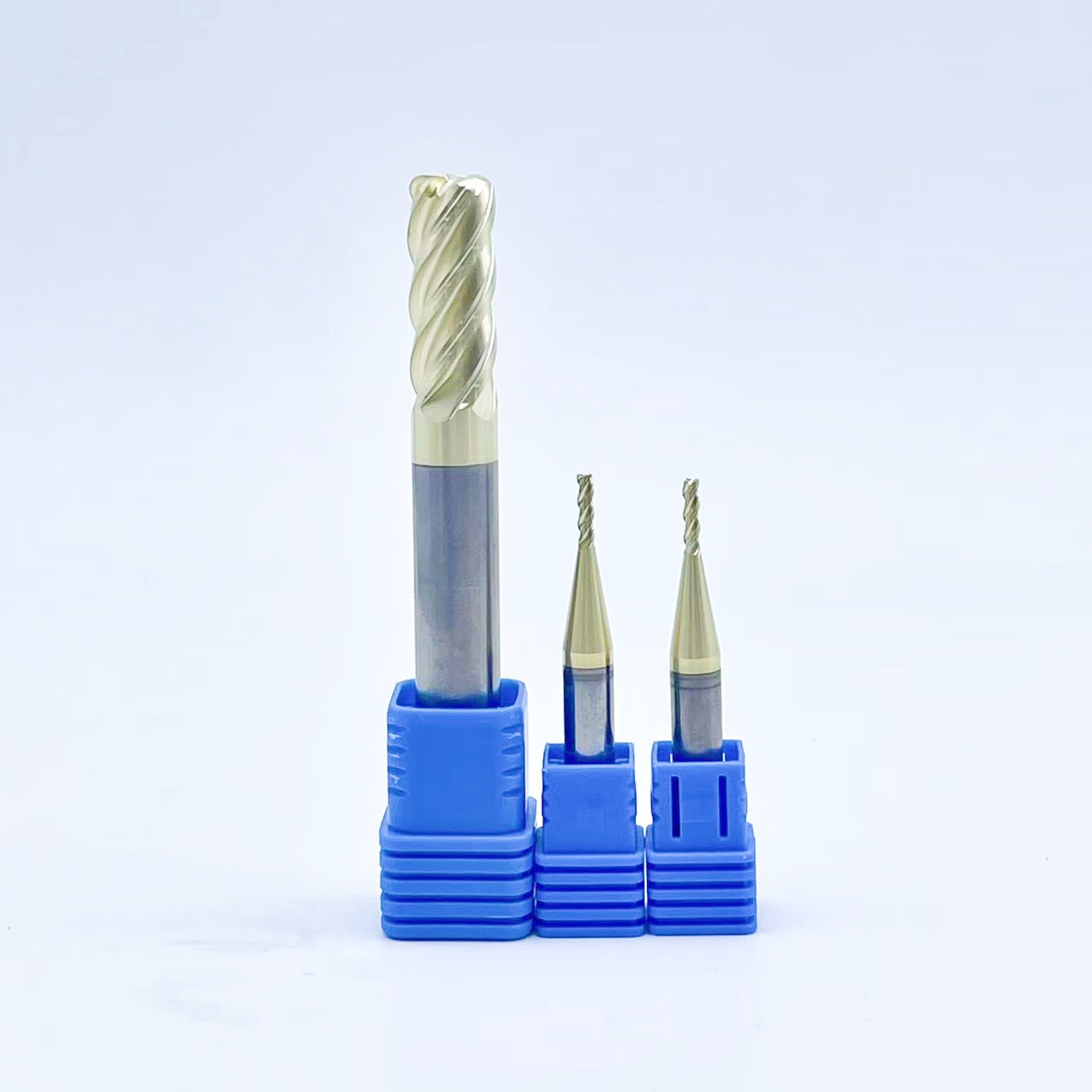
When evaluating a titanium milling cutter, core strength and corner protection are the most critical features. Engineers should look for tools with a heavy core diameter, typically found in 5-flute configurations. A higher flute count allows the core to remain thick while providing enough space for the relatively small, tightly curled chips produced during titanium machining. Furthermore, selecting a corner radius end mill over a square end mill is highly recommended. The corner radius distributes cutting forces along a curve rather than a sharp point, drastically reducing the chance of corner chipping during heavy roughing. Variable helix angles and unequal flute spacing remain mandatory to suppress chatter.
It is crucial to avoid coatings that have a high chemical affinity with the workpiece. Because titanium is highly reactive at high temperatures, using a standard Titanium Nitride coating can cause the workpiece material to chemically bond with the tool coating. This pulls microscopic pieces of carbide away when the chip breaks off. Instead, specialized AlTiN or proprietary silicon-doped coatings are recommended to maintain chemical inertness at the cutting zone.
Tool life is not dictated by the physical tool alone. The programming strategy plays an equal role. High-Efficiency Milling, also known as trochoidal milling, is highly recommended. This strategy utilizes a low radial depth of cut combined with a high axial depth of cut, engaging the entire length of the flute. This distributes heat and wear evenly across the tool rather than concentrating it at the bottom corner, thereby extending the tool life exponentially.
The focus shifts slightly when dealing with stainless steel. Here, the primary objective is outsmarting the material tendency to work-harden and gall. You must prioritize shearing efficiency and chip management over pure core rigidity.
The best stainless steel milling tools utilize a highly positive rake angle. This geometry creates a razor-sharp shearing action that slices cleanly through the material, minimizing the friction that causes strain hardening. By cutting cleanly, the tool ensures that the next pass does not encounter a hardened layer of metal. A 4-flute configuration is generally considered the industry standard for slotting and heavy profiling, providing the optimal balance between core rigidity and flute valley size.
Chip packing is a primary cause of tool breakage in these applications. When stringy stainless chips are not evacuated efficiently, they are re-cut by the tool. Recutting work-hardened chips will instantly destroy the cutting edge. To manage this, the flute depth and the surface finish inside the flute valley must be optimized. Deep, polished flutes ensure that chips glide out of the cutting zone without sticking.
While some modern coatings allow for dry machining, stainless steel typically demands heavy coolant application. High-pressure coolant, or ideally through-tool coolant, serves a dual purpose. It provides necessary lubricity to prevent galling, and it physically blasts the tough chips away from the cutting zone. Proper coolant delivery is often just as important as the tool geometry itself.
Even the most advanced, perfectly coated end mill will fail prematurely if applied incorrectly. Maximizing your tooling investment requires a holistic approach to the entire machining environment.
Relying solely on generic manufacturer charts is insufficient for high-performance machining. Surface footage and chip load must be dynamically adjusted based on the specific tool engagement. For example, when utilizing dynamic strategies with a low radial engagement, machinists must calculate for radial chip thinning. As the radial step-over decreases, the actual chip thickness becomes smaller than the programmed feed rate. If the feed is not increased to compensate, the tool will rub against the material rather than cutting it, causing rapid heat buildup and work-hardening.
Runout is the silent killer of CNC milling tools. Because carbide is extremely hard, it is inherently brittle. If a tool spins off-center by even a few ten-thousandths of an inch, the chip load becomes unevenly distributed. One flute will take a massive cut while the others take nothing, leading to rapid edge chipping. For tough materials, standard ER collets often lack the necessary gripping force. Shrink-fit tool holders or hydraulic chucks are highly recommended to ensure maximum rigidity and minimize runout.
The direction of the cut significantly impacts tool life. Climb milling, where the tool rotates in the direction of the feed, is almost universally preferred over conventional milling for these alloys. Climb milling ensures the chip starts at its maximum thickness and tapers to zero, transferring the heat into the chip rather than the workpiece. This reduces friction, lowers the risk of work-hardening, and leaves a vastly superior surface finish.
Machining tough metals like titanium and stainless steel is an exact science, not a matter of guesswork. It requires specific geometric features and advanced chemical coatings working in tandem. You need a robust solid carbide cutter equipped with anti-chatter designs and heat-resistant layers to survive the harsh environment of the cutting zone.
Investing in the proper, material-specific tools drastically reduces expensive machine downtime and prevents scrapped parts. This strategic approach ultimately lowers your overall cost-per-part, padding your bottom line. Take the time to evaluate your current tooling setup today. Ensure you have the exact geometry and coating tailored for your next critical project by exploring the specialized high-performance milling solutions at SS End Mill.
While general-purpose, high-performance tools do exist, using them for both materials will result in compromised tool life and slower cycle times. For optimal manufacturing efficiency, material-specific tools are required. Titanium requires thicker cores for extreme rigidity and slightly honed edges to withstand high cutting forces. Conversely, stainless steel requires deeper flutes for chip evacuation and razor-sharp cutting edges to shear the metal before it can work-harden.
Yes, in almost all cases involving these specific alloys. While a TiAlN coating thrives in high-heat environments by forming a protective aluminum oxide layer, the materials being cut dictate the need for coolant. Titanium poses a severe fire risk if chips ignite, and stainless steel requires heavy fluid application to physically flush the stringy chips out of the cutting zone to prevent recutting and built-up edge.
Visual inspection often reveals micro-chipping on the cutting edge or localized flank wear. However, machine feedback is a more reliable indicator. Operators should monitor the spindle load meter. A sudden increase of 10 to 15 percent in spindle load indicates the edge is degrading. Additionally, auditory changes like a higher-pitched squeal, sparking during the cut, or a sudden degradation in the workpiece surface finish are all empirical signs that the tool has reached the end of its usable life.
A 4-flute variable helix end mill is typically the optimal choice for stainless steel. Four flutes provide the perfect geometric balance. They offer enough open space in the flute valleys to evacuate the long, stringy chips typical of stainless steel, while maintaining a core diameter strong enough to prevent tool deflection during heavy slotting or roughing operations.
The best strategy involves maintaining a low surface footage to control heat generation, while keeping a relatively high chip load to ensure the tool is cutting rather than rubbing. Combining this with High-Efficiency Milling toolpaths allows you to utilize the entire flute length at a low radial engagement. This prevents localized heat buildup and maximizes material removal rates without burning up the cutter.
A corner radius significantly extends tool life when roughing tough alloys like titanium and stainless steel. Sharp square corners are the weakest point on an end mill and are highly susceptible to chipping under heavy loads. Adding a radius distributes the cutting forces over a larger, curved surface area, reinforcing the edge and preventing catastrophic corner failure during aggressive dynamic milling.