Please Choose Your Language
- All
- Product Name
- Product Keyword
- Product Model
- Product Summary
- Product Description
- Multi Field Search

Views: 0 Author: Site Editor Publish Time: 2026-09-22 Origin: Site

Ever ruined an expensive sheet of cast acrylic during a critical CNC job? The distinct, acrid smell of melting polymer and the horrifying sound of a snapping end mill are all too familiar on the shop floor. Standard metal-cutting tools create excessive friction. This rapidly melts temperature-sensitive plastics and destroys the edge finish. Suddenly, a profitable run turns into a bin full of scrap.
To prevent this mechanical nightmare, operators must pivot away from traditional geometries. It is time to embrace specialized tooling. In this comprehensive guide, we will explore the underlying physics of polymer routing. We will dissect why single-flute geometry is the ultimate solution. Finally, we will outline how proper tooling choices dictate your manufacturing success.
Heat is the Enemy: Plastics and acrylics possess incredibly low melting points. Specialized tooling is mandatory to evacuate thermal energy quickly and efficiently.
Single-Flute Superiority: A single-flute configuration provides the largest possible flute valley. This allows for massive chip ejection and minimal frictional buildup.
The Polished Advantage: Utilizing a mirror-finished cutter prevents hot plastic chips from adhering, melting, and subsequently welding to the carbide.
Material Matters: Cast acrylic, extruded acrylic, and ductile plastics demand distinct tooling geometries and highly tailored feed-rate strategies.
Perfecting the Finish: Proper tool selection eliminates the grueling need for post-machining manual polishing. This saves significant production time and labor costs.
Before diving into the physics of cutting, we must understand the broader manufacturing landscape. The global push for lightweighting in electric vehicles, aerospace components, and medical devices has triggered a massive shift toward advanced engineering plastics. Materials like polycarbonate, PEEK, and high-density polymers are rapidly replacing heavy metal brackets and housings. This macroeconomic trend demands precision routing capabilities. Machine shops that master polymer machining are securing lucrative contracts. In contrast, those clinging to outdated metal-only strategies are struggling to stay competitive.
Machining non-metallic polymers presents a unique set of physical and thermal hurdles. These differ vastly from cutting steel or aluminum. For shop owners and CNC operators, understanding the molecular behavior of plastics under sheer stress is the foundational step toward optimizing production.
The primary failure point when milling plastics is thermal accumulation. Unlike metals, which can absorb and dissipate heat throughout the workpiece, plastics act as thermal insulators. When a rotating tool engages the material, the resulting friction generates intense localized heat. Because the polymer cannot conduct this heat away, the temperature at the cutting zone spikes rapidly. Once it exceeds the material's glass transition state, the plastic turns into a sticky, molten mess. This melted resin wraps tightly around the tool, cools instantly into a hardened mass, and triggers a catastrophic failure known as chip galling.
Achieving a pristine, glass-like finish on clear materials requires a delicate shearing action rather than blunt force. When an incorrect or dull tool geometry is applied, the cutter effectively plows through the material. This violent impact introduces severe mechanical stress into the polymer chains. In brittle substrates like clear acrylic, this stress manifests as crazing. Crazing is a network of microscopic, spiderweb-like fractures along the machined edge. Consequently, it leaves a frosted, opaque finish that compromises both the optical clarity and the structural integrity of the final part.
Walk into many traditional machine shops, and you will see operators attempting to route polycarbonate with standard four-flute end mills designed for aluminum. This is a recipe for disaster. Metal-cutting tools are engineered with lower rake angles and shallow flute valleys to maintain core rigidity against hard impacts. However, when applied to soft plastics, these restrictive valleys trap the chips. The trapped chips rub aggressively against the trench walls. This generates secondary friction that guarantees immediate melting.
To circumvent the thermal and mechanical bottlenecks associated with polymers, tool engineers have developed highly specific geometries. These are tailored exclusively for soft, heat-sensitive materials.
At its core, a nonmetal CNC tool is a specialized rotary cutter engineered explicitly for routing, milling, and profiling materials that cannot withstand high friction. This broad category encompasses acrylics, polycarbonates, high-density polyethylene, rigid foams, and engineered woods. The driving engineering directive behind these tools is rapid heat evacuation rather than extreme structural rigidity. They shift the operational focus from surviving hard impacts to maximizing material removal rates while keeping the cutting zone ice-cold.
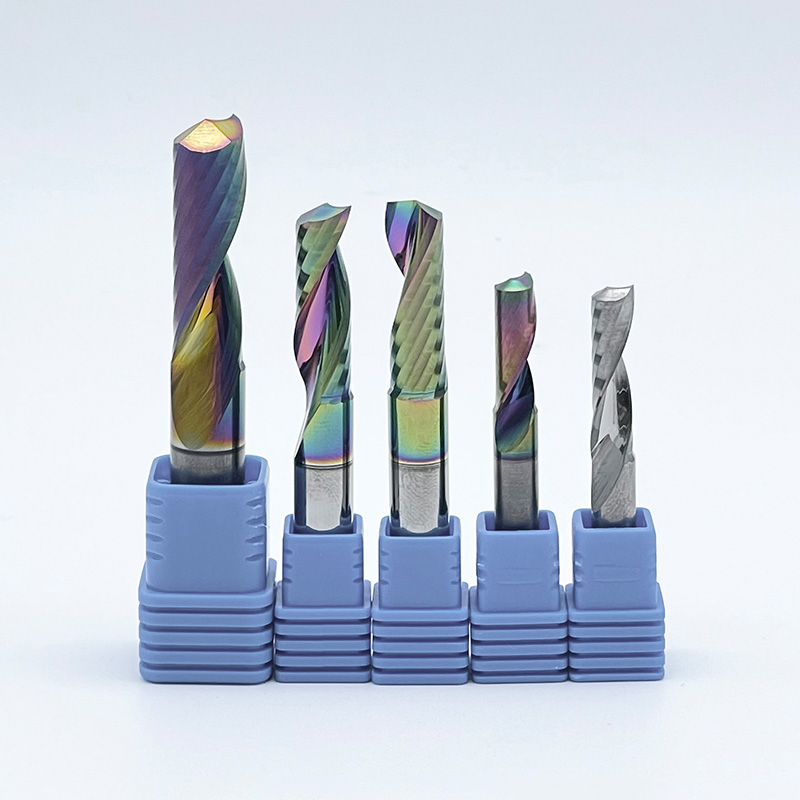
A dedicated cutter looks and performs entirely differently than your standard shop tooling. High-end manufacturers utilize micro-grain solid carbide substrates to ensure the tool withstands high-speed engagement without microscopic chipping. Common industrial parameters feature shank diameters ranging from 3.175mm up to 8mm, with cutting lengths optimized for single-pass sheet routing. Furthermore, the cutting edge is ground to an acute, razor-sharp high positive rake angle. This geometry allows the tool to slice cleanly under the plastic surface, shearing away the chip with minimal resistance.
The fundamental secret to machining plastics flawlessly lies in flute reduction. By stripping away cutting edges, engineers have created the optimal geometric configuration for temperature-sensitive nonmetals.
In the realm of plastic machining, the chip itself acts as the primary vehicle for heat removal. The ultimate goal is to transfer the thermal energy generated by friction directly into the chip. You must then eject that chip from the trench before the heat can bleed into the surrounding workpiece. A single flute end mill possesses only one cutting edge, meaning the remaining circumference of the tool is a massive open cavity. This cavernous space allows for the formation of thick, curling chips that escape the channel instantly. Specifically, the popular O-flute design curls the chip perfectly to prevent jamming.
Every single time a cutting edge strikes the material, friction is born. A four-flute tool strikes the plastic four times per single revolution. In stark contrast, a single-flute tool strikes the material only once. By drastically reducing the number of cutting edges, frictional engagement time plummets by up to 75 percent. Less friction equals a significantly cooler cutting environment. This keeps the polymer safely below its melting threshold.
Counterintuitively, babying the machine and cutting plastic slowly is exactly what causes melting. Single-flute geometries are specifically designed to be pushed hard and fast. By ramping up the machine feed rate, the tool takes a heavier chip load. This means it bites off a thicker chunk of material per revolution. A thick chip absorbs heat efficiently. If you feed too slowly, the tool merely rubs the surface, generating a cloud of static-cling dust and intense heat. Single-flute tools empower operators to maximize their feed rates safely and confidently.
While having a single flute provides the necessary physical space for chip clearance, geometry alone is not always enough for high-end optical finishes. The surface treatment of the carbide plays a vital role in fluid chip dynamics.
During the standard manufacturing of end mills, industrial grinding wheels leave microscopic striations and grooves inside the flute valley. To create a premium tool, an additional labor-intensive manufacturing step is introduced. The inside of the flute is meticulously lapped and buffed to a mirror-like finish. Upgrading to a polished flute cutter eradicates all microscopic grinding marks and yields a flawlessly smooth surface.
Heated polymer chips are incredibly adhesive. They naturally want to grab onto rough or porous textures. The microscopic striations left on unpolished tools act as perfect gripping points for hot plastic. Conversely, a polished surface acts much like a non-stick frying pan. The ultra-smooth finish drastically lowers the coefficient of friction. This forces the plastic chip to glide seamlessly up and out of the flute without ever adhering to the carbide core.
Selecting the correct tool requires a nuanced understanding of the operational differences between flute counts. Using the wrong tool for the wrong material is a guaranteed path to scrapped parts.
Tool Type | Heat Generation | Chip Clearance capability | Ideal Application |
|---|---|---|---|
Single-Flute O-Flute | Very Low | Maximum (Massive gullet) | Acrylics, Polycarbonate, HDPE, High-speed routing |
Two-Flute End Mill | Moderate | Medium | Stiff composites, dense hardwoods, lightweight CNC machines |
Four-Flute End Mill | Extremely High | Poor (Chips trap instantly) | Metals only. Guaranteed to melt plastics. |
Achieving a flawless finish requires acknowledging that not all plastics behave identically under the spindle. The molecular structure and manufacturing origin of the material dictate how it will react to shear forces.
Acrylic dominates the sign-making and display industries. However, it is available in two distinct formulations that demand entirely different machining approaches.
Cast Acrylic: Manufactured by pouring liquid resin between glass plates, cast acrylic features a uniform, isotropic structure. It possesses a higher melting point and fractures cleanly when cut, producing distinct, granular chips. When working with cast sheets, utilizing a dedicated acrylic cutting tool featuring an O-flute design will yield a nearly polished, frosted edge that requires minimal post-processing.
Extruded Acrylic: Formed by forcing molten polymer through a die, extruded acrylic holds internal directional tension and has a notoriously low melting point. It is incredibly gummy. Machining this variant requires the sharpest possible single-flute tool, hyper-aggressive feed rates, and excellent air cooling to prevent the gummy ribbons from re-welding to the cut wall.
Industrial engineering plastics such as High-Density Polyethylene and Teflon present a different mechanical challenge. Unlike brittle acrylic, these soft plastics are highly ductile. When struck by a dull edge, they stretch, tear, and extrude rather than cut cleanly. This leaves a fuzzy, burr-riddled edge. A sharp cutter with a high shear angle is mandatory here to slice through the ductile fibers cleanly before they have a chance to bend away from the tool.
Even the most premium, mirror-polished carbide in the world will fail spectacularly if driven by incorrect machining parameters. Machining nonmetals requires a specific mathematical approach to speeds and feeds that often feels backward to veteran metal machinists.
Chip load is the physical thickness of the material removed by one cutting edge in a single revolution. For plastics, maintaining a heavy chip load is non-negotiable. A typical target is between 0.1mm and 0.3mm depending on the tool diameter. Because a thicker chip absorbs more heat, maximizing the chip load within the limits of the tool structural integrity is your primary defense against melting.
If there is a golden rule for plastic machining, it is this: Lower your Spindle Speeds, and Maximize your Feed Rates. Running a spindle screaming at 24,000 RPM while creeping the gantry along at 50 inches per minute will instantly liquefy the plastic due to severe rubbing. A much more effective baseline is to drop the spindle speed to a conservative 14,000 to 18,000 RPM. From there, push the machine feed rate as fast as the frame rigidity will allow without inducing chatter.
Because plastics require aggressive feed rates, lateral cutting forces can be surprisingly high. If the thin plastic sheet vibrates or lifts even a fraction of a millimeter, it will cause microscopic chatter marks that destroy optical clarity. Vacuum tables paired with high-flow pumps are the industry standard. For smaller, intricate parts, double-sided masking tape combined with superglue provides rock-solid fixturing.
Furthermore, traditional liquid CNC coolant is generally avoided. It creates a sticky, unmanageable slurry with plastic chips and can induce environmental stress cracking in clear acrylics. Instead, operators should utilize a continuous, high-velocity blast of compressed air. A specialized cold air gun directed squarely at the cutting zone will clear chips instantly while chilling the carbide.
Transitioning to highly efficient plastic machining is a strategic investment. Selecting the correct geometry involves an honest assessment of your machinery and the specific operations you intend to execute.
Before purchasing aggressive tooling, evaluate your CNC router rigidity. If your lightweight gantry router shudders and screams when pushed past heavy feed rates, you will not be able to utilize large-diameter single-flute tools effectively. In these scenarios, stepping down to a smaller diameter plastic milling cutter allows you to maintain the proper chip load without overloading the machine frame and inducing surface chatter.
The direction of the flute spiral dictates where the chips flow and where the cutting force is applied to the material. An upcut spiral is the undisputed standard for most plastics. It pulls chips aggressively up and out of the cut, preventing recutting. However, it applies lifting force to the material, demanding excellent workholding. A downcut spiral pushes chips downward into the cut. This is ideal for very thin, flexible laminates that might lift off the table, but it requires slower feed rates since chip evacuation is severely hindered. Finally, a straight flute features a neutral geometry that neither pulls up nor pushes down. It is often utilized for routing stiff plastics where pristine edge quality is paramount on both the top and bottom faces simultaneously.
Mastering the art of plastic and acrylic machining ultimately boils down to one critical factor: heat management. By moving away from inappropriate metal-working end mills and embracing specialized single-flute, polished geometries, operators can evacuate chips rapidly and keep temperatures well below the melting point.
Investing in high-quality tooling transforms a frustrating, high-scrap process into a smooth, highly profitable operation. Premium carbide retains its razor-sharp edge longer, drastically reduces scrap rates, and frequently eliminates the need for labor-intensive manual polishing. Evaluate your shop parameters, upgrade your tooling arsenal, and start achieving the flawless, glass-like surface finishes your clients demand. For industry-leading solutions tailored to your specific application, visit www.ssendmill.com to explore a comprehensive lineup of precision nonmetal machining tools.
While it is physically possible to force a standard wood router bit through acrylic, it is highly discouraged for professional applications. Wood bits lack the specialized high-rake angles and polished flute valleys required to manage the thermal properties of plastics. Using a wood tool on acrylic typically results in excessive friction, melted edges, and a high likelihood of micro-fracturing the material.
The optimal RPM is entirely dependent on your machine feed rate capabilities and the specific diameter of the tool. However, a reliable baseline for a standard single-flute tool is between 14,000 and 18,000 RPM, paired with a fast feed rate. The objective is to keep the RPM low enough to prevent friction-induced melting, while keeping the feed rate high enough to maintain a healthy, heat-absorbing chip load.
Melting is strictly a heat management failure. This occurs when the tool generates more friction than the chip can carry away. The three most common culprits are running the spindle RPM too high, creeping the feed rate too slowly, or using a tool with too many flutes. Switching to a single-flute tool and increasing your feed rate will usually resolve this issue immediately.
An O-flute is a highly specialized cutter characterized by a distinct, circular O shape carved into its flute valley. This unique geometry is specifically engineered to curl plastic chips as they are sheared from the material, preventing them from expanding and jamming in the trench. O-flute tools are almost always manufactured with a mirror-polished finish, making them the industry standard for achieving pristine edges on clear acrylics and polycarbonates.
Liquid coolant is rarely necessary and can often be highly detrimental when machining plastics. Certain synthetic coolants trigger chemical reactions or thermal shock, leading to stress cracks in clear nonmetals. Instead of messy liquids, the industry standard is to use a continuous, high-velocity blast of compressed air. Utilizing a cold air gun directed exactly at the cutting zone is the most effective way to clear chips and chill the tool simultaneously without the messy cleanup.
Chipping, often referred to as edge blowout, happens when the cutter lacks the sharpness to shear the brittle material cleanly or when the material vibrates during the cut. To prevent this, ensure your workholding is absolutely rigid using a strong vacuum system or tape. Additionally, utilize a brand-new, razor-sharp single-flute cutter and consider leaving a 0.5mm allowance for a final, high-speed finishing pass to skim away any micro-fractures.
An upcut bit features a spiral that pulls plastic chips upward and ejects them rapidly, which is excellent for heat evacuation but tends to pull thin materials off the CNC bed. A downcut bit has a reverse spiral that pushes chips downward, pressing the material firmly against the table. Downcut bits are ideal for thin, flexible plastic sheets that struggle with vacuum hold-down, though they require slower feed rates because chip clearing is less efficient.