Please Choose Your Language
- All
- Product Name
- Product Keyword
- Product Model
- Product Summary
- Product Description
- Multi Field Search

Views: 0 Author: Site Editor Publish Time: 2026-09-21 Origin: Site

Cutting deep, narrow slots in metal remains a notoriously demanding operation on the modern CNC shop floor. Standard end mills routinely hit physical limits during these cuts. Severe tool deflection, trapped chips, and catastrophic tool breakage are daily headaches for machinists. When standard catalog tooling chokes your production, engineered solutions become a necessity rather than a luxury. Transitioning to purpose-built cutting tools allows facilities to slash cycle times, achieve flawless surface finishes, and hold strict dimensional accuracy. We will break down the mechanics of thin slot cutting, evaluate different cutter architectures, and establish exactly when upgrading to specialized circular blades makes the most financial sense for your shop.
Defeating Deflection: Thin slotting demands extreme tool rigidity. Standard micro-tools bend under lateral forces. Engineered circular solutions maintain dead-center stability by distributing cutting forces efficiently.
The Carbide Advantage: Solid carbide delivers unmatched wear resistance and thermal stability compared to traditional High-Speed Steel. It is the only viable choice for high-volume runs and exotic alloys.
Precision and Finish: Mounting a dedicated circular cutter on a heavy-duty arbor eliminates axial runout. This guarantees tight tolerances deep inside narrow grooves.
Customization Drives ROI: When standard dimensions fail, custom tooling consolidates operations. Matching exact slot specifications eliminates secondary finishing passes.
Setup is Everything: Premium cutters still demand optimized feeds, precise chip loads, and rigid workholding to prevent chatter and premature failure.
Machining deep, narrow channels introduces physical and thermal roadblocks completely absent in standard profiling or facing. Recognizing these mechanical pain points is the first step toward building a bulletproof machining strategy.
Picture a machinist running a high-dollar aerospace component. Suddenly, a sharp snap echoes through the machine enclosure. Pushing standard micro-tools beyond their physical limits ends exactly like this. The core issue with standard micro-end mills in slotting applications is a severe lack of cross-sectional strength. Shrinking a tool's diameter to fit a narrow slot exponentially reduces its rigidity.
Attempting high depth-to-width ratios generates immense lateral cutting force. The tool bends. In a confined groove, even microscopic deflection forces the flutes to rub against the freshly cut walls. This friction generates massive heat. The enclosed space also chokes off fluid flow, causing chips to pack tightly. When evacuated material cannot escape, the tool recuts its own chips. Cutting pressure spikes instantly, and the carbide shatters.
Relying on the wrong tooling drains a machine shop's profitability. Scrapped parts are the most visible financial hit. When a brittle end mill snaps and embeds into a valuable workpiece, extracting the broken stub requires slow, expensive EDM hole-popping. Often, the entire part goes into the scrap bin.
Poor tooling also destroys cycle times. Operators try to compensate for weak tools by drastically dropping feed rates and programming dozens of shallow depth passes. This prevents immediate breakage but artificially inflates cycle times. Throughput plummets. Standard tools struggling with deflection leave terrible surface finishes characterized by heavy chatter marks and tapered slot walls that fail quality control inspections.
When off-the-shelf tools fail, manufacturers must pivot to specialized solutions. Understanding what makes a cutter truly optimized for specific geometries is critical for upgrading your process.
The gap between standard catalog tools and a special milling tool comes down to engineering intent. Standard options are mass-produced to handle general-purpose applications with acceptable results. Custom-engineered cutters are built to conquer the unique constraints of a specific workpiece, material grade, or machine dynamic.
These engineered solutions feature tailored geometries unavailable on standard shelves. You might need custom rake angles optimized for shearing Inconel, specific tooth counts matched to your spindle's horsepower, or modified dish angles to prevent wall rubbing in extremely deep slots. Matching the tool geometry exactly to the application eliminates the compromises of general-purpose machining.
Different slotting applications require distinct mechanical approaches. Engineers typically select from three main tool architectures in CNC environments.
T-Slot Cutters: Built with a narrow neck and a wider cutting head. These mill undercut slots but are highly susceptible to chip packing if the initial vertical channel lacks proper clearance.
Woodruff Keyseat Cutters: Featuring a small circular cutting head on a solid shank. These excel at shallow, localized semi-circular keyways in shafts but lack the reach for continuous deep grooves.
Arbor-Mounted Circular Saws: These offer the absolute highest depth-to-width ratio capabilities. The immense rigidity of the mounting arbor provides unmatched stability.
Circular blades dominate narrow channels because of their specific geometric features and structural design. Let us examine how they are built.
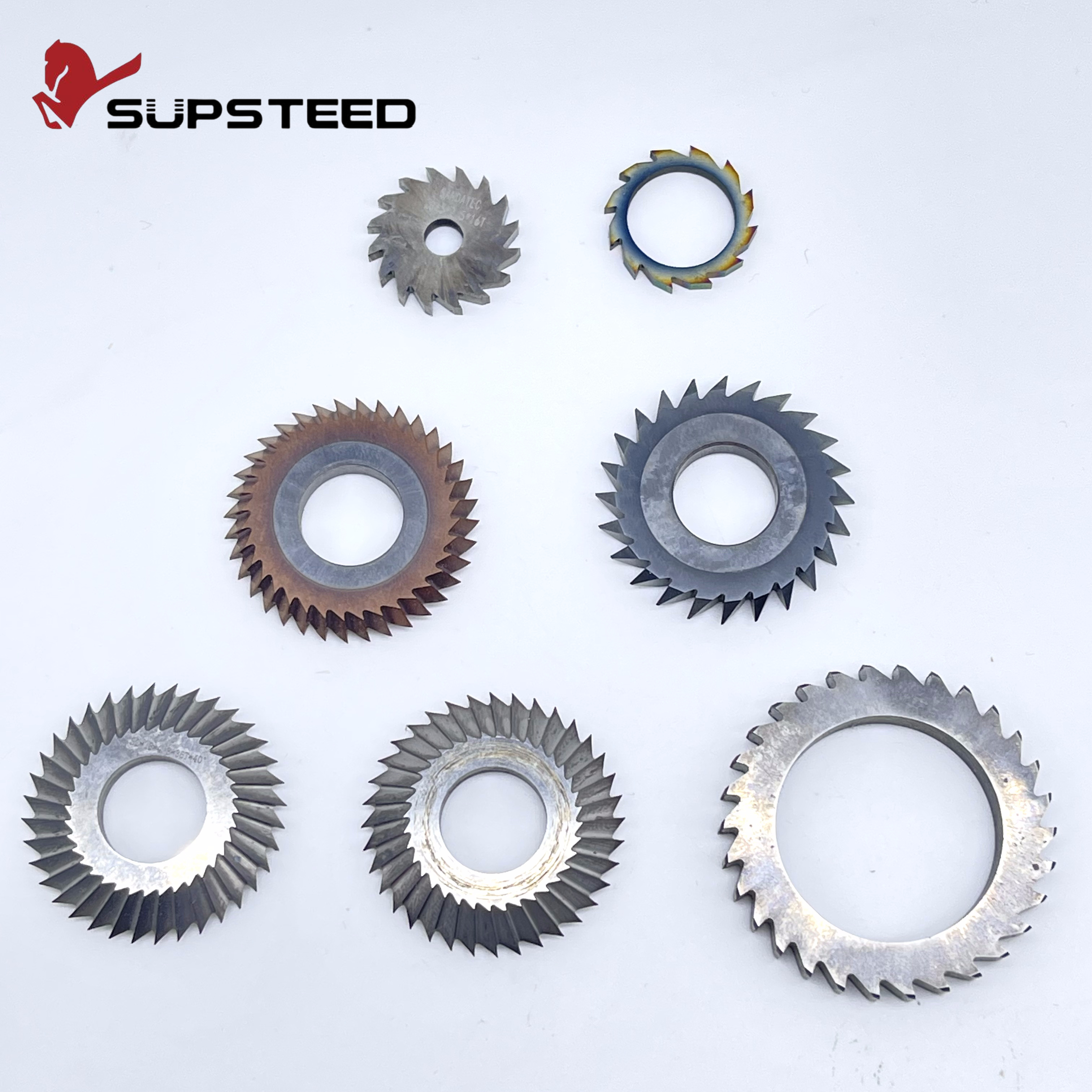
A carbide slitting saw is a highly specialized circular cutting tool ground from solid tungsten carbide blanks. Unlike standard end mills cutting on the bottom and sides, this tool features cutting teeth exclusively on its outer periphery. Driven by the CNC spindle via a heavy-duty arbor holder, it excels at parting off operations and cutting deep grooves inaccessible to shank-driven tools.
A critical design element is the dished profile. The sides of the blade feature a slight concave taper from the outer cutting edge toward the center mounting hole. This geometry provides essential side clearance. Only the peripheral cutting teeth contact the workpiece. Preventing the solid body of the saw from rubbing against the newly cut walls drastically reduces friction, heat generation, and the risk of binding.
True performance relies on matching exact specifications to your operational requirements. High-end industrial blades typically feature outer diameters ranging from 20mm to 100mm, with ultra-thin cutting widths starting as low as 0.2mm.
Tooth Count and Pitch: The number of teeth dictates chip load and evacuation speed. A coarse pitch creates larger gullets, making it ideal for deep slots or gummy materials like aluminum where chip clearance is vital. A fine pitch distributes cutting forces across more edges, reducing shock when machining thin-walled parts or hardened steels.
Rake Angles: The angle of the cutting face affects cutting pressure. Positive rake angles shear material cleanly for plastics and aluminum. Neutral or slightly negative rake angles provide the robust edge strength required for hardened alloys.
Thickness Tolerances: Precision cutters hold thickness tolerances down to 0.005mm. This exactness guarantees the final slot width meets strict aerospace specifications without requiring secondary finishing passes.
The manufacturing landscape is driving hard toward miniaturization. The medical device and aerospace sectors demand components that are smaller, lighter, and vastly more complex. Machine shops are constantly tasked with cutting incredibly narrow slots into exotic, high-strength alloys like Titanium Ti-6Al-4V and Inconel 718.
This shift has fundamentally disrupted tooling strategies. Relying on traditional steel tools to cut deep grooves in these tough materials is a losing battle against rapid tool wear and bloated cycle times. Adopting solid carbide circular blades with custom-engineered geometries is now standard operating procedure for top-tier shops. Facilities embracing these advanced cutting solutions are winning more bids. They hold tighter tolerances and dramatically reduce their cost-per-part on complex assemblies.
Solid carbide circular blades require a higher initial investment. Manufacturers must base their tooling decisions on objective criteria that guarantee a return on investment through improved efficiency.
Machine uptime is the ultimate metric for profitability in high-volume environments. Standard tools wear out quickly, forcing frequent machine stops for tool changes, offset adjustments, and first-article inspections. Solid carbide maintains its razor-sharp edge significantly longer. Shops can run massive batches with consistent dimensional accuracy. This effectively lowers the overall cost per part despite the higher upfront price tag.
Modern engineering demands materials notorious for poor machinability. Cutting aerospace-grade titanium, stainless steel, or abrasive composites generates immense heat at the cutting zone. Traditional steel tools soften and degrade rapidly. Solid carbide possesses superior red hardness and thermal resistance. It withstands extreme temperatures without losing structural integrity or deforming the cutting edge.
Physics dictates how deep a standard shank tool can cut before it snaps. When a blueprint demands a slot exceptionally deep relative to its width, such as a 1.0mm wide slot cut 15mm deep, an end mill simply cannot survive. Under these demanding conditions, an arbor-mounted thin slot cutter is the only practical solution. The massive core stability of the thick arbor supports the blade, allowing the circular teeth to reach extreme depths safely.
Selecting the right base material dictates your machining parameters. A direct comparison highlights why carbide dominates modern CNC floors.
Feature | High-Speed Steel | Solid Carbide |
|---|---|---|
Wear Resistance | Low to Moderate | Exceptionally High |
Thermal Stability | Poor under extreme heat | Excellent red hardness |
Vibration Tolerance | Forgiving and tough | Brittle, requires high rigidity |
Cutting Speeds | Slow feed rates required | Supports aggressive RPM and feeds |
Best Application | Manual mills, low-volume runs | Rigid CNCs, high-volume production |
High-Speed Steel remains a staple for older manual machines lacking structural rigidity. It absorbs shock and spindle backlash well. However, in modern CNC environments, HSS wears out rapidly on abrasive materials and flexes under heavy loads, destroying slot straightness.
Solid carbide is engineered for high-performance manufacturing. It runs at significantly higher surface speeds, slashing cycle times. The inherent stiffness prevents tool flex, resulting in perfectly straight slots. The only drawback is its brittleness. Carbide demands a highly rigid setup, tight workholding, and precision arbors to prevent the teeth from micro-chipping.
Buying premium tooling is only half the battle. Flawless implementation on the machine floor maximizes tool life and part quality.
A circular saw is only as good as the arbor holding it. Mount the blade as close to the machine spindle as part clearance allows. Long arbor overhangs act as a lever, amplifying vibration and destroying tool life.
Minimizing axial runout is absolutely critical. Operators must meticulously clean the arbor, mounting spacers, and the blade before assembly. A microscopic piece of debris causing 0.02mm of wobble forces the saw to cut an oversized slot. This places uneven, destructive stress on the teeth and leads to premature failure. Always utilize clean, precision-ground arbors.
Milling direction dictates tool longevity. Climb milling is the preferred method in rigid CNC setups. The tooth engages the material at maximum chip thickness and exits at zero thickness. This dynamic directs cutting forces downward into the fixture, transfers heat into the chip, and reduces work hardening. Conventional milling should only be used if the machine suffers from excessive backlash.
Calculating the exact chip load per tooth is vital. A precision saw cutter can feature anywhere from 20 to over 100 teeth. Feeds and speeds must be calculated based on the specific tooth count. Feeding too slowly causes the tool to rub and dull. Feeding too fast overloads the gullets and snaps the teeth.
Trapped chips are the enemy of slotting. If chips remain in a deep groove, the blade recuts them, causing immediate binding. For aluminum and stainless steels, direct high-pressure, high-volume liquid coolant directly into the slot. This flushes chips out and provides necessary lubricity. When machining cast iron or hardened tool steel, a strong, continuous high-pressure air blast is far more effective. Air blast clears chips rapidly without subjecting hot carbide teeth to sudden temperature drops, preventing thermal shock and micro-fractures.
Knowing exactly how to specify your tooling saves significant time and money.
Standard catalog blades are manufactured in nominal fractional or metric thicknesses. If your part falls within these tolerances, off-the-shelf tools are highly cost-effective. Modern proprietary designs frequently require non-standard slot widths, specific corner radii, or combined profile geometries.
Partnering with specialized tool manufacturers ensures the cutter matches your exact application flawlessly. Custom slotting tools eliminate the need for taking multiple step-over passes to achieve a specific width, improving part consistency and massively reducing cycle times.
Provide your tool manufacturer with precise data to engineer a successful custom tool. Follow this standard selection guide.
Material Data: Specify the exact material grade and hardness condition, such as 4140 Steel at HRC 32.
Slot Dimensions: Detail the nominal width, maximum depth of cut, and acceptable tolerance ranges.
Machine Capabilities: Share your maximum spindle RPM, available coolant delivery systems, and the specific arbor interface utilized on your floor.
Cutting thin slots does not have to be a constant bottleneck. Standard tools lead to operator frustration, scrapped parts, and broken cutters. Investing in purpose-built engineering changes the machining dynamic entirely. Upgrading to solid carbide circular blades provides the rigidity, thermal resistance, and precision required to conquer deep, narrow grooves. Whether profiling aerospace alloys or running high-volume aluminum extrusions, selecting the right cutter lowers your cost per part and elevates your manufacturing capabilities. If you are ready to eliminate tool breakage and optimize your slotting operations, explore the engineered solutions at SS End Mill. Our custom and standard carbide cutting tools are designed to meet your exact specifications and drive your production forward.
A carbide slitting saw cuts using its outer periphery and is supported by a thick, robust arbor. This offers significantly more rigidity than a fragile micro-end mill. This architectural advantage allows for cutting much deeper and narrower slots without the tool deflecting, rubbing, or snapping under lateral pressure.
High-precision solid carbide slitting saws can be manufactured with cutting widths as thin as 0.15mm to 0.20mm, depending on the outer diameter of the blade. These ultra-thin tools require exceptionally rigid arbors and zero-runout setups to function without breaking.
While technically possible, it requires extreme caution and is not recommended. Solid carbide is inherently brittle. Manual machines often suffer from spindle backlash and lack structural rigidity, which easily causes the carbide teeth to chip or shatter during interrupted cuts. They belong in highly rigid CNC environments.
Tooth count depends on chip formation. Soft, gummy materials like aluminum require fewer teeth and larger gullets to evacuate chips quickly without packing. Hard materials like titanium or tool steel require a higher tooth count to distribute the cutting forces across more edges, reducing the shock on any single tooth.
Binding is almost always caused by poor chip evacuation or thermal expansion. Ensure you use adequate high-pressure coolant or a strong air blast to physically flush chips out of the deep groove. Utilizing a saw featuring concave sides prevents the solid tool body from generating friction against the newly cut slot walls.
Yes, particularly for high-volume production runs or when machining difficult aerospace materials. A custom tool designed specifically for your exact slot width eliminates the need for taking multiple step-over passes. This drastically reduces cycle times, meaning the tool pays for itself quickly through increased daily productivity.
Slotting tools are designed to cut a groove to a precise depth within a workpiece without severing it. Parting tools are designed to cut entirely through a piece of material to separate it from the main stock. Many precision circular cutters can perform both operations effectively depending on the toolpath setup.