Please Choose Your Language
- All
- Product Name
- Product Keyword
- Product Model
- Product Summary
- Product Description
- Multi Field Search

Views: 0 Author: Site Editor Publish Time: 2026-09-17 Origin: Site

Choosing the right flute count makes or breaks your hard milling operation. It directly dictates core thickness, chip evacuation space, and permissible feed rates. When cutting ultra-hard alloys, structural rigidity always beats aggressive material removal. You cannot simply push a tool through HRC65 steel. You must engineer the cut.
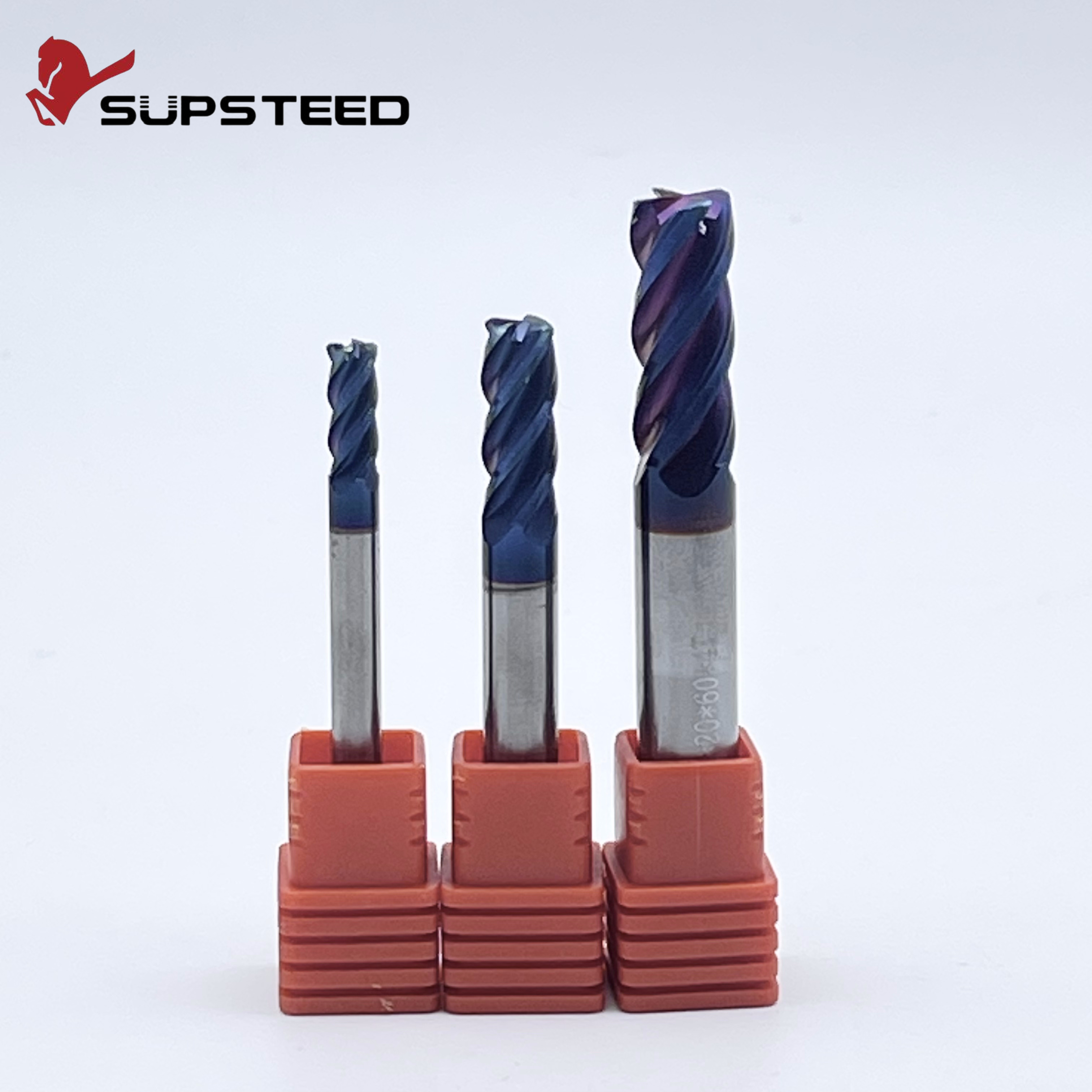
A 4-flute configuration serves as the baseline for hard milling. This design offers a calculated balance between core strength and chip gullet capacity. When performing slotting operations or plunging into hardened materials, a 4-flute carbide end mill provides crucial room for chip evacuation. This extra space minimizes the risk of chip recutting. Recutting is a dangerous scenario that triggers sudden spikes in cutting temperatures and destroys the cutting edge prematurely. However, the core remains marginally thinner than a multi-flute tool. Operators must carefully manage the axial depth of cut to prevent unwanted tool deflection.
In contrast, 6-flute to 8-flute configurations become the industry standard for side milling, profiling, and finishing passes on HRC65 steel. Increasing the flute count significantly expands the core diameter. This maximizes cross-sectional strength. This inherent rigidity practically eliminates tool deflection. It ensures strict dimensional tolerances remain intact even under heavy lateral loads. Furthermore, higher flute counts allow for an increased overall machine feed rate while maintaining a low and safe chip load per tooth. Ultimately, this translates to superior mirror-like surface finishes. It frequently bypasses the need for secondary grinding operations entirely.
Feature | 4-Flute End Mills | 6 to 8-Flute End Mills |
|---|---|---|
Core Rigidity | Moderate to High | Maximum |
Chip Evacuation | Excellent for slotting | Limited strictly for profiling |
Surface Finish | Good | Mirror-like finish |
Best Application | Roughing and slotting | High-speed finishing and side milling |
Modern manufacturing is experiencing a massive shift toward dry machining and direct hard milling. Historically, shops machined parts in a soft state and sent them out for heat treatment. This traditional workflow introduced unpredictable metal warpage and added weeks to lead times. Today, modern supply chains demand faster turnarounds. Engineers are completely altering traditional workflows by machining parts directly in their fully hardened state.
This evolution places immense pressure on tooling technology. We are seeing a rapid market drive toward hyper-specialized geometries capable of predictable wear in fully automated environments. The integration of ultra-fine 0.6-micron nano-grain carbide substrates paired with advanced silicon-based coatings allows tools to survive temperatures exceeding 1200 degrees Celsius. This technological leap enables lights-out manufacturing cells to reliably cut HRC65 materials without constant operator intervention.
The ability to accurately cut hardened steel unlocks massive commercial value. It reduces scrap rates and drastically shortens production cycles in high-stakes industries.
Imagine carving a complex cavity into a block of D2 tool steel already hardened to 62 HRC. In the past, this required tedious electrical discharge machining or slow grinding processes. Today, utilizing specialized mold machining tools allows manufacturers to directly mill pre-hardened tool steel. This direct hard-milling approach ensures absolute dimensional fidelity. It maintains sharp corner radii and delivers exceptional surface finishes. It drastically reduces total lead times for complex injection molds and stamping dies.
Both the aerospace and automotive sectors rely heavily on ultra-hard alloys for critical load-bearing components. Transmission gears, drive shafts, turbine components, and specialized fasteners are routinely hardened to resist extreme wear over millions of cycles. Machining these finished components requires tools that can endure punishing mechanical stress. High-hardness rated end mills provide the predictable tool life required for continuous production runs typical in these zero-failure industries.
Even with premium tooling and meticulous setup, variables in the machining environment cause suboptimal performance. Documenting and analyzing tool wear patterns is crucial for process optimization. When things go wrong on the shop floor, operators must diagnose the root cause objectively rather than simply swapping out a broken tool for a new one.
Catastrophic Breakage: You hit cycle start, and within seconds, a sharp popping sound echoes through the shop. The tool just snapped at the shank. This is almost always caused by excessive spindle runout, unstable workholding, or an overly aggressive depth of cut. To correct this, verify your collet runout is below 0.005mm using shrink-fit chucks and immediately decrease the axial depth of cut.
Edge Chipping: Notice micro-fractures along the cutting edge under a loupe? You are likely experiencing thermal shock from liquid coolant, machine chatter, or an excessive feed per tooth. Switch immediately to a high-pressure air blast. Implement variable helix tools to disrupt harmonic vibrations and lower your feed rate.
Rapid Flank Wear: Smooth and accelerated wear on the tool flank indicates the cutting temperature is simply too high for the substrate. Reduce your surface speed to lower heat generation. Ensure you are utilizing a genuine AlTiN coated end mill rather than uncoated or standard titanium nitride coated carbide.
Built-Up Edge: If workpiece material is welding itself to the cutting flute, your cutting temperature might actually be too low, or chip evacuation is inadequate. Increase the cutting speed slightly to generate proper shearing heat. Verify your air blast is effectively clearing chips from the cutting zone.
Procuring the correct tooling for HRC65 steel requires a systematic metallurgical evaluation. Do not rely on basic dimensional specs. Procurement engineers and CNC programmers must prioritize tools manufactured from ultra-fine nano-grain carbide substrates. These specific substrates provide the exact ratio of hardness to transverse rupture strength needed to resist sudden chipping under heavy loads.
Specifically, look for heat-resistant PVD coatings like AlTiN or TiSiN. These are non-negotiable for thermal shielding during dry machining. Furthermore, a rigid geometry featuring a thick core and negative rake angles ensures the cutting edge survives the brutal initial impact with the workpiece. Incorporating corner radius designs, ranging from R0.5 to R2.0, significantly reinforces the weakest point of the tool and extends operational life.
Finding a consistent and technically proficient tooling supplier is vital for maintaining predictable production schedules. If your operations require premium-grade tooling engineered to withstand extreme hardness profiles, evaluating a professional-grade hard steel cutter is a logical next step. Selecting properly calibrated cutting tools ensures your CNC metrics remain stable. This minimizes scrapped parts and drastically reduces the overall cost-per-part.
Successfully milling HRC65 steel does not have to be a nightmare of shattered tools and ruined tolerances. By approaching the process with a clear understanding of cutting mechanics, you can master hard milling. Selecting the correct carbide substrate, leveraging advanced heat-resistant coatings, and utilizing rigid tool geometries are the foundational pillars of success.
Investing in high-quality HRC65 end mills upfront inevitably saves money on machine downtime and replacement tools. Take the time to review your current tooling setup. Transition from liquid coolant to high-pressure air-blast cooling. Upgrade your end mills to specialized hard-milling geometries for your next high-hardness project. For reliable tooling solutions engineered for extreme materials, explore the high-performance selections available at ssendmill.com.
No. Standard carbide lacks the specific micro-grain structure, rigid core geometry, and advanced heat-resistant coatings required for extreme hardness. It will chip, dull, or break almost immediately under the immense cutting forces generated by HRC65 steel.
An AlTiN or TiSiN coating is highly recommended. These specific coatings thrive in high-heat environments. During the cutting process, they form a microscopic layer of aluminum oxide that insulates the vulnerable carbide core from the intense temperatures generated during hard milling.
Generally, no. Liquid coolant causes severe thermal shock in hard milling applications. When cold coolant hits a superheated carbide tool, it creates rapid expansion and contraction. This leads to micro-cracking and chipping on the cutting edge. High-pressure compressed air blast is the safest and most effective method for clearing chips and managing heat.
For hard milling, 4-flute, 6-flute, or even 8-flute end mills are ideal depending on the operation. While 4-flute tools are acceptable for slotting, higher flute counts provide a much thicker and stronger tool core. This allows for better surface finishes, reduced deflection, and tighter dimensional accuracy in hardened materials.
To avoid heat-treatment distortion, modern molds and dies are often machined directly from blocks of steel that have already been hardened to HRC60 or higher. Specialized tools are specifically engineered to hold incredibly tight tolerances and provide excellent surface finishes in this hard state without wearing out prematurely. This eliminates the need for slow secondary electrical discharge machining processes.
Surface speeds must remain conservative to control heat generation. Typically, cutting speeds between 30 to 50 meters per minute are optimal for HRC65. Pair this conservative speed with a low chip load per tooth to prevent rapid flank wear and ensure a stable cutting process.
Tool runout is the ultimate enemy of hard milling. Even a minimal runout of 0.01mm causes an uneven chip load across the flutes. In ultra-hard materials, this uneven force instantly causes micro-chipping on the overworked flute. Always aim for a total indicated runout below 0.005mm by utilizing high-precision tool holders like shrink-fit or hydraulic chucks.