Please Choose Your Language
- All
- Product Name
- Product Keyword
- Product Model
- Product Summary
- Product Description
- Multi Field Search

Views: 0 Author: Site Editor Publish Time: 2026-09-17 Origin: Site

In high-volume production machining, seconds matter. Scrapped parts drain profitability instantly. Walk onto any busy shop floor, and you will find that one of the most critical and frequently challenging operations is creating internal threads. Choosing the wrong threading solution often leads to sudden tool breakage, compromised thread quality, and agonizing machine downtime.
Ultimately, selecting the right equipment depends heavily on workpiece material, spindle rigidity, and overall production volume. This comprehensive guide breaks down the empirical differences between High-Speed Steel and solid carbide substrates. The goal is to help machinists and procurement teams make confident, data-driven decisions that keep spindles turning.
Foundation of Success: The reliability of any threaded feature depends entirely on the precision of the pre-drilled hole and the specific cutting geometry applied.
HSS Taps: These provide essential flexibility and toughness. They remain highly cost-effective for general applications and environments where spindle rigidity is less than optimal.
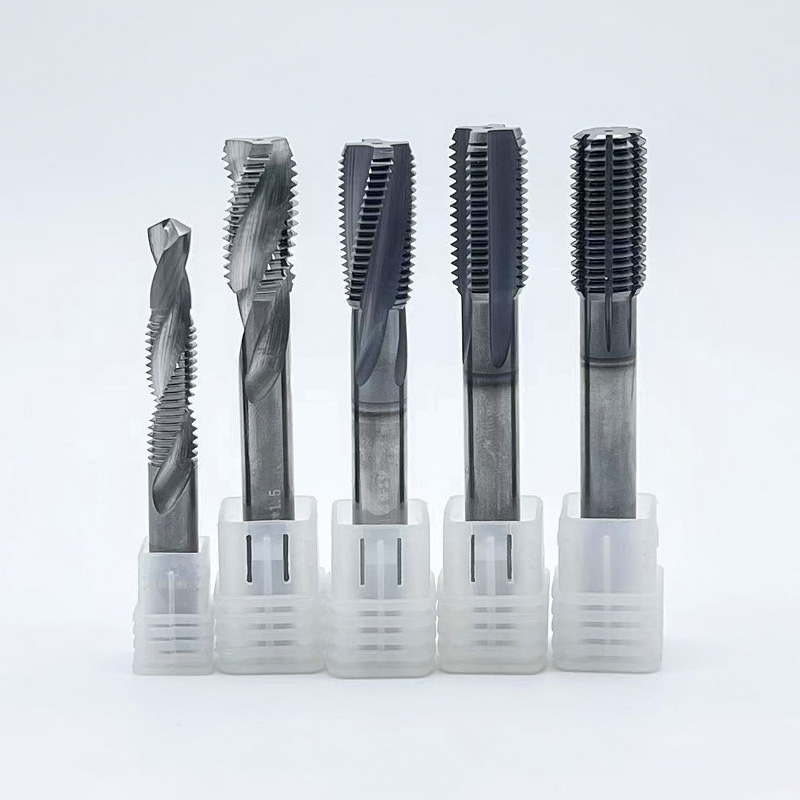
Carbide Taps: Delivering exceptional heat tolerance and wear resistance, solid carbide is the premier choice for abrasive materials and high-speed automated environments.
Cost-Per-Part Economics: While premium cutting assets require a higher initial investment, their vastly extended lifespan significantly reduces the cost-per-part during continuous production runs.
Rigidity Requirements: Carbide demands strict machine rigidity and precise alignment. Conversely, steel variants tolerate slight misalignments without immediate catastrophic failure.
The manufacturing landscape is undergoing a massive shift toward fully automated, lights-out machining. As skilled labor becomes scarcer, job shops and massive production facilities alike rely heavily on robotics and automated pallet pools. In these environments, process reliability is paramount. You simply cannot afford an unexpected tool breakage during an unattended night shift.
Simultaneously, the rise of the electric vehicle and advanced aerospace sectors has introduced tougher, more abrasive alloys to the standard production cycle. High-silicon aluminum and heat-resistant superalloys demand tooling that can withstand extreme thermal cycles and aggressive feed rates. Consequently, the industry is moving away from treating cutting implements as disposable commodities. Data-driven procurement now prioritizes predictable tool life and process stability over the lowest initial catalog price.
In the sequence of precision manufacturing, cutting a thread is frequently the absolute final operation performed on a workpiece. Imagine a complex aerospace manifold block. By the time the part reaches this stage, it has already accumulated thousands of dollars in milling, turning, and drilling value. If a tap shatters inside a blind cavity, extracting it is notoriously difficult. This nightmare scenario often results in a completely scrapped component and hours of lost production time.
Consequently, the success of internal threading tools is inextricably linked to the preceding operations. The primary drilling phase dictates the exact core diameter of the cavity. If the initial drill yields a dimension that is even slightly undersized, the torque load on the subsequent cutting edge spikes exponentially. This triggers premature edge degradation or sudden snapping.
Machinists can no longer rely on universal, one-size-fits-all cutters. They must meticulously match their implements to the exact metallurgical properties of the alloy and the dynamic capabilities of their machining centers.
High-Speed Steel has served as the foundational standard in metalworking for decades. In contemporary production facilities, standard steel is frequently upgraded to HSSE which incorporates cobalt, or PM-HSS which utilizes powder metallurgy. These advanced variations significantly enhance thermal resistance and structural uniformity while retaining the core ductile benefits of traditional steel.
From a practical standpoint, the primary advantage of HSS taps is their inherent toughness and high modulus of elasticity. Unlike extremely rigid composites, steel can flex microscopically under lateral stress without fracturing. This characteristic makes it exceptionally forgiving in setups lacking perfect rigidity. For instance, older equipment plagued by minor spindle runout or operations utilizing floating tension-compression holders pair perfectly with steel substrates.
In addition, the lower initial purchase price makes steel an attractive, low-risk option for job shops managing low-volume orders or rapid prototyping. However, these tools possess objective limitations. They exhibit lower thermal resistance compared to advanced composites, meaning they cannot sustain the ultra-high surface speeds demanded by aggressive mass manufacturing. They truly excel when processing tough, stringy materials like austenitic stainless steels, where the cutting edge must remain razor-sharp to shear the metal cleanly without inducing work-hardening.
Solid carbide is engineered from a composite of tungsten particles bonded with a cobalt matrix. This specific metallurgical structure yields a cutting asset that behaves fundamentally differently from steel regarding hardness, thermal stability, and operational dynamics.
The most profound advantage of carbide taps is their extreme hardness and unparalleled wear resistance. When machining highly abrasive materials like high-silicon aluminum or cast iron, a solid carbide tool can outlast its steel equivalent by a staggering margin. It often completes thousands of cycles before showing measurable flank wear.
Specifically, its high-temperature tolerance permits drastically increased spindle speeds. Running faster directly slashes cycle times, which remains a critical performance metric in high-volume environments. The sheer stiffness of the material also ensures minimal deflection, yielding exceptionally clean threads with mirror-like surface finishes. Despite these impressive benefits, carbide is not universally applicable. Its extreme hardness introduces severe brittleness. These tools possess virtually zero flexibility. Any lateral vibration, improper chip evacuation, or misalignment during the reversing cycle will cause the flute to shatter instantly.
To make an informed purchasing decision, production engineers must evaluate both substrates across several empirical performance metrics on the shop floor. Below is a practical breakdown to guide your tooling strategy.
Performance Metric | HSS / PM-HSS | Solid Carbide |
|---|---|---|
Wear Resistance | Moderate to High | Exceptional |
Tool Toughness | High flex tolerance | Brittle, zero flex |
Cutting Speed | Standard | 3x to 5x faster than steel |
Machine Rigidity Needed | Forgiving | Absolute rigidity required |
Ideal Applications | Low-volume, stringy alloys | High-volume, abrasive materials |
Selecting the optimal solution involves analyzing the specific variables of the job at hand. A systematic evaluation prevents costly catastrophic failures. Moving away from abstract concepts, here is how you match precision thread tools to actual shop floor conditions.
Metallurgical properties heavily influence selection. Soft, gummy alloys like pure titanium tend to adhere to the cutting edge, creating a condition known as built-up edge. In these instances, highly polished steel often performs better due to its sharper geometry. On the other hand, materials that produce short, powdery chips or contain abrasive elements will rapidly degrade steel. For hardened steels up to HRC55 or cast iron, advanced carbide composites coated with TiAlN are the only mathematically viable option.
The geometry of the cavity dictates the necessary chip evacuation strategy. Through-holes typically require Spiral Point geometries, which push the chips forward and out the bottom of the part. Blind cavities require Spiral Flute designs to draw chips upward toward the spindle. Because brittle materials cannot tolerate chip packing, proper flute selection is critical to prevent jamming.
Volume dictates the overarching economic strategy. High-mix, low-volume job shops frequently change setups. Here, the versatility and lower upfront cost of steel provide financial safety. Low-mix, high-volume facilities running continuous shifts benefit immensely from the speed and longevity of carbide. If a premium steel tool costs $30 and safely completes 500 cycles, the cost per hole is $0.06. If a solid carbide equivalent commands $150 but completes 5,000 cycles, the cost per hole plummets to $0.03. In mass production, the more expensive tool delivers a demonstrably higher return on investment.
Even the most advanced CNC tapping setups will underperform if the surrounding machining ecosystem is neglected. A holistic approach to the machining environment is required.
This metal removal process generates extreme friction and localized heat. Proper lubrication is absolutely non-negotiable. Standard flood coolant often fails to reach the cutting zone in deep blind cavities. Utilizing through-coolant designs where high-pressure fluid is forced down through the center of the tool evacuates chips efficiently and prevents thermal shock. Additionally, maintaining coolant concentration at 10 to 12 percent specifically enhances lubricity, drastically reducing friction-induced wear.
As established, the cutter is only as effective as the cavity it enters. Utilizing premium quality solid carbide drills ensures the bore is perfectly cylindrical and sized to the exact minor diameter required. A drill that cuts oversize or leaves a work-hardened surface will immediately compromise the subsequent threading operation.
Runout is the enemy of thread quality. For rigid composites, precision collet chucks or specialized synchronized chucks with micro-compensation are highly recommended. These advanced holders absorb microscopic thrust variations during the spindle reversal phase, protecting brittle edges from micro-chipping and ensuring Total Indicator Runout remains near zero.
In modern manufacturing, purchasing cheap, unverified tooling is a documented false economy. The initial savings on a low-cost cutter are instantly erased by the cost of a single scrapped medical component. You must also factor in the hourly burden rate of machine downtime while an operator attempts a manual extraction.
Investing in top-tier precision tools ensures dimensional stability and process repeatability. High-quality variants are manufactured with strict tolerances regarding pitch, relief angles, and advanced PVD coatings. These engineered features reduce scrap rates, minimize manual operator intervention, and ensure every feature passes strict quality control gauge inspections.
When evaluating solutions, there is no universal answer. High-speed steel remains the undisputed champion of versatility, toughness, and low-volume economic efficiency. It forgives older machinery and handles difficult, stringy alloys with ease. In contrast, solid carbide stands as the king of speed, longevity, and high-volume mass production. By carefully analyzing your specific material, volume, and equipment capabilities, you can confidently select the right assets to maximize your manufacturing profitability. For a comprehensive range of proven industrial solutions, exploring the specialized catalog at SS Endmill ensures you match the perfect geometry and substrate to your exact production needs.
It is generally not recommended unless the machine has been meticulously maintained to ensure minimal spindle runout. Solid carbide is extremely hard, which makes it inherently brittle. Older equipment often suffers from spindle wear, excessive vibration, or mechanical backlash in the Z-axis. Because the material cannot flex, any slight misalignment or chatter will likely cause it to snap instantly. If your machine requires a floating holder to compensate for synchronization errors, you should stick to premium steel variants.
Thread milling and tapping serve different operational needs. Thread mills offer incredible versatility for complex operations, allowing a single cutter to produce various diameters and machine right to the bottom of a blind cavity. They are also much safer for extremely expensive aerospace parts. If a thread mill breaks, it does not jam in the hole. However, for standard sizes in high-volume environments, tapping is significantly faster, creating the entire profile in a single pass. If minimizing cycle time is your primary metric, traditional tapping remains the most efficient choice.
The fundamental difference lies in how the profile is generated. Cutting taps feature flutes and sharp edges that physically remove material, generating metal chips that must be carefully evacuated. Forming taps, also known as roll taps, have no flutes. Instead, they utilize a polygonal lobed geometry to displace and cold-form the metal. Because they do not cut, they produce zero chips, making them incredibly reliable for deep blind cavities. However, forming requires a very precise pre-drilled diameter and can only be used in ductile materials like aluminum, brass, or low-carbon steel.
Breakage is highly preventable through strict process control. First, ensure your pre-drilled hole is the exact correct diameter. An undersized bore drastically increases the torque load. Second, optimize your coolant strategy by ensuring the concentration is high enough to provide adequate lubricity. Third, address chip evacuation immediately by using spiral flute designs for blind cavities to pull chips upward, preventing packing at the bottom. Finally, ensure your workpiece is securely clamped to eliminate microscopic movement during the machining cycle.
Oversized threads are typically caused by a combination of spindle runout and improper chip evacuation. If the tool holder is worn or the spindle is out of alignment, the tool will wobble as it enters the hole, cutting a larger pitch diameter than intended. Additionally, if chips pack into the flutes instead of evacuating properly, they can score the walls of the thread and push the tool off-center. Always verify your Total Indicator Runout and ensure you are using the correct pre-drill size before adjusting your cutting parameters.
The pre-drilled hole size, or minor diameter, is critical for achieving the correct thread percentage. For metric threads, a simple and highly effective formula is to subtract the pitch from the nominal major diameter. For example, an M8 x 1.25 thread requires a 6.75mm drill. For unified threads, subtract the pitch from the major diameter. Always consult standard drill charts provided by your tooling manufacturer, as forming operations require a slightly larger starting hole than cutting operations.