Please Choose Your Language
- All
- Product Name
- Product Keyword
- Product Model
- Product Summary
- Product Description
- Multi Field Search

Views: 0 Author: Site Editor Publish Time: 2026-09-21 Origin: Site

Listen to the sound of a standard end mill hogging out tough alloys. That high-pitched scream is not just noise. It is the sound of your spindle bearings degrading. Traditional cutters often overheat, wear prematurely, and snap with zero warning during aggressive passes. The result is always the same: scrapped billets and thousands of dollars in shop downtime.
Upgrading your tooling arsenal is the most direct path to preventing these manufacturing disasters. In the roughing phase, your primary goal is never a mirror finish. It is pure volumetric efficiency. This comprehensive guide breaks down how specialized geometries fundamentally alter cutting dynamics to protect your equipment and boost profitability.
Serrated profiles fracture chips into smaller fragments, completely eliminating recutting and catastrophic tool breakage.
The unique knuckle-like geometry of a purpose-built cutter reduces radial cutting forces, paving the way for significantly deeper and faster passes.
Solid carbide substrates deliver superior heat resistance, rigidity, and operational longevity when compared to traditional high-speed steel alternatives.
Allocating budget toward specialized tooling directly multiplies material removal rates, transforming the overall production capacity of a shop floor.
General-purpose cutters simply cannot survive the rigorous demands of aerospace or heavy industrial hogging. Removing metal as quickly and safely as possible requires cutting tools engineered specifically to endure extreme mechanical stress and intense thermal loads.
The fundamental divide between a standard finishing tool and a heavy-duty rougher lies entirely in the cutting edge geometry. Standard end mills feature continuous and smooth cutting edges. While this pristine design is absolutely necessary for achieving tight dimensional tolerances, it becomes a severe liability during heavy roughing.
Smooth edges shear the material into long continuous stringers. These stringers quickly pack into the tool flutes. Picture a deep pocketing operation. When stringy chips cannot evacuate the confined cutting zone, the tool aggressively recuts them. This immediate friction spikes the temperature, causes built-up edge, and inevitably leads to tool failure. Conversely, specialized roughing end mills feature wavy and interrupted edges that prioritize rapid chip evacuation over surface aesthetics.
What makes a cutter truly heavy-duty? A reinforced core diameter is the primary indicator. A thicker core provides the absolute structural integrity needed to resist deflection under extreme side loads. Beyond the core, the flute gullets are meticulously designed to channel high volumes of metal away from the workpiece instantly. This synergy ensures the cutter absorbs immense mechanical shock without fracturing.
To fully grasp why these specialized tools outperform standard options, we must examine the physical interaction happening at the micro-level between the tool geometry and the raw material.
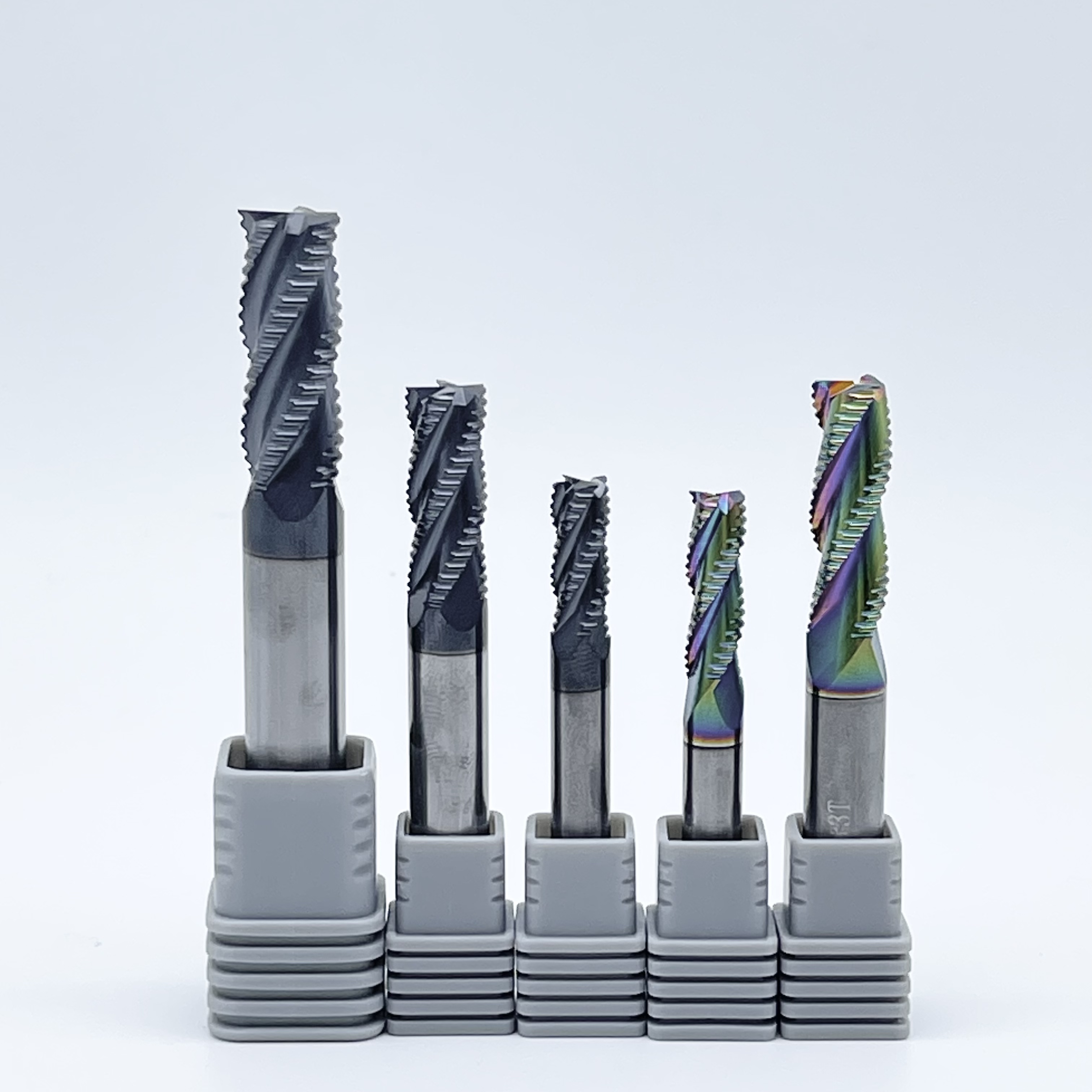
The defining visual feature of a serrated end mill is its knuckle-like profile. Machinists affectionately refer to this as a corn cob design. Unlike a straight edge that engages the metal along its entire length simultaneously, these serrations consist of alternating peaks and valleys.
As the spindle rotates and feeds into the billet, only the peaks of the serrations bite into the material at any given microsecond. Because these serrations are staggered from one flute to the next, the subsequent flute shears away the material left behind by the valleys of the previous one. Specifically, this staggered engagement drastically reduces the total contact area. It drops the spindle load and minimizes friction.
Reliable chip control is the most critical factor in continuous unattended machining. If long chips wrap around the tool holder during a lights-out shift, the machine will crash. The serrations intentionally interrupt the cutting profile, forcing the chip to fracture exactly where the valley occurs. Instead of hazardous ribbons, the tool produces tiny granular chips that resemble coarse sand. These discrete fragments are incredibly easy to flush out of deep cavities using standard coolant pressure or compressed air.
The manufacturing sector is aggressively shifting toward lights-out automation and smart factories. Tooling technology is evolving rapidly to keep pace. Recent market analyses highlight a definitive pivot away from generic cutting tools toward application-specific geometries.
The aerospace, electric vehicle, and medical sectors increasingly rely on heat-resistant superalloys like Inconel and specialized titanium composites. Machining these demanding materials with traditional end mills is no longer economically viable due to unpredictable tool life. Modern shops cannot afford unexpected tool breakage when operators are away from the control panel. Consequently, the adoption of specialized roughing geometries has surged. This trend is driven entirely by the operational necessity for predictable tool life, thermal stability, and flawless chip control in extreme environments.
Procurement managers and CNC programmers must justify higher initial tooling costs through measurable operational improvements. Transitioning to serrated cutting geometries offers distinct advantages that directly impact the bottom line.
Achieving sustained high material removal is the ultimate metric of roughing efficiency. Because the staggered engagement of a serrated tool reduces overall cutting forces by up to 20 percent, machinists are empowered to push the boundaries of their equipment. Lower cutting pressure means the machine draws significantly less horsepower per cubic inch of metal removed. Programmers can confidently increase feed rates, take deeper axial cuts that utilize the entire flute length, and widen radial step-overs.
In addition, these tools drastically reduce machine vibration. Chatter is a destructive self-exciting vibration that occurs when the harmonic frequency of the cutting process matches the resonant frequency of the machine tool. It destroys carbide edges, damages delicate spindle bearings, and ruins the part. The irregular cutting action of a serrated edge acts as a mechanical dampener. It constantly disrupts harmonic frequencies before they can build into resonance. This stabilizing effect protects your expensive CNC machinery.
Furthermore, heat dissipation improves dramatically. In optimal metal cutting, approximately 80 percent of the generated heat should transfer into the chip. When standard tools create long chips that loiter in the cutting zone, that intense heat transfers backward into the solid carbide. Because serrated tools fracture chips instantly, those small fragments evacuate away from the cut zone in milliseconds. This rapid evacuation literally carries the heat away before it can soak into the workpiece.
High-speed steel tools were once the backbone of the industry. Today, modern CNC machining demands substrates that withstand extreme speeds and blistering temperatures.
Manufactured from a dense composite of tungsten carbide particles bonded with a cobalt binder, carbide roughing tools possess a stiffness nearly three times that of high-speed steel. This extreme rigidity ensures the tool resists bending and deflection under heavy side loads. High-speed steel begins to soften and lose its cutting edge at around 600 degrees Celsius. Solid carbide maintains its structural integrity at temperatures exceeding 900 degrees Celsius.
Let us look at a direct technical comparison to understand the performance gap:
Feature | Solid Carbide Roughing End Mill | Traditional High-Speed Steel End Mill |
|---|---|---|
Heat Resistance | Maintains hardness over 900 degrees Celsius | Rapidly softens around 600 degrees Celsius |
Rigidity and Deflection | Extremely rigid core, minimal deflection | Highly prone to bending under heavy side loads |
Tool Life Expectancy | 3 to 5 times longer in tough superalloys | Rapid edge wear in abrasive materials |
Operational Speed | Operates at highly elevated spindle speeds | Strictly limited to slower surface speeds |
The physical geometry of the cutter is only half the performance equation. Advanced Physical Vapor Deposition coatings, such as Aluminum Titanium Nitride, synergize perfectly with serrated edges. Under the extreme heat of roughing, these coatings form a microscopic protective layer of aluminum oxide on the tool surface. This acts as a highly effective thermal barrier, reflecting heat back into the chip and providing incredible oxidation resistance.
Selecting the correct heavy milling cutter requires a careful analysis of specific material properties and machine capabilities on your shop floor.
First, evaluate the flute count. For softer gummy materials like aluminum, a 3-flute design is required to provide massive gullets for evacuating large volumes of material. For harder alloys like steel, titanium, or cast iron, 4 to 6 flutes are preferred. Higher flute counts increase the core strength and allow for faster feed rates.
Next, look at the pitch profile. Pitch refers to the distance between the serrations. A coarse pitch creates larger chips and is utilized for softer materials to prevent clogging. In contrast, a fine pitch creates smaller chips and distributes cutting forces more evenly. This makes a fine pitch strictly necessary for harder abrasive alloys where tool stability is paramount.
When transitioning from a standard end mill to a serrated rougher, you must adjust your programming parameters. Because the serrated profile induces a chip-thinning effect, the actual chip thickness is often less than the programmed feed. You must increase the feed per tooth to ensure the tool is actually shearing the metal rather than just rubbing against it. Rubbing generates excessive heat and causes premature wear. A standard rule of thumb is to increase your feed rate by 15 to 25 percent compared to a standard end mill. Combine this with a massive axial depth of cut while keeping the radial step-over moderate.
Mastering aggressive metal removal requires moving away from the limitations of standard tools and fully embracing the engineering behind serrated end mills. Specialized carbide roughers carry a slightly higher upfront procurement cost. However, the hours saved in cycle times and the drastic reduction in catastrophic tool failures result in massive operational cost savings.
Evaluate your current roughing processes, identify your machining bottlenecks, and consult with tooling experts. By upgrading your tooling inventory to include application-specific geometries today, you can protect your spindles, run unattended shifts with confidence, and fundamentally improve your shop efficiency. Ready to push your CNC machines to their true potential? Browse the high-performance selection at SS End Mill to find the exact serrated roughing tools engineered for your toughest materials.
No, roughing end mills leave a visible ridged finish on the workpiece due to the serrated peaks and valleys. A separate standard finishing tool with a smooth continuous cutting edge must be used for the final pass to achieve the required surface roughness specifications and tight dimensional tolerances.
Coarse pitch cutters are used for softer gummy materials like aluminum to allow for maximum chip clearance and highly aggressive feed rates. Fine pitch cutters are engineered for harder abrasive materials like tool steel and titanium to distribute cutting forces evenly across the tool, preventing edge chipping and improving overall stability.
Because these specialized tools generate incredibly high torque and significant axial pulling forces during aggressive material removal, it is highly recommended to use rigid tool holders. Heavy-duty milling chucks, shrink-fit holders, or hydraulic chucks are vastly preferred over standard collets to prevent tool pull-out and minimize dangerous runout.
Chatter is caused by harmonic resonance building up between the tool and the workpiece. The irregular staggered cutting edges of a serrated tool constantly disrupt these harmonic frequencies, preventing them from amplifying. This continuous breaking of resonance mechanically absorbs vibration and stabilizes the machining process.
Due to the chip-thinning effect inherent to the corn cob geometry, you cannot use standard end mill feed rates. Machinists must generally increase the feed per tooth by 15 to 25 percent. If the feed rate is too low, the cutting edge will rub against the material instead of shearing it, which generates excessive heat and destroys the tool coating.
Serrated end mills significantly reduce CNC spindle load compared to standard smooth-edge end mills. Because the staggered teeth engage the material at alternating intervals, the total surface area in contact with the metal at any given millisecond is much smaller. This reduction in radial cutting force lowers the horsepower required, allowing older or less rigid machines to perform heavy roughing tasks safely.