Please Choose Your Language
- All
- Product Name
- Product Keyword
- Product Model
- Product Summary
- Product Description
- Multi Field Search

Views: 0 Author: Site Editor Publish Time: 2026-09-25 Origin: Site

Machining deep cavities is frequently cited as one of the most stressful challenges a CNC programmer faces. When standard end mills plunge past conventional depths, the physical limitations of off-the-shelf geometry become aggressively apparent. Tools deflect under pressure. High-pitched chatter echoes across the shop floor. Delicate surface finishes are ruined instantly. Worse yet, relying on standard options at extreme depths often leads to sudden, catastrophic tool breakage.
As part designs grow increasingly complex, the need to reach deeper without sacrificing rigidity has never been more critical. This is especially true within aerospace components, plastic injection molds, and intricate engine blocks. Custom welded tool designs step in exactly here. They bridge the gap between physical accessibility and dynamic cutting stability.
By strategically combining different metallurgical properties, engineers actively neutralize the reach problem. A prime example is fusing a highly wear-resistant solid carbide cutting head to a shock-absorbing heavy-metal shank. In this comprehensive guide, we will explore the mechanics behind deep cavity machining. We will dissect why welded designs outperform traditional solid carbide at extended lengths, and help you determine exactly when it makes financial sense to invest in a tailored tooling solution.
Deep cavity machining demands specialized tooling geometry to actively prevent cantilever deflection, harmonic vibration, and premature tool failure.
Custom welded tools brilliantly combine the shearing performance of micro-grain solid carbide with the vibration-dampening characteristics of structural steel or tungsten heavy-metal shanks.
Investing in a custom carbide cutter engineered specifically for your part unique draft angles and corner radii can drastically reduce cycle times and eliminate secondary bench-work.
Long reach tooling must incorporate precise through-tool coolant delivery and custom neck relief to flush chips safely away from the cutting zone.
Partnering with a specialized manufacturer for bespoke CNC tools delivers a highly predictable return on investment, especially when processing high-value alloys or scaling up production volumes.
Deep pockets serve as the ultimate stress test for any CNC machining setup. Specifically, when operators attempt to carve out deep fluid channels or core blocks using standard catalog end mills, they immediately encounter hidden operational costs. These inefficiencies quietly erode profit margins through scrapped materials, accelerated spindle wear, and extended machine downtime.
The primary adversary in extended-reach milling is tool deflection. In mechanical terms, a cutting tool operates as a cantilever beam anchored at the spindle. The rigidity of this beam relies heavily on its length-to-diameter ratio. According to fundamental engineering principles, deflection increases proportionally to the cube of the tool length.
Consequently, if you double the reach of an end mill to hit the bottom of a deep pocket, its susceptibility to bending does not just double. It multiplies by a factor of eight. Standard solid carbide tools simply cannot defy this mathematical reality when pushed beyond a length-to-diameter ratio of 5:1 or 8:1. As the tool bends away from the programmed path, it leaves behind tapered walls and dimensional inaccuracies that inevitably fail strict quality control inspections.
Deflection rarely happens in a static, predictable manner. The dynamic forces generated during metal removal cause the elongated tool to bounce erratically against the workpiece. This self-excited vibration is universally known as chatter, and it remains the bane of precision manufacturing.
Standard tools stretched to their limits possess incredibly low dynamic stiffness. Once harmonic frequencies take hold, chatter leaves distinct tiger-striped marks on the cavity walls. In industries like fluid dynamics or optical mold making, these visual imperfections lead to immediate part rejection. To salvage the workpiece, machinists are forced into hours of tedious manual honing or polishing. This introduces human error into what should be a tightly controlled automated process.
Deep cavities act like gravity traps for metal chips. Standard end mills are optimized for shallow slotting or peripheral profiling, meaning they lack the specialized flute volume required to lift chips vertically out of a deep hole.
If chips accumulate at the bottom of the pocket, the cutting edge is forced to recut work-hardened material. You can often smell the burning coolant before you hear the tool snap. Chip recutting causes massive spikes in localized thermal shock, micro-chipping the carbide coating, and ultimately snapping the tool in half. Digging a broken piece of solid carbide out of a high-value titanium aerospace forging is a high-risk salvage operation that shops simply cannot afford to perform regularly.
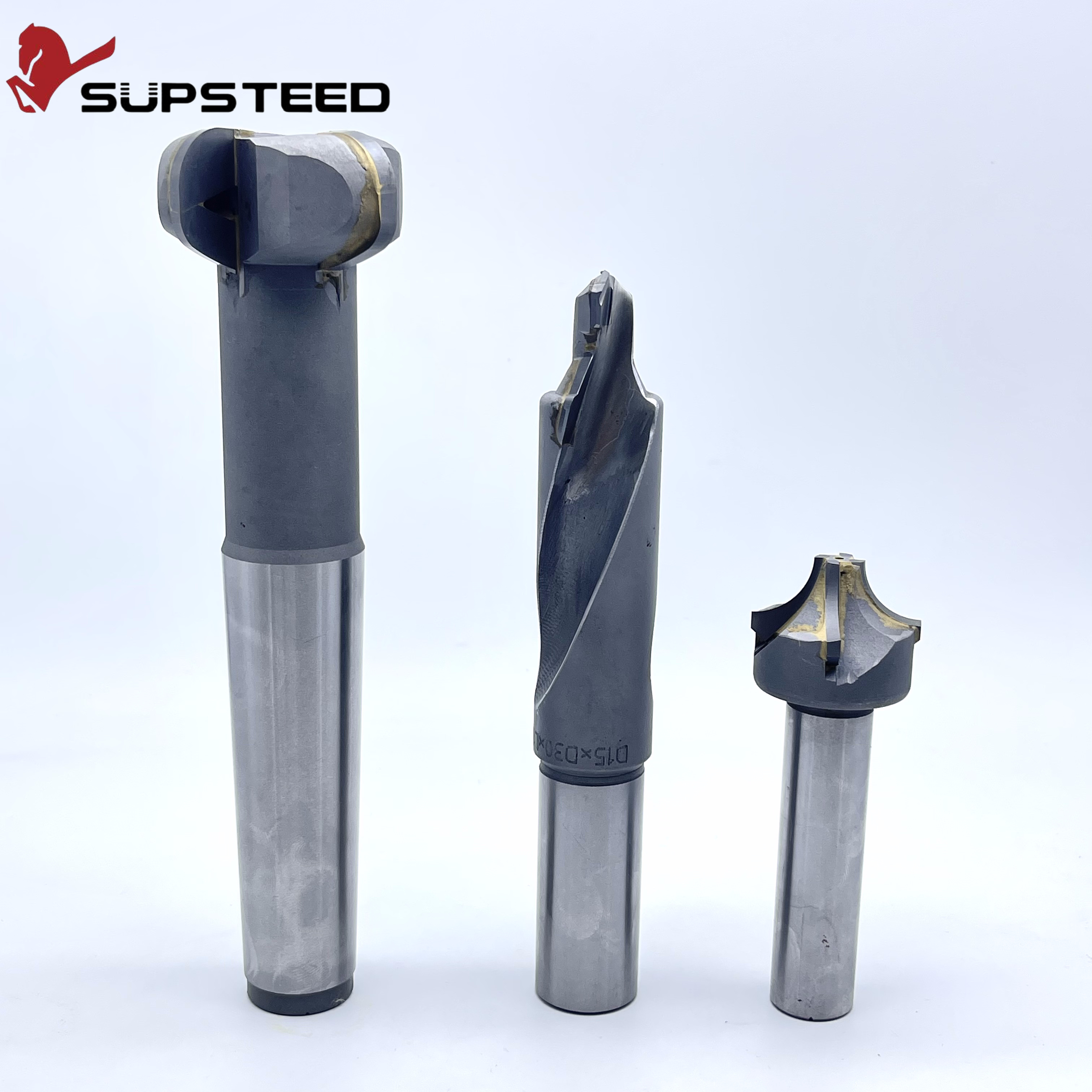
To overcome the physical boundaries of standard catalogs, tooling engineers developed a highly effective hybrid approach. Custom welded tools, frequently referred to as brazed tools, are sophisticated assemblies that permanently join two distinct materials to form a single, optimized cutting instrument. This architecture allows manufacturers to dictate the exact reach, rigidity, and geometry required for a specific cavity.
The brilliance of a welded tool lies in its material synergy. The assembly is divided into two distinct zones: the cutting head and the shank. The cutting head is ground from premium micro-grain solid carbide, housing the flutes, cutting edges, and specialized PVD coatings. Carbide is essential here because it delivers exceptional thermal stability and wear resistance.
In contrast, the shank is machined from a completely different material. Tool designers typically utilize high-tensile tool steel, stainless steel, or a dense tungsten heavy-metal alloy. By fusing the carbide head to this custom shank, the resulting custom welded tools benefit from superior shock absorption and tensile strength. These are vital characteristics when reaching deep into a rigid workpiece.
A frequent question on the shop floor is why programmers cannot simply order an extra-long solid carbide end mill. There are three objective reasons why monolithic carbide fails at extreme lengths. First is brittleness. Solid carbide possesses a massive Young Modulus, making it incredibly stiff, but it severely lacks fracture toughness. Under extreme bending moments, a ten-inch solid carbide tool will snap violently without warning, whereas a steel shank will flex and absorb the load.
Second, solid carbide acts as an excellent transmitter of vibration. Any chatter generated at the tip travels straight up the solid shank and into the machine spindle bearings. Finally, there is the raw material cost. Manufacturing a massive tool entirely out of premium tungsten carbide is financially prohibitive. Welded designs restrict the expensive carbide strictly to the cutting zone, optimizing the tool lifecycle cost.
Joining these two disparate materials requires precision metallurgy. Tool manufacturers utilize advanced induction brazing techniques, employing a silver-based brazing alloy as the filler. This micro-layer of silver actually acts as a secondary shock absorber between the carbide and the steel.
During this process, absolute concentricity is paramount. Advanced toolmakers utilize optical comparators to ensure the Total Indicator Reading remains under 0.0002 inches. A perfectly aligned weld joint ensures the tool spins true, preventing runout and uneven edge wear.
Transitioning to a welded tooling architecture unlocks mechanical advantages that directly stabilize the milling process. These tangible benefits are exactly why advanced manufacturing facilities abandon generic catalogs when tackling complex internal geometries.
Standard end mills feature generic neck lengths that rarely match the actual profile of the part being machined. Conversely, long reach cutting tools are engineered from the spindle down to fit the exact dimensions of the cavity.
Tool designers will maximize the shank diameter for as long as physically possible before necking down to clear the cavity walls. For instance, if a deep pocket requires a half-inch cutting diameter at a depth of seven inches, but the upper portion of the cavity is wide open, the custom tool can feature a robust heavy-metal shank that only tapers down at the very bottom. This strategic retention of core mass drastically increases the tool moment of inertia, effectively neutralizing cantilever deflection.
The bi-metal construction inherently disrupts acoustic resonance. When mechanical vibrations travel from the carbide cutting edge into the braze joint and subsequently into the steel shank, the energy encounters sudden changes in material density.
These transitions actively scatter harmonic frequencies. Heavy-metal shanks made from tungsten alloys excel at this. Their extreme density absorbs vibrational energy before it can resonate into chatter. This dampening effect allows CNC programmers to maintain aggressive feed rates and spindle speeds at depths that would otherwise force them to crawl.
Feature | Standard Solid Carbide | Custom Welded Heavy-Metal Tool |
|---|---|---|
Max Reliable Reach Ratio | Up to 5:1 | Up to 10:1 or higher |
Vibration Dampening | Poor (Transmits chatter to spindle) | Excellent (Absorbs harmonic resonance) |
Fracture Toughness | Low (High risk of snapping) | High (Shank flexes under extreme load) |
Geometry Optimization | Generic neck lengths and reliefs | Engineered specifically for part draft angles |
Lifecycle Cost at Scale | High (Frequent replacement needed) | Low (Longer tool life, re-tipping options) |
Looking at the broader manufacturing landscape, the industry is witnessing a definitive shift in tooling strategies. As the aerospace and electric vehicle sectors increasingly rely on ultra-high-strength alloys and complex, monolithic part designs, the tolerance for machining errors has plummeted. Recent industry analyses highlight that forward-thinking machine shops are moving away from treating cutting tools as disposable commodities. Instead, they are integrating customized hybrid tooling early in the CAM programming phase. This proactive engineering approach guarantees unattended machining reliability, a critical factor as shops combat skilled labor shortages and push for lights-out manufacturing capabilities.
Procuring a tailored solution is a highly collaborative process. Tooling engineers analyze the workpiece material, the specific kinematics of your CNC machine, and the exact CAD geometry to formulate the perfect cutting instrument.
The micro-geometry of the cutting edge dictates how the tool shears metal. For deep cavity applications, engineers rely heavily on variable pitch and variable helix designs. Standard tools often feature symmetrically spaced flutes, which can create a rhythmic pounding against the cavity wall, initiating harmonic chatter.
A custom carbide cutter disrupts this rhythm by altering the flute spacing, such as indexing at 88, 92, 89, and 91 degrees. This variable indexing breaks the harmonic cycle before it starts. Furthermore, rake and relief angles are customized based on the alloy. Gummy aerospace aluminum requires high positive rake angles for clean shearing, while hardened P20 mold steel demands a reinforced negative rake for maximum edge strength.
Evacuating chips from a hole six times deeper than its diameter requires targeted fluid dynamics, not just ambient flood coolant. Custom tools are routinely engineered with internal coolant channels that run the entire length of the shank, exiting precisely behind the cutting edges.
This design ensures that high-pressure coolant, often exceeding 1,000 PSI, blasts directly into the cutting zone. The pressurized fluid actively forces chips up the flutes and out of the cavity, while simultaneously preventing thermal shock from destroying the tool protective AlTiN coating.
Friction is the enemy of deep pocket milling. If the non-cutting shank rubs against the cavity wall, it generates immense heat and immediate deflection. Custom tools are modeled with highly specific neck reliefs that perfectly mirror the draft angle of the cavity.
By tailoring the transition from the cutting diameter to the neck, engineers ensure maximum shank thickness for rigidity while guaranteeing absolute clearance from the workpiece walls, no matter how deep the tool plunges.
Determining the exact moment to abandon standard tooling in favor of custom engineering requires a calculated evaluation of risk, cycle times, and production volume. While bespoke tools require an upfront investment, the financial return is highly predictable if you know exactly what parameters to look for.
Instead of relying on guesswork, modern machine shops use strict operational triggers to justify custom tooling. You should immediately consider a bespoke CNC tool if your application meets any of the following conditions:
Reach Ratio Exceeds 5:1: If you are machining deeper than five times the cutting diameter, standard solid carbide will deflect. Heavy-metal shanks become mandatory.
Material Hardness Surpasses 45 HRC: Hardened tool steels and superalloys amplify cutting forces. Custom geometries with reinforced edges and superior vibration dampening are required to maintain tool life.
High Value Workpieces: If the raw material of a single component costs over $1,000 before machining begins, risking scrap with a generic end mill is an unacceptable gamble. Custom tools act as an insurance policy for expensive aerospace or medical forgings.
Cycle Time Bottlenecks: When a deep cavity requires three different standard tools to rough, semi-finish, and finish a corner radius, a single custom step-tool can consolidate these operations, slashing cycle time by up to 50 percent.
The break-even point for custom tooling is heavily influenced by scale. For a rapid prototype run of three parts, standard tools might be the most economical choice despite their inefficiencies. However, as production scales into medium or high-volume runs, the economics shift dramatically.
Custom tools deliver a significantly lower cost-per-part over extended runs. Because they exhibit longer tool life due to optimized geometries and superior chip evacuation, operators spend less time swapping out worn tools and resetting tool offsets. The initial engineering cost is rapidly amortized over hundreds of flawless parts.
Theoretical advantages translate directly into measurable performance gains across various high-precision sectors. Deep cavity machining is not a monolithic challenge. Different industries face unique material and geometric hurdles that demand specialized interventions.
The mold and die sector is arguably the most intensive testing ground for extended-reach milling. Mold bases and cavity blocks are typically machined from pre-hardened tool steels and feature deep, narrow ribs, steep draft angles, and complex three-dimensional contours.
Standard end mills struggle to reach the bottom of these core cavities without severe deflection, leading to poor surface finishes that require hours of labor-intensive manual polishing. Custom heavy-metal shank tools provide the rigidity needed to hold tight tolerances at the bottom of the mold, leaving a superior as-machined finish that drastically reduces bench-work and secondary electrical discharge machining processes.
Aerospace manufacturing frequently involves hogging deep structural pockets out of solid billets of aluminum or titanium to maximize the strength-to-weight ratio. The goal is to remove massive amounts of material while leaving thin, tall structural walls.
In titanium machining, heat management is critical. Custom tools for these applications are designed with advanced through-tool coolant channels to flush chips instantly, preventing thermal degradation of the carbide edge. Variable helix geometries allow aerospace manufacturers to aggressively rough and precisely finish these deep pockets without inducing chatter on the delicate thin walls.
The automotive industry relies heavily on bespoke tooling for engine blocks, transmission housings, and complex hydraulic manifolds. These cast iron or aluminum components feature deep intersecting fluid galleries and valve seats that must be machined to exacting tolerances.
When machining deep inside an engine block, standard boring bars frequently encounter chatter due to extreme overhangs. Custom welded tools utilizing tungsten heavy-metal shanks are deployed here to naturally disrupt vibrational frequencies, ensuring critical fluid seals and bearing journals meet strict quality control standards in high-volume transfer lines.
Transitioning from standard catalog items to a custom solution requires a transparent, collaborative partnership with a specialized tool manufacturer. The process is highly technical and relies on accurate data sharing regarding part geometry and machine capabilities.
The procurement process begins with application analysis. Manufacturers must provide the tooling engineers with detailed CAD models or prints of the specific cavity. Additionally, data regarding the CNC machine, such as spindle taper, maximum RPM, and coolant pressure capabilities, is essential.
Based on this data, engineers select the appropriate carbide grade, flute count, and shank material. The manufacturer then provides a detailed CAD approval drawing of the proposed tool, highlighting exact dimensions, tolerances, and the location of the weld joint. Once approved, the prototype is manufactured on advanced multi-axis CNC tool grinding centers, ensuring the cutting geometry is exact before being shipped to the customer.
Not all tooling manufacturers possess the engineering infrastructure to produce reliable welded tools. When selecting a partner, evaluate their capabilities in rapid prototyping and strict quality control.
A reliable partner should utilize advanced optical inspection systems to guarantee runout tolerances are kept to an absolute minimum. Furthermore, manufacturers that offer in-house PVD coating capabilities can tailor the tool coating specifically to the material you are machining, adding another layer of performance optimization.
While standard catalog tools will always have a place in general machining, deep cavity applications demand a highly specialized approach. Pushing off-the-shelf end mills beyond their physical limits results in nothing but scrapped parts, broken tools, and immense frustration.
Custom welded tool designs eliminate the compromise between reach and rigidity. By leveraging material synergy, variable geometries, and targeted coolant delivery, these tools provide unparalleled stability in the most demanding environments. Ultimately, customized tooling is not an operational expense. It is a strategic investment in process reliability, superior part quality, and overall machine shop profitability. When you are ready to stop fighting chatter and start machining with confidence, partnering with a dedicated tooling engineer at SS Endmill is the most profitable step you can take. Explore our tailored solutions to find the exact geometry your application demands.
Yes, and in many extended-reach applications, they perform significantly better. While solid carbide possesses high static rigidity, it is inherently brittle. A welded tool utilizes premium carbide exclusively at the cutting edge for maximum wear resistance, while integrating a structural steel or heavy-metal shank. This bi-metal construction absorbs shock and dampens harmonic vibration far better than solid carbide, substantially reducing the risk of the tool snapping when machining deep cavities.
Lead times are highly dependent on the manufacturer current capacity and the complexity of the requested geometry. However, with the integration of modern rapid prototyping software and advanced multi-axis CNC tool grinding equipment, custom tools can often be engineered, subjected to approval drawings, manufactured, coated, and delivered within a two to four-week window.
Absolutely. In fact, for deep cavity machining, through-tool coolant is heavily advised by machining experts. Custom tools are routinely engineered with precise internal coolant channels. These channels ensure that high-pressure cutting fluid is delivered directly to the cutting zone, which is critical for evacuating chips vertically out of deep pockets and mitigating thermal shock to the cutting edge.
The cost-effectiveness depends entirely on the complexity and value of the workpiece. If the part is made of expensive aerospace alloys, features complex geometries, or if standard tools are repeatedly failing and causing machine downtime, a custom tool pays for itself almost immediately, even on low-volume runs. Conversely, for simple, easily accessible features on low-cost materials, standard catalog tools remain the most logical choice.
To ensure an accurate and functional tool design, you must provide comprehensive operational data. This includes the exact material grade being machined, the CNC machine tool specifications such as maximum spindle RPM and available coolant pressure, and a 3D CAD model or detailed print of the specific part or cavity. The tooling manufacturer engineering team will utilize this data to calculate optimal geometries, clearances, and shank materials.
While standard solid carbide typically fails past a 5:1 ratio, custom welded tools utilizing high-density tungsten heavy-metal shanks can reliably machine at ratios of 10:1. In highly controlled setups with optimized toolpaths and light radial engagements, engineers have successfully deployed custom tools reaching up to 15:1 without catastrophic chatter.
Standard tool steel shanks are excellent for general shock absorption, but they lack the density required for extreme reaches. Heavy-metal shanks are manufactured from tungsten alloys, which possess a significantly higher density and modulus of elasticity than standard steel. This massive structural core actively absorbs and dissipates harmonic resonance, preventing chatter from reaching the cutting edge during deep cavity operations.