Please Choose Your Language
- All
- Product Name
- Product Keyword
- Product Model
- Product Summary
- Product Description
- Multi Field Search

Views: 0 Author: Site Editor Publish Time: 2026-09-19 Origin: Site

Electronic devices are shrinking at a staggering pace. Whether you are engineering an IoT wearable strapped to a wrist or a high-density sensor embedded deep within an electric vehicle battery management system, the demand for miniaturization is absolute. Traditional cutting methods simply buckle under the pressure of microscopic sizes. At this scale, the margin for error completely evaporates.
Achieving sub-micron precision is no longer a luxury for advanced applications; it is a fundamental necessity on the shop floor. Micro machining tools have emerged as the backbone of modern electronics manufacturing. This guide explores the specific instruments required for cutting intricate connectors, delicate sensors, and other miniature components. We will also detail actionable engineering strategies to maximize tool life and minimize costly scrap.
Micro machining tools are the foundational elements required for achieving the sub-micron precision demanded in modern electronic component machining.
Specialized miniature cutting instruments must be meticulously engineered to process complex geometries without causing burrs, material deformation, or thermal damage.
Selecting the correct tool geometry, advanced coating, and ultra-fine carbide substrate is strictly necessary when machining gummy copper alloys, tough titanium, and specialized polymers.
Controlling spindle runout, optimizing feed rates for microscopic chip loads, and utilizing high-quality precision instruments are proven methods to prevent premature tool breakage.
Recent industry analyses highlight a dramatic shift in the electronics manufacturing sector. Driven by the rapid expansion of 5G and 6G communication infrastructure, advanced driver-assistance systems in next-generation vehicles, and AI-powered medical implants, the market for micro-scale components is experiencing exponential growth. A notable trend is the strict requirement for ultra-fine pitch components, often with pitches under 0.3mm.
While alternative manufacturing technologies like laser ablation and chemical etching are gaining traction, mechanical micro-machining remains indispensable. Lasers often leave a heat-affected zone that can alter the electrical properties of delicate copper laminates. In contrast, mechanical cutting is uniquely capable of delivering precise 3D geometries, superior surface finishes, and the structural integrity required by conductive copper alloys and specialized engineering plastics.
In industrial manufacturing, the classification of a micro tool generally applies to cutting instruments with a diameter of 3.175mm or smaller. They frequently scale down to fractions of a millimeter, such as 0.1mm to 0.5mm. Unlike standard tooling, these instruments are not simply scaled-down versions of larger cutters. They require highly specialized micro-grain carbide substrates and unique edge preparations to maintain structural integrity.
At this microscopic scale, cutting dynamics change significantly. The edge radius of the tool becomes comparable to the chip thickness itself. This introduces complex shearing forces that standard machining calculations often fail to predict.
The electronics industry operates under strict, unforgiving dimensional tolerances. Modern electronic assemblies require components that fit together flawlessly. A dimensional deviation of merely a few microns can lead to severe real-world consequences. These include electrical short circuits, high-resistance connections, poor signal integrity, or total device failure. Therefore, relying on highly accurate cutting instruments is a baseline requirement for quality assurance and functional safety.
Historically, achieving sub-micron tolerances was limited to slow, specialized laboratory equipment. Today, the ability to mass-produce reliable micro components is a direct result of advancements in CNC technology and multi-axis tool grinding capabilities. High-speed machining centers equipped with advanced vibration dampening and thermal compensation systems can now utilize modern miniature cutters to produce thousands of identical parts. Furthermore, the evolution of ultra-fine grinding wheels and automated optical inspection during tool manufacturing ensures that these tiny cutters perform consistently across demanding production runs.
The fabrication of electronic connectors presents unique mechanical challenges. Connectors often consist of micro-pins, tight-tolerance sockets, and complex interlocking housings designed to operate in harsh, high-vibration environments. When machining these components, achieving an absolutely burr-free finish is critical. Even microscopic burrs left behind by a dull tool can scrape off delicate gold plating during insertion. This leads to rapid oxidation and eventual signal failure.
To create the tiny slots, keyways, and intricate locking mechanisms required in aerospace, automotive, and consumer electronic connectors, manufacturers rely heavily on customized micro cutters. These tools are engineered with specific relief angles to shear material cleanly rather than plowing through it. Rigidity is paramount here; any deflection during the cutting process can result in out-of-tolerance pins that immediately fail standard insertion-loss testing.
Sensors act as the nervous system for the Internet of Things and modern industrial automation. Manufacturing sensor housings, pressure diaphragms, and optical mounts requires dealing with delicate materials and incredibly thin wall structures. Machining a pressure diaphragm, for instance, may require leaving a functional wall thickness of less than 0.05mm.
In these highly sensitive scenarios, the cutting tools must exert the lowest possible radial and axial forces. Excessive cutting pressure will inevitably cause the thin walls to deform, vibrate, or tear, rendering the sensor useless. Engineers must carefully calculate microscopic chip loads and utilize tools with highly polished flutes and razor-sharp cutting edges to slice through the material with minimal friction.
Beyond connectors and sensors, the broader field of electronic fabrication encompasses custom printed circuit boards, miniaturized heat sinks, and micro-switches. While standard mass-market PCBs are often routed, custom or rigid-flex PCBs used in high-frequency radar applications require precise mechanical milling to strictly control dielectric thickness and edge profiles.
Specifically, micro cutters are deployed to route small pockets, create blind vias, and define complex outer profiles in miniature electronic housings. For thermal management components like micro heat sinks, these cutters must plunge and mill deep, incredibly narrow channels in aluminum or copper to maximize the surface area for heat dissipation.
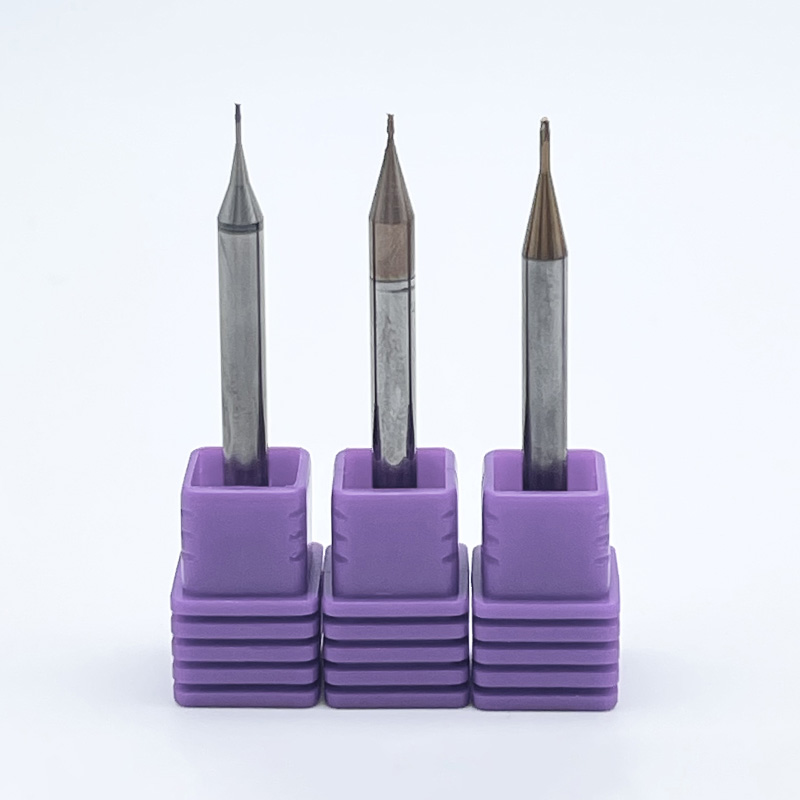
These are highly versatile tools predominantly used for cutting slots, facing surfaces, and profiling miniature parts. Depending on the specific geometry of the electronic component, different profiles are utilized to achieve the desired mechanical outcome. A high-quality micro end mills setup, often utilizing diameters as small as 0.1mm with a 30-degree or 35-degree helix angle, is frequently the difference between a scrapped part and a perfect component.
End Mill Type | Key Characteristics | Primary Electronics Application |
|---|---|---|
Square Micro End Mill | Sharp 90-degree corners, flat bottom. | Milling precise pockets for microchips, cutting straight connector slots. |
Ball Nose Micro End Mill | Hemispherical cutting end. | 3D contouring of sensor housings, machining complex optical mounts. |
Corner Radius Micro End Mill | Flat bottom with rounded corners for added strength. | High-speed roughing of miniature heat sinks, reducing stress concentrations in thin walls. |
When the operation requires facing, profiling, or deep pocketing, specialized cutters are selected based on their flute count. The number of flutes dictates the tool core strength and its ability to evacuate chips from the microscopic cutting zone. In micro machining, chip evacuation is a critical failure point.
A 2-flute cutter provides larger flute valleys. This makes it ideal for softer, gummy materials like plastics or aluminum where chip packing is a severe risk. Conversely, a 4-flute cutter offers a larger core diameter, providing greater rigidity. This makes the 4-flute variant optimal for machining harder alloys or achieving superior surface finishes on the outer profiles of electronic housings.
Creating micro-holes for vias, alignment pins, and mounting points requires micro drills that perfectly balance core web thickness with flute volume. These drills often feature specialized point angles to prevent the tool from walking when entering the material, ensuring the hole location is accurate to within microns.
For internal threading in miniature components, micro thread milling is objectively superior to traditional tapping. Tapping miniature threads such as M1 or M1.2 carries an exceptionally high risk of tool breakage. A micro thread mill uses helical interpolation to cut the thread. Because it is smaller than the hole diameter, cutting forces are significantly lower.
The interaction between the cutting tool and the workpiece material dictates the success of the machining operation. Electronic components utilize a wide array of materials, each presenting distinct mechanical challenges at the micro-scale.
Copper and its alloys are ubiquitous in electronic connectors due to their excellent electrical conductivity. However, from a machining perspective, pure copper is highly ductile and extremely gummy. As the tool cuts, the copper tends to adhere to the cutting edge, a phenomenon known as Built-Up Edge. This alters the tool geometry, leading to poor surface finishes, oversized dimensions, and eventual tool failure.
To counteract this, operators must utilize an ultra-sharp, uncoated micro milling cutter. Highly polished flutes are essential, as they drastically reduce the coefficient of friction, allowing the sticky copper chips to slide up and away from the cutting zone before they can weld to the carbide substrate.
Advanced polymers like PEEK and PTFE are widely used as insulators and dielectric barriers in sensors and connectors, while FR4 is the standard substrate for PCBs. Machining plastics requires strict heat management. Because polymers have exceptionally low thermal conductivity, the heat generated by the cutting action does not dissipate into the chip or the workpiece; instead, it stays in the tool and the immediate cutting zone.
If the temperature exceeds the material glass transition point, the plastic will instantly melt, smear, or delaminate. Tools designed for plastics feature high rake angles and low flute counts to shear the material cleanly and evacuate chips instantly.
Medical electronics and rugged industrial sensors often rely on titanium and stainless steel for their biocompatibility and corrosion resistance. These metals are characterized by high tensile strength and a frustrating tendency to work-harden during machining.
Cutting these tough metals at microscopic sizes requires maximum tool rigidity. Deflection must be eliminated to prevent the tool from rubbing against the work-hardened surface. Precision tools engineered for these metals utilize ultra-fine micro-grain carbide substrates for high transverse rupture strength and are coated with advanced thermal barriers.
When scaling down to the micro-level, the physical dynamics of cutting change dramatically. A standard tool design simply scaled down will fail immediately when subjected to the demands of miniature component fabrication. Evaluating high-quality precision tools requires a deep understanding of metallurgy, surface engineering, and strict metrology.
The foundation of any reliable micro-cutting instrument is its substrate. In standard machining, standard-grain tungsten carbide is often sufficient. However, for micro-scale operations, ultra-fine micro-grain carbide is a non-negotiable requirement.
Grain size directly influences the transverse rupture strength and edge sharpness of the tool. Standard carbide grains typically measure between 0.8 and 1.2 microns. In contrast, premium sub-micron or ultra-fine grain carbide features grain sizes ranging from 0.2 to 0.5 microns. Because the cutting edge of a micro tool is incredibly small, a large carbide grain at the cutting edge can easily dislodge under cutting forces, leading to immediate edge chipping.
Surface coatings serve as a critical thermal barrier and a friction reducer. In electronic component manufacturing, selecting the correct coating based on the workpiece material is critical for preventing thermal degradation.
Coating Type | Friction Coefficient | Optimal Electronic Materials | Key Benefit in Micro Machining |
|---|---|---|---|
TiAlN / TiSiN | 0.40 | Stainless steel, Titanium | High thermal stability; protects the micro-edge from heat during dry machining of rugged sensor bodies. |
DLC | 0.10 - 0.20 | Aluminum, PEEK, PTFE | Extremely low friction; prevents melting in polymers and eliminates chip welding in aluminum heat sinks. |
Uncoated / Highly Polished | N/A | Copper, Brass, Gold | Prevents gummy non-ferrous materials from adhering to the tool; ensures burr-free finishes on connector pins. |
In macro-machining, a slightly rounded cutting edge can occasionally increase tool strength. In micro-machining, however, a rounded edge is highly detrimental due to the ploughing effect. When the feed per tooth is smaller than the cutting edge radius, the tool rubs and compresses the material rather than shearing it. This causes immense friction, part deflection, and severe burr formation.
In addition, highly polished flutes are non-negotiable. Micro-chips lack the mass to be easily evacuated by centrifugal force alone. A mirror-like flute finish reduces friction, allowing chips to flow smoothly out of the cutting zone.
Runout is the ultimate enemy of micro-machining. Runout refers to the inaccuracy of the tool rotation around its true axis. If a 12mm end mill has 0.01mm of runout, the effect is negligible. However, if a 0.1mm micro milling cutter experiences the same 0.01mm runout, that deviation represents 10 percent of the tool entire diameter.
This massive imbalance causes one flute to take a heavy chip load while the other takes nothing. This leads to instant tool snapping, poor surface finish, and dimensionally inaccurate components. Premium micro tools are manufactured with concentricity tolerances held to strictly within 2 to 3 microns.
Even the most precisely engineered tools will fail if utilized incorrectly. Integrating high-performance miniature CNC tools into a production workflow requires a paradigm shift in how operators approach speeds, feeds, vibration control, and environmental factors.
Calculating chip loads at the micro-scale requires absolute precision. Because the tools are so fragile, the feed per tooth must be carefully controlled to prevent deflection. However, to maintain a productive feed rate while keeping the feed per tooth very low, the spindle speed must be exceptionally high.
Standard CNC machines max out at 10,000 to 15,000 RPM, which is often insufficient for tools under 0.5mm. For optimal performance, high-speed spindles ranging from 30,000 to over 100,000 RPM are frequently required. Running a micro tool at insufficient RPM forces the operator to drop the feed rate so low that the tool begins to rub rather than cut.
Rigidity is paramount when working with microscopic tolerances. Any vibration in the machining center will be transferred directly to the cutting edge.
Tool Holders: Standard collet chucks such as ER collets often lack the concentricity required for micro-machining. Shrink-fit tool holders or high-precision hydraulic chucks are strongly recommended.
Tool Overhang: The length of the tool protruding from the holder must be kept to the absolute minimum. Excessive overhang exponentially increases the risk of deflection and chatter.
Machine Dynamics: The machine tool itself must possess high dynamic stiffness to dampen vibrations effectively.
Thermal management is a complex variable in electronic component machining. While flood coolant is standard in macro-machining, it can be fatal to micro tools. When a tool is cutting at 60,000 RPM, the cutting edge heats up rapidly. Hitting that microscopic, super-heated carbide edge with a high-pressure blast of cold liquid can cause severe thermal shock.
Instead, Minimum Quantity Lubrication or continuous air blasts are often the preferred methods. Minimum Quantity Lubrication delivers a fine aerosol mist of oil that provides necessary lubricity to prevent chip welding without inducing thermal shock.
The supply chain for precision manufacturing requires rigorous vetting. General-purpose tooling suppliers often lack the specialized grinding equipment and metrology required to produce reliable micro-scale instruments. When sourcing tools for critical electronic assemblies, it is imperative to partner with manufacturers who dedicate their engineering resources specifically to micro-machining dynamics.
A reliable manufacturer should offer comprehensive documentation regarding substrate composition, coating specifications, and guaranteed runout tolerances. Batch-to-batch consistency is the hallmark of a premium supplier; a tool ordered today must perform identically to a tool ordered six months from now.
If you are looking to elevate your electronic component manufacturing, explore the industry-leading precision tools at SS End Mill. From ultra-fine 0.1mm diameters to advanced DLC and TiSiN coatings, you can find the perfect micro end mills and specialized cutters tailored for your specific material and machine setup. Their commitment to 0.2-micron ultra-fine grain substrates and strict quality control ensures the reliability required for modern miniaturization.
As electronic devices continue to shrink rapidly, reliable micro-machining becomes highly critical to global manufacturing success. Specialized cutters maintain strict accuracy in complex electronic components, ensuring that everything from aerospace sensors to consumer wearables functions flawlessly. Investing in high-quality equipment reduces scrap, prevents silent machine downtime, and fundamentally elevates the quality of the final product. Evaluate your current setup, control your runout, and upgrade to specialized micro tools engineered for your exact production needs.
Standard micro end mills are widely available down to 0.1mm in diameter, which is roughly the thickness of a human hair. For highly specialized electronic component machining, custom tool manufacturers can produce cutting diameters as small as 0.05mm or even 0.01mm. These ultra-miniature tools are essential for cutting microscopic features in medical implants, micro-fluidic sensors, and high-density semiconductor testing equipment.
Tool breakage in copper is typically caused by improper chip evacuation and excessive runout. Copper is a highly ductile, gummy material that tends to adhere to the cutting edge, creating a built-up edge. Once this occurs, the tool geometry changes, friction spikes, and the fragile tool snaps. To prevent this, utilize uncoated, highly polished micro milling cutters with sharp rake angles. Additionally, ensure your spindle runout is below 3 microns and utilize Minimum Quantity Lubrication to provide necessary lubricity.
While it is technically possible, standard CNC machines often yield poor results and high tool breakage rates. Standard machines typically lack the necessary spindle speeds, which forces operators to run feed rates too low, causing the tool to rub instead of cut. Furthermore, standard machines often lack the vibration damping and low-runout spindles required. For optimal results, dedicated micro-machining centers or air-driven spindle speed multipliers are highly recommended.
The choice depends entirely on the material being cut and the specific operation. A 2-flute cutter provides significantly larger flute valleys, offering superior chip clearance. This makes 2-flute tools ideal for slotting operations, plunging, and machining softer or gummy materials like plastics, aluminum, and copper. Conversely, a 4-flute cutter has a thicker core, providing greater tool rigidity and a superior surface finish. 4-flute tools are the optimal choice for profiling operations and machining harder alloys like titanium or stainless steel sensor housings where chip evacuation is less problematic.
To maintain a proper chip load without snapping the fragile cutter, micro machining typically requires spindle speeds ranging from 30,000 RPM to well over 100,000 RPM. Tools under 0.5mm in diameter must spin incredibly fast to achieve a productive surface footage while keeping the feed per tooth low enough to prevent tool deflection.
Preventing runout requires a holistic approach to your tooling setup. First, abandon standard ER collets in favor of shrink-fit tool holders or high-precision hydraulic chucks, which provide uniform clamping force. Second, meticulously clean the spindle taper and tool shank before every tool change. Finally, utilize a dial indicator or laser presetter to verify that Total Indicator Reading is strictly kept under 3 microns before initiating the cutting cycle.