Please Choose Your Language
- All
- Product Name
- Product Keyword
- Product Model
- Product Summary
- Product Description
- Multi Field Search

Views: 0 Author: Site Editor Publish Time: 2026-09-20 Origin: Site

When you are machining a neurovascular stent or a spinal implant, "close enough" simply does not exist. A fraction of a millimeter means the difference between a successful biological integration and a catastrophic critical failure. Complex life-saving devices demand flawless microscopic precision. Achieving this level of exactness requires highly specialized tooling. As implantable mechanisms and micro-surgical instruments become increasingly intricate, shop floors face immense pressure to hold microscopic tolerances and deliver perfect surface topography.
The secret to overcoming these manufacturing hurdles lies directly in your tool crib. Standard setups cannot cope with the physics of miniaturization. In this technical guide, we will break down the strict tolerance and surface finish requirements for life-critical devices. We will also explore the distinct challenges of cutting medical-grade alloys and demonstrate how choosing the proper micro tools can drastically accelerate your product timeline.
Extreme Precision is Mandatory: Life-critical micro-mechanisms dictate tolerances of ±0.01mm or tighter to ensure reliable assembly and biological function.
Surface Finish Dictates Functionality: Surface roughness directly governs biocompatibility. Ultra-smooth finishes prevent bacterial colonization on surgical equipment. Conversely, controlled rough textures promote bone growth on orthopedic implants.
Tool Material Matters: Premium solid carbide is fundamental. It maintains structural rigidity, resists thermal wear, and holds razor-sharp cutting edges when processing difficult medical-grade alloys.
Task-Specific Tooling is Key: Deploying engineered miniature cutters minimizes tool deflection, reduces costly scrap rates, and ensures dimensional consistency across massive production batches.
Medical micro machining is a highly specialized discipline within CNC manufacturing. It focuses on the production of features smaller than 1.0mm. Operators often utilize cutting tools with diameters as minute as 0.05mm. As modern medicine pivots aggressively toward minimally invasive surgery and micro-robotics, the demand for microscopically scaled components has surged exponentially.
You cannot simply scale down conventional CNC tooling to meet these rigorous requirements. When standard tools are reduced to micro-dimensions, their physical properties change detrimentally. The primary failure mode on the shop floor is tool deflection. In machining physics, a tool's deflection is inversely proportional to the fourth power of its diameter. Consequently, a microscopic reduction in tool diameter results in an exponential loss of rigidity.
Imagine programming a 5-axis CNC to mill a delicate titanium bone plate. If the tool deflects by even a few microns, it induces chatter. This micro-vibration triggers rapid edge wear and ultimately leads to catastrophic tool breakage. The entire batch is scrapped. To overcome these severe physical limitations, manufacturers must transition to advanced precision component tools. These specialized instruments feature reinforced web thicknesses and sub-micron grain materials designed to withstand the distinct radial forces of micro-cutting.
In general manufacturing, a tolerance of ±0.05mm is often celebrated as highly precise. However, within the medical device sector, the industry benchmark routinely begins at ±0.01mm and frequently ventures deep into the sub-micron range. Optical diagnostic instruments and implantable pacing devices demand this strict dimensional accuracy. Even microscopic deviations can dramatically alter fluid dynamics or cause mechanical binding.
Looking at current industry trends, there is a massive shift happening across the med-tech sector. Robotic-assisted surgeries are quickly becoming the global standard of care. This clinical shift requires instruments capable of navigating delicate human anatomy without causing tissue trauma, pushing the demand for ultra-miniaturization to new heights. Standard CNC capabilities are now stretched to their absolute breaking point. Facilities failing to adopt sub-micron metrology and task-specific tooling are rapidly losing their competitive edge in the supply chain. OEMs no longer view flawless precision as a premium feature; they demand it as a baseline requirement.
The specific application of a component dictates its tolerance profile. The engineering requirements differ significantly between devices that remain permanently in the body and those utilized temporarily.
Orthopedic and Cardiovascular Implants: Devices such as spinal screws and vascular stents require absolute geometric perfection. Poor fitment with biological structures or uneven load distribution can quickly lead to implant failure and severe patient trauma.
Micro-Surgical Instruments: Biopsy forceps and endoscopic scissors focus heavily on mating tolerances and clearance fits. A surgeon relies entirely on the tactile feedback provided by the friction coefficient of the tool's moving parts. If tolerances are loose, the parts may jam or exhibit excessive play.
Failing to maintain these strict tolerances carries severe operational consequences. Components falling outside specified tolerance bands result in immediate compliance failures under ISO 13485 standards. Furthermore, medical-grade materials are notoriously expensive. Elevated scrap rates directly erode profit margins. Utilizing appropriate medical micro machining techniques ensures repeatable accuracy and mitigates the risk of disastrous regulatory recalls.
Dimensional accuracy is only half of the manufacturing equation. The topography of a component's surface is equally critical. Surface roughness is most commonly measured as Ra, calculating the average deviation of a surface profile from a mean line. In this highly regulated space, Ra is not merely an aesthetic standard. It is a functional biological requirement.
The interaction between human tissue and a machined component relies entirely on the micro-texture of the part. Preventing infection is paramount. Reusable surgical tools and scalpel handles require ultra-smooth finishes, often demanding an Ra of 0.4 micrometers to as low as 0.1 micrometers. Microscopic machining marks act as safe havens, harboring bioburden that can shield bacteria from rigorous sterilization processes like autoclaving. Achieving a near-mirror finish eliminates these microscopic hiding places entirely.
Conversely, promoting healing requires a completely different approach. Titanium dental implants target a rougher Ra, typically between 3.0 and 5.0 micrometers. This specific macro-texture significantly increases the surface area. It allows bone-forming cells to physically adhere to the metal. This biological bonding process is vital for the long-term stability of the implant.
The final Ra value is the direct result of machining parameters interacting with the condition of the cutting edge. Cutting speeds, feed rates, and depth of cut must be perfectly synchronized. More importantly, the sharpness of the tool dictates exactly how the material is sheared. A dull edge will tear or plow the material rather than cutting it cleanly. This results in a high Ra value and potential surface micro-cracking. High-precision tooling minimizes friction and ensures a pristine shear plane.
Selecting the correct tooling architecture is arguably the most consequential decision in the micro-manufacturing process. Standard high-speed steel or generic carbide grades are entirely insufficient for the intense thermal and mechanical stresses encountered here.
Tooling Attribute | Standard CNC Tooling | Specialized Micro Machining Tooling |
|---|---|---|
Material Composition | Standard Carbide / HSS | Ultra-fine sub-micron grain tungsten carbide |
Deflection Resistance | Low at small diameters | Exceptionally high due to reinforced web geometry |
Minimum Diameter | Typically 1.0mm | Commercially viable down to 0.05mm |
Surface Finish Capability | Ra 0.8 to 1.6 micrometers | Ra 0.1 to 0.4 micrometers |
Solid carbide remains the definitive gold standard. However, not all carbide is created equal. High-performance micro carbide tools utilize ultra-fine grain tungsten carbide. This highly specific metallurgical composition provides exceptional stiffness, actively resisting the deflection that plagues micro-machining. Sub-micron carbide maintains its structural integrity even at elevated cutting temperatures. It preserves the razor-sharp cutting edges required to shear tough alloys, drastically reducing machine downtime.
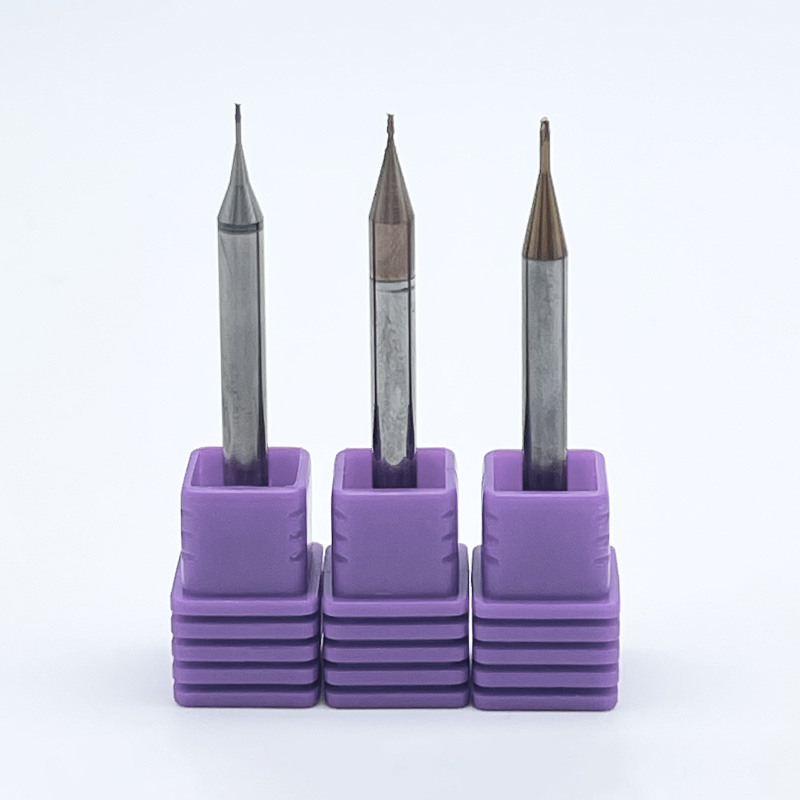
When contouring complex micro-implants like maxillofacial plates, specialized miniature end mills are deployed. Premium suppliers like SS End Mill engineer these instruments with cutting diameters down to a staggering 0.05mm. The selection of flute count is highly dependent on the workpiece material. Two-flute designs provide larger chip valleys, making them ideal for evacuating stringy chips from medical plastics. Multi-flute designs offer greater core strength for peripheral milling of hard metals. Specialized PVD coatings like Titanium Aluminum Nitride are frequently applied to increase surface hardness and provide a crucial thermal barrier.
Creating deep precise holes in life-saving components presents a unique set of physics challenges. As the depth-to-diameter ratio increases, chip evacuation becomes severely restricted, and coolant flow to the cutting zone is entirely blocked. Engineered small diameter drills solve these critical issues through optimized geometries. They feature precise web thinning to reduce thrust forces at the chisel edge. This prevents the drill from walking upon entry. Parabolic flute designs widen the chip space, allowing for efficient material extraction and preventing catastrophic drill snapping.
Medical components are inherently constrained by strict material requirements. They must be mechanically strong, incredibly lightweight, and biologically inert. The materials that successfully meet these criteria are notoriously difficult to machine.
Polyetheretherketone, commonly known as PEEK, has become highly prevalent in spinal cages due to its bone-like modulus of elasticity. Unfortunately, PEEK is highly sensitive to heat. During the machining process, operators often listen for a specific pitch change in the spindle. This is a telltale sign that the tool is generating excessive friction and the plastic is beginning to locally melt rather than shear. Melting leads to severe burr formation and immediate dimensional failure. To prevent this, machinists must use ultra-sharp uncoated micro tools with highly polished flutes. High positive rake angles slice cleanly through the polymer without heat accumulation.
Metals used in medical devices pose distinct thermal hurdles that can destroy standard tooling in seconds. Titanium Ti-6Al-4V possesses exceptionally low thermal conductivity. Instead of the heat dissipating safely into the metal chip, it concentrates entirely at the cutting edge. To combat this intense thermal shock, machining titanium requires specific edge preparations and abundant high-pressure coolant.
Similarly, medical-grade 316L Stainless Steel is highly prone to rapid work-hardening. If a cutting tool rubs against the material rather than engaging in a positive cut, the surface of the steel hardens instantly. This makes subsequent passes extremely difficult. Precision tools must maintain continuous aggressive feed rates, ensuring the cutting edge always penetrates beneath the newly work-hardened layer.
Medical device prototyping is notoriously slow. It is often bogged down by rigorous regulatory testing and endless design iterations. This prototyping bottleneck can severely delay life-saving products from reaching the market. By utilizing highly reliable precision tooling from the outset, engineering teams can eliminate secondary finishing processes like manual polishing under a microscope.
When selecting your tooling partner, evaluate them against these strict criteria:
Sub-Micron Metrology: Ensure the manufacturer utilizes laser inspection for edge radii and dynamic runout.
Custom Geometry Capabilities: Standard tools lead to suboptimal chip evacuation on proprietary device designs. Look for manufacturers who can tailor rake angles and flute counts to your specific alloy.
Batch Consistency: Tool consistency ensures that prototype tolerances perfectly match final production tolerances.
Tolerance and surface finish are never just suggestions on a blueprint. They are critical specifications that directly ensure patient safety and long-term device success. The success of any micro-machining project hinges entirely on the quality of the cutting tool applied to the workpiece. By investing in premium engineered micro tools, manufacturers drastically reduce scrap rates and speed up production cycles. Do not let subpar tooling compromise your next life-saving project. Equip your shop floor with reliable, high-precision solutions from SS End Mill and secure flawless final products.
The required surface roughness is entirely dependent on the biological function of the specific component. Cardiovascular devices and blood-contacting surgical instruments require an ultra-smooth surface finish, typically ranging from Ra 0.4 to as low as 0.1 micrometers. This highly polished surface is critical for preventing platelet adhesion and bacterial colonization. Orthopedic implants like titanium hip stems require a controlled rougher texture, usually Ra 3.0 to 5.0 micrometers. This micro-roughness mimics the structure of cancellous bone, accelerating osseointegration.
The preference for solid carbide is rooted in material physics. Tungsten carbide possesses a significantly higher stiffness compared to high-speed steel. When machining at micro-scales, tool deflection is the primary cause of dimensional inaccuracy. The extreme rigidity of carbide minimizes this deflection. Furthermore, carbide maintains its structural integrity at much higher temperatures, preventing premature edge degradation when cutting heat-generating alloys like Titanium.
Advancements in CNC grinding technology have pushed the boundaries of micro-tooling significantly. Today, high-performance miniature end mills are commercially viable with cutting diameters as small as 0.05mm, which is roughly half the thickness of a human hair. Operating tools at this microscopic scale requires highly specialized machining environments, including spindle speeds exceeding 60,000 RPM and machine tool runout controlled to less than 1 micron.
PEEK has a relatively low glass transition temperature. If the cutting tool generates excessive friction, the material will soften and push over the edge of the workpiece, resulting in stubborn burrs. Engineers must utilize tools with highly specific geometries featuring ultra-sharp cutting edges and high positive rake angles. Utilizing uncoated tools with highly polished flutes reduces the coefficient of friction. Combining these sharp tools with high spindle speeds and aggressive coolant strategies effectively eliminates burr formation.
Yes, but deep hole drilling in titanium presents severe engineering challenges. Titanium alloys have incredibly low thermal conductivity, meaning heat transfers directly into the cutting tool. To successfully execute deep hole applications, manufacturers must utilize highly specialized small diameter drills engineered with parabolic flute profiles. These profiles widen toward the shank for rapid chip evacuation. Precise web thinning at the drill point is also required to reduce thrust force and prevent snapping.
Micro milling titanium requires a delicate balance to prevent thermal shock at the cutting edge. Generally, surface speeds should be kept relatively low, often between 30 to 60 meters per minute, depending on the specific Ti-6Al-4V alloy condition and tool coating. However, because the tool diameter is so small, achieving this surface speed still requires high spindle RPMs. Maintaining a consistent chip load is more critical than maximizing speed to prevent the tool from rubbing and work-hardening the material.
In micro machining, tool runout is the silent killer of dimensional accuracy and tool life. If a 0.5mm end mill experiences just 0.005mm of runout, the chip load becomes entirely uneven. One flute takes a massive bite of material while the other cuts nothing. This dynamic imbalance causes severe chatter, poor surface finish, and rapid tool breakage. For medical components requiring tight tolerances, total indicator runout at the tool tip must be kept strictly under 2 microns.