- All
- Product Name
- Product Keyword
- Product Model
- Product Summary
- Product Description
- Multi Field Search

Views: 0 Author: Site Editor Publish Time: 2026-09-24 Origin: Site

You know the sound. A high-volume production run is cruising along smoothly, and suddenly, that distinct, high-pitched whine of a dulling bit cuts through the shop noise. An operator hits the emergency stop. Valuable production minutes vanish instantly. Machine downtime remains one of the most persistent, profit-draining bottlenecks in professional woodworking and CNC operations. Every time a spindle halts for a manual tool swap or an operator is forced to recalibrate the Z-axis for a fresh edge, the overall efficiency of the fabrication shop takes a massive hit.
Optimizing tool life and maximizing feed rates are no longer just goals. They are critical survival metrics for modern manufacturers. Innovative engineering solutions are completely transforming how facilities manage their tooling inventory and machine uptime. By effectively doubling the cutting life of a single unit, specialized tooling minimizes the frequency of manual interventions required by the operator on the floor.
This comprehensive guide explores how selecting the right cutting geometries can drastically reduce changeovers. Implementing these advanced tooling strategies allows woodworking professionals to improve their bottom line, reduce scrap rates, and streamline the entire milling process. When you upgrade to a high-endurance woodworking cutter, the impact on your daily output is immediate and measurable.
Double-ended designs effectively double your cutting life and halve your tool changeover time, directly increasing CNC machine uptime.
Investing in premium solid carbide reduces long-term operational costs compared to cheaper alternatives that degrade rapidly under severe thermal stress.
Proper selection of milling geometries based on wood density and grain direction prevents material tear-out and drastically reduces wasted stock.
Optimizing your consumable inventory is often the most immediate, cost-effective method to scale production output without investing in new heavy machinery.
Before diving into tool geometries, we must look at where the fabrication industry is heading. Recent market analyses reveal a massive shift toward automated, high-speed nested-based manufacturing. As skilled labor shortages continue to challenge the sector, shop managers are pushing machines to run faster and longer, often moving toward "lights-out" unattended operations.
In this high-pressure environment, the physical limitations of the cutting edge become the primary bottleneck. A CNC router capable of 2,000 inches per minute is useless if the tool burns out after forty sheets of MDF. Consequently, the industry is rapidly abandoning cheap, consumable-heavy models. The new standard demands high-endurance tooling engineered specifically for continuous, aggressive cutting cycles.
Modern CNC routing demands a level of precision and durability that traditional manual woodworking never required. As automated machines evolved to push feed rates faster and spindle speeds higher, the tooling industry had to adapt fundamentally.
Historically, High-Speed Steel served as the standard for woodworking. While this material can be sharpened to an exceptionally fine edge, it possesses a critical vulnerability. Heat is the ultimate enemy. Spindles routinely scream at 18,000 to 24,000 RPM. At these velocities, the friction generated against dense hardwoods or composite panels creates intense thermal shock.
When steel reaches its critical temperature, it loses its temper. The result is immediate edge degradation. This operational bottleneck drove the industry-wide shift to solid micro-grain carbide. These modern bits are manufactured from a dense composite of tungsten carbide particles bonded with a cobalt binder. This specific micro-grain structure maintains its extreme hardness at significantly higher temperatures. Carbide tools easily sustain the aggressive feed rates required in modern routing while maintaining edge retention up to fifty times longer than their steel counterparts.
In a production environment, the true cost of a tool goes far beyond its purchase price. It includes the operational cost of using and replacing it. Every single minute a CNC machine sits idle while an operator changes a dull bit is lost revenue. These hidden expenses compound rapidly over a fiscal quarter.
Consider the standard changeover procedure on a busy shop floor. The machine must ramp down, move to a safe position, and release the tool holder. The operator must then retrieve a replacement, clean the collet, insert the new bit, torque it to exact specifications, and recalibrate the Z-axis height. This process directly destroys Overall Equipment Effectiveness. Minimizing this specific downtime is a primary objective for lean manufacturing facilities.
To combat the stark inefficiencies of frequent tool changes, tooling engineers developed a specialized structural solution. This design represents an optimization aimed squarely at high-production environments. It provides maximum utility from a single piece of raw carbide material.
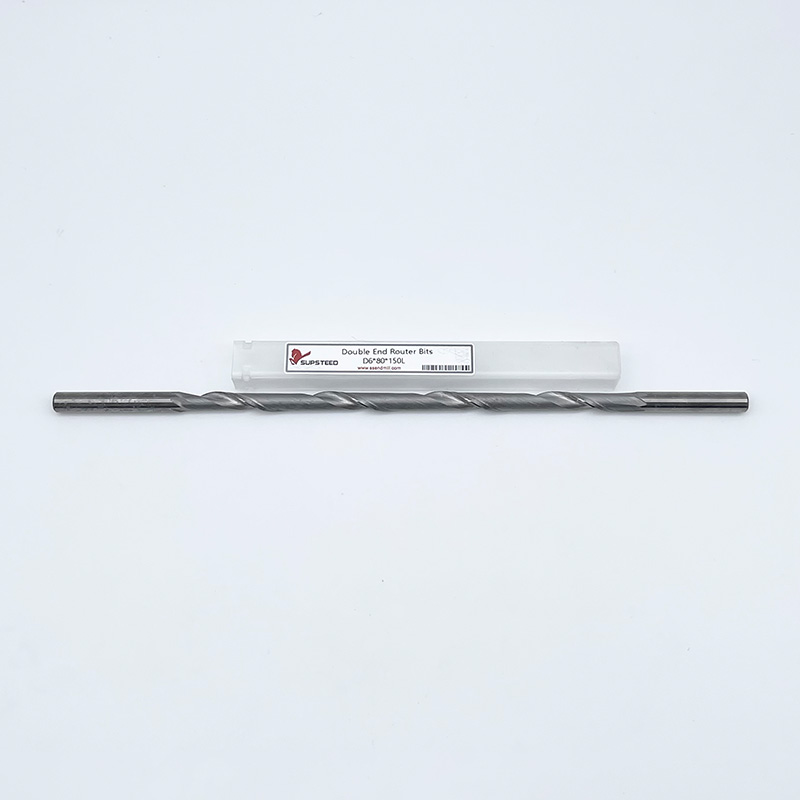
The physical design is elegantly simple yet highly engineered. It consists of a single, precision-ground solid carbide shank featuring identical cutting flutes machined onto both ends. The central portion of the shank remains perfectly smooth. This allows for secure, concentric clamping within the CNC collet.
When the active cutting edge eventually dulls through normal use, the operator does not need to discard the tool. They do not even need to walk to the tool crib for a replacement. Instead, they simply loosen the collet nut, flip the double end router bits 180 degrees, re-tighten to the proper torque, and immediately resume cutting.
Standard single-end bits utilize only half of the carbide blank for cutting, leaving the rest strictly for clamping. Double-ended variants require significantly more advanced grinding techniques. The manufacturing process must ensure strict concentricity and dynamic balance on both ends simultaneously. Because the non-cutting end sits inside the collet, the flute geometry must be designed so it does not compromise the clamping force. Any introduced runout or wobble during high-speed rotation would degrade cut quality and severely damage expensive spindle bearings.
Keeping the spindle turning is the ultimate goal for any shop manager. By addressing specific friction points in the tool replacement workflow, these specialized bits offer measurable improvements to daily production schedules.
Spindle uptime is the core metric dictating a shop's profitability. When using standard tooling, a dull bit triggers a lengthy multi-step replacement process. With a dual-ended approach, this workflow is heavily truncated.
Because the operator utilizes the exact same physical shank, there is no need to log a new tool out of inventory. Specifically, if your facility utilizes preset tool collars on an ISO30 or HSK63F tool holder, the Z-axis offset often remains perfectly identical after the flip. This entirely eliminates the need to recalibrate the tool height. A potential five-minute stoppage transforms into a rapid 60-second adjustment.
From a procurement perspective, optimizing your inventory yields immediate financial benefits. Purchasing one dual-ended bit is mathematically more cost-effective than buying two separate single-end bits of the exact same quality. You are simply not paying for the extra raw tungsten carbide required for a second shank.
Beyond the direct purchase price, this consolidation simplifies inventory management. Tool cribs require less physical storage space. Procurement managers have fewer individual SKUs to track, order, and audit. In high-volume shops where hundreds of bits are consumed monthly, halving the required inventory volume significantly reduces administrative overhead.
Metric | Standard Single-End Bit | Double-End Router Bit | Operational Impact |
|---|---|---|---|
Tool Life per Unit | 1x Lifespan | 2x Lifespan | Reduces purchasing frequency by 50%. |
Changeover Time | 3 - 5 Minutes | 1 - 2 Minutes | Increases daily machine uptime. |
Inventory Space | Requires 2 slots | Requires 1 slot | Optimizes tool crib storage. |
Cost per Cutting Edge | Higher | Lower | Improves overall Return on Investment. |
While flipping a tool optimizes changeover times, the actual geometry of the cutting edge must perfectly match the material being processed. Furniture manufacturing involves highly diverse materials. Solid hardwoods behave very differently than engineered composites like MDF or melamine-faced plywood. Each requires a specific approach to cutting dynamics.
Choosing the correct carbide router bits prevents material tear-out. Tear-out remains a leading cause of rejected parts on the floor. The direction of the cutting flute dictates exactly how the chip is evacuated and how the material fibers are sheared.
For Deep Slotting and Fast Clearance: Use Up-Cut Bits. These feature flutes that pull wood chips upward and away from the cut. They clear debris efficiently. However, the upward pulling action can cause severe splintering on the top surface of veneered materials.
For Delicate Veneers and Shallow Pockets: Use Down-Cut Bits. These push chips downward, leaving an exceptionally clean top edge. The drawback is that chips are compressed into the cut. You must use slower feed rates to prevent dangerous heat buildup.
For Double-Sided Laminates and Plywood: Use Compression Bits. These are the premier standard for nested manufacturing. A compression bit features an up-cut geometry at the tip and a down-cut geometry on the rest of the flute. This forces the chips toward the center of the material core, leaving both the top and bottom edges perfectly clean in a single, aggressive pass.
The number of flutes on a bit directly impacts the required feed rate and the resulting chip load. A single-flute bit provides maximum space for chip evacuation. This makes it suitable for high-speed roughing passes or cutting plastics where melting is a serious concern. Two-flute bits offer the industry standard balance, providing a smoother finish while still allowing for adequate chip clearance.
In contrast, three-flute bits deliver the smoothest possible finish on wooden furniture parts but demand significantly faster feed rates. If your CNC machine moves too slowly with a high-flute bit, the tool will rub against the wood rather than shear it. This friction causes severe burn marks and guarantees premature tool failure.
To maintain a versatile and highly capable production floor, a woodshop must curate a strategic selection of cutting geometries. While specialty tools exist for almost every conceivable task, a core set of reliable cutters forms the absolute backbone of daily operations.
Creating seamless edges and decorative profiles is a staple of commercial furniture production. Profiling CNC routing tools, such as round-overs, chamfers, and ogees, are utilized to finish the exposed edges of tabletops and cabinet doors. Precision in these tools is critical. Any runout or vibration translates directly into chatter marks that require labor-intensive manual sanding to remove.
Structural integrity in furniture relies heavily on precise joinery. The cutters used for these tasks must maintain strict dimensional accuracy over hundreds of cycles. Straight bits and specialized spiral bits are deployed to cut dados, rabbets, mortises, and tenons. If a joinery bit loses its exact cutting diameter due to excessive wear or deflection, the resulting joints will be loose. This ultimately compromises the final product's assembly and strength.
A CNC machine is only as accurate as the bed the material rests on. Spoilboard surfacing bits, also known as fly cutters, feature a large cutting diameter. They are designed to skim the top layer off the MDF sacrificial board perfectly flat relative to the spindle. Regularly surfacing the spoilboard ensures that the vacuum hold-down system functions correctly. It guarantees that all subsequent Z-axis depth cuts are perfectly uniform across the entire sheet.
Even the highest quality solid carbide tools will underperform if they are neglected. Purchasing premium tooling is merely the first step. Implementing a strict, floor-level maintenance protocol extends tool life, ensures consistent cut quality, and protects the expensive spindle of your CNC machine.
As tools cut through wood, particularly resinous softwoods like pine or fir, pitch and sap literally bake onto the cutting flutes due to the heat of routing. This buildup acts as a severe thermal insulator. Instead of the heat escaping through the wood chip as engineered, the heat is forced back into the carbide core.
As this heat becomes trapped, it rapidly accelerates the breakdown of the cobalt binder. This causes the cutting edge to dull prematurely, mimicking a worn blade. Operators should routinely soak fouled bits in specialized citrus-based resin dissolvers. After a ten-minute soak, gently scrub the flutes with a brass wire brush. Never use steel brushes, which will micro-scratch the polished carbide face and invite more resin buildup.
Carbide's extreme hardness comes with a strict trade-off: brittleness. If a solid carbide bit is dropped onto a concrete floor or knocked against another metal tool, it is highly susceptible to micro-fractures or catastrophic chipping. Tools should never be stored loose in a drawer.
They must be kept in their original plastic sleeves or placed in custom wooden tool holder racks that physically separate the bits. Furthermore, collet maintenance is absolutely critical. Fine dust and resin accumulate inside the collet over time, preventing it from gripping the tool evenly. Replacing collets every 500 to 700 operating hours prevents micro-slippage. Slippage leads directly to poor cut quality, extreme vibration, and drastically reduced tool lifespans.
Transitioning from standard consumables to advanced tooling solutions requires a fundamental shift in procurement philosophy. Shop managers must move away from evaluating tools based solely on the initial purchase price. Instead, they must analyze the total cost of operation over the machine's lifespan.
To justify the investment in premium furniture milling tools or double-ended configurations, facilities should utilize a simple Return on Investment framework. The calculation involves measuring the initial cost difference against the concrete operational savings.
First, determine the hourly cost of running the CNC machine, factoring in machine depreciation, operator wages, and overhead. Next, time exactly how long a standard tool change takes, and multiply that by the shop's per-minute rate. Track how many times a standard bit is changed per week versus an advanced double-ended bit. Finally, subtract the cost of the new tool from the total value of the machine time saved over the tool's extended lifespan.
In high-volume scenarios, if a premium bit costs thirty percent more but lasts twice as long and saves twenty minutes of downtime per week, the return on investment is typically realized within the first month of operation.
Integrating advanced tooling should be viewed as one vital component of a broader lean manufacturing strategy. By standardizing the tooling inventory and aggressively reducing the frequency of machine stops, production managers create highly predictable manufacturing schedules. Predictability leads directly to more accurate job costing, tighter delivery windows, and ultimately, a much more scalable and profitable woodworking operation.
While standard single-end bits will eventually get the job done, optimizing your routing process requires a much more strategic approach to your equipment. High-quality double-ended tooling easily maximizes daily efficiency by slashing the precious time wasted on manual changeovers and Z-axis recalibrations.
Solid micro-grain carbide remains the proven, uncompromising secret to scaling woodworking operations. It offers the exact heat resistance and edge retention necessary for today's aggressive feed rates. Remember that reliable cutting tools are not just a consumable expense; they are a genuine investment in your shop's productivity and spindle health. Upgrading your current tool crib today will streamline your entire workflow, keeping your spindles turning and your projects on schedule. Ready to scale your production? Evaluate your current spindle uptime and explore the high-endurance precision solutions at SS Endmill to find the exact geometries your shop demands.
Solid carbide router bits are the industry standard for high-volume work due to their incredible heat resistance and exceptional edge retention. For maximum operational efficiency and reduced downtime, double-ended configurations are highly recommended by production engineers to keep machines running longer between tool swaps.
Yes, they are highly versatile tools. As long as you select the correct cutting geometry, such as up-cut, down-cut, or compression, and the appropriate flute count for your target feed rate, they perform exceptionally well on solid hardwoods, softwoods, MDF, and veneered plywood.
Empirical signs of a dull tool include a burned or glazed finish on the wood edge, an increased high-pitched noise or chatter during cutting, visible tear-out on the material surfaces, and the CNC spindle drawing higher amperage as it works much harder to push through the material.
While High-Speed Steel can be sharpened to a finer edge initially, it simply cannot withstand the extreme thermal loads generated by high-speed CNC routing. Carbide maintains its structural integrity at much higher temperatures, allowing it to stay sharp up to 50 times longer than steel, making it far more cost-effective for continuous operations.
Feed rates and spindle speeds depend heavily on the material density and the bit's flute count. A general engineering rule is to maintain a proper "chip load" so the tool shears rather than rubs. Always start with the manufacturer's recommended chip load chart. For example, a 2-flute compression bit in 18mm MDF typically performs best around 18,000 RPM at a feed rate of 15 to 20 meters per minute, but you should adjust based on your machine's rigidity.
No, provided they are manufactured correctly and inserted properly. High-quality double-ended tools feature a precision-ground central shank designed specifically for standard collets like ER32 or ER40. As long as the fluted section does not sit directly inside the clamping zone of the collet, the grip strength remains identical to a standard single-end tool, ensuring zero introduced runout.