- All
- Product Name
- Product Keyword
- Product Model
- Product Summary
- Product Description
- Multi Field Search

Views: 0 Author: Site Editor Publish Time: 2026-09-23 Origin: Site

A high-speed Computer Numerical Control router tears through sheets of Medium-Density Fiberboard on a busy factory floor. Suddenly, a standard steel bit loses its edge. Violent tear-outs occur, forcing the operator to halt the entire line. Machine downtime silently kills factory profitability. Standard steel bits degrade rapidly when exposed to abrasive composites. This rapid wear leads to slow production and wasted materials. To maintain a competitive edge, production managers require industrial-grade solutions. This comprehensive technical guide details how to choose the precise tooling to maximize CNC output and significantly boost operational margins.
The transition from manual craftsmanship to automated routing has fundamentally transformed the furniture manufacturing landscape. Past production relied heavily on basic machinery. This inherently limited output and resulted in inconsistent product quality. Today, high-volume production facilities operate sophisticated nesting machines that run continuously. These modern centers demand tooling capable of withstanding immense physical stress and scorching thermal loads.
Recent market analyses reveal a dramatic shift in the global woodworking sector. Consumer demand for customized, flat-pack, and modular furniture continues to surge. Consequently, production facilities are increasingly transitioning to fully automated manufacturing. Furthermore, sustainability initiatives have introduced highly abrasive recycled wood composites and eco-friendly resins into the supply chain. These new materials act like sandpaper against cutting edges. Traditional steel tools fail rapidly under these harsh conditions. As a result, high-volume plants are migrating toward advanced carbide furniture cutting tools to maintain uninterrupted throughput and flawless edge quality.
Historically, High-Speed Steel served as the standard material for cutting applications. High-Speed Steel remains relatively inexpensive and easy to sharpen. However, it possesses severe limitations in modern factory environments. Specifically, standard steel cannot survive the aggressive feed rates and 24,000 revolutions per minute spindle speeds required by automated routers. When subjected to these extreme parameters, traditional steel quickly overheats, loses its structural temper, and dulls.
Modern automated routing requires instruments engineered for sheer endurance. A specialized cutter must maintain a razor-sharp edge through thousands of linear meters of dense material. If a tool snaps or degrades prematurely, the machine must be stopped, recalibrated, and retooled. Ultimately, this hidden downtime remains one of the most significant financial drains in modern manufacturing.
The dramatic shift in raw materials has driven the urgent need for advanced tooling. Modern cabinetry and furniture are rarely crafted from solid wood. Instead, they rely heavily on engineered panels such as Medium-Density Fiberboard, particleboard, and melamine-faced chipboard. These engineered composites are notoriously abrasive. They are manufactured using dense urea-formaldehyde resins and glues. High-volume production demands materials that actively resist this chemical and physical abrasion. Premium tooling prevents the financial bleed associated with frequent tool changeovers and rejected parts.
To combat the abrasive nature of modern panel materials, the woodworking industry has widely adopted Tungsten Carbide Tipped technology. These robust TCT router bits are manufactured through a highly precise high-frequency silver brazing process. A wear-resistant sub-micron tungsten carbide cutting edge is permanently fused onto a durable, shock-absorbent steel body.
Production managers constantly evaluate equipment for the factory floor. They must weigh the differences between Solid Carbide and Tungsten Carbide Tipped options. Both have specific use cases in an industrial setting, but they behave vastly differently under heavy loads.
Tool Material | Structural Characteristics | Best Factory Application | Cost-Effectiveness at Scale |
|---|---|---|---|
High-Speed Steel | High shock absorption, very low heat resistance. | Low-volume solid wood, prototype routing. | Poor. Frequent downtime negates low initial cost. |
Solid Carbide | 100% micro-grain carbide. Exceptionally sharp but brittle. | Intricate detailing, hard plastics, aluminum. | Moderate. High risk of snapping under heavy vibration. |
Tungsten Carbide Tipped | Steel core with brazed carbide inserts. High shock absorption. | High-volume composite cutting, large-diameter sizing. | Excellent. Maximum durability and lowest cost-per-cut. |
Solid carbide is undeniably sharp. Yet its brittleness becomes a liability during aggressive machining. In contrast, composite tools offer optimal performance for heavy furniture production. The steel body absorbs the intense vibrations generated by rapid feed rates. Meanwhile, the carbide tip delivers sustained, flawless cutting performance.
Understanding the physical anatomy of these tools is crucial for identifying genuine quality on the market. True industrial tools feature specific engineering tolerances.
Precision Shank: The cylindrical base gripped tightly by the collet. Premium tools feature precision-ground shanks with strict dimensional tolerances within 0.005mm. This eliminates runout and dangerous vibration.
Optimized Flute Geometry: The engineered groove that facilitates chip evacuation. Proper flute geometry prevents catastrophic heat buildup by ejecting waste material swiftly away from the cutting zone.
Calibrated Cutting Angle: Specifically engineered for wood fibers and resins. This ensures a clean shearing action rather than a destructive tearing action.
Micro-Grain Carbide: Industrial bits utilize virgin sub-micron tungsten carbide. This provides a denser, harder edge that successfully resists the chemical degradation caused by engineered wood glues.
Tooling represents a significant budget line item for purchasing departments. Viewing these instruments purely as an expendable expense often leads to decreased profitability. Upgrading to premium CNC wood cutter solutions offers immediate and measurable returns on the factory floor.
The primary advantage of tungsten carbide lies in its exceptional thermal stability and hardness. Factory floor data indicates that carbide edges remain sharp 10 to 25 times longer than standard steel when processing highly abrasive materials. This extended lifespan directly correlates to increased machine uptime. Every minute an operator spends unbolting a dull bit and recalibrating the spindle is a minute of lost production capacity.
Engineered panels featuring delicate melamine or thin wood veneer surfaces are highly susceptible to chipping. When a blunt tool impacts these sensitive surfaces, it shatters the brittle laminate layer. High-quality tools maintain a razor-sharp edge that cleanly shears through the laminate without disruption. Consequently, this superior finish quality eliminates frustrating downstream bottlenecks. It drastically reduces the labor-intensive need for manual sanding or scrapping defective parts.
In high-volume manufacturing, the true metric of tooling value is the Cost-Per-Cut, rather than the initial purchase price. Consider a standard steel bit that costs twenty dollars and cuts fifty panels before dulling. The cost per panel is forty cents. In contrast, a premium industrial bit might cost one hundred dollars upfront but flawlessly cuts one thousand and five hundred panels before requiring sharpening. The cost per panel drops to a mere six cents. Despite the higher initial investment, the premium tool slashes the cost-per-cut by nearly 85 percent.
No single tool is universally applicable for all routing operations. Selecting the exact geometry and specification for your specific material is critical. The right configuration will optimize both the lifespan of the tool and the aesthetic quality of the final product.
Different raw materials demand distinct cutting approaches. Softwoods and hardwoods possess distinct grain directions. Therefore, tools with standard spiral geometries are typically preferred to manage chip clearance effectively and prevent scorching. Composites lack a grain structure but are incredibly dense. These materials require specific shear angles to penetrate tough glue layers without generating damaging friction.
The direction of the flute twist dictates exactly how the tool interacts with the material surface. CNC operators must match the geometry to the laminate condition.
Up-Cut Geometry: Pulls chips upward toward the spindle. Leaves a clean bottom edge but may fray the top edge. Ideal for blind holes, deep slotting, and thick solid wood.
Down-Cut Geometry: Pushes chips downward into the cut. Leaves a pristine top edge but may fray the bottom. Best suited for shallow routing and sizing single-sided laminates.
Compression Geometry: Features an up-cut at the bottom and a down-cut at the top. Delivers clean, chip-free edges on both top and bottom surfaces simultaneously. Strictly necessary for double-sided melamine panels.
The number of cutting edges significantly impacts the required feed rate and spindle speed. A single-flute design offers maximum chip clearance. This makes it ideal for plastics or very fast feed rates where rapid heat evacuation is the priority. Double-flute designs provide a much smoother finish but require higher feed rates to prevent the tool from merely rubbing against the material. Rubbing generates intense friction. This inevitably leads to ugly burn marks and premature degradation of the carbide tip. Calculating the correct chip load is vital for maximizing tooling inventory lifespan.
Equipping a high-volume machine requires a strategic approach. A well-rounded tooling library ensures that operators can handle complex machining processes without unnecessary delays. Standardizing the inventory of carbide woodworking tools is a proven method to maintain consistent output quality.
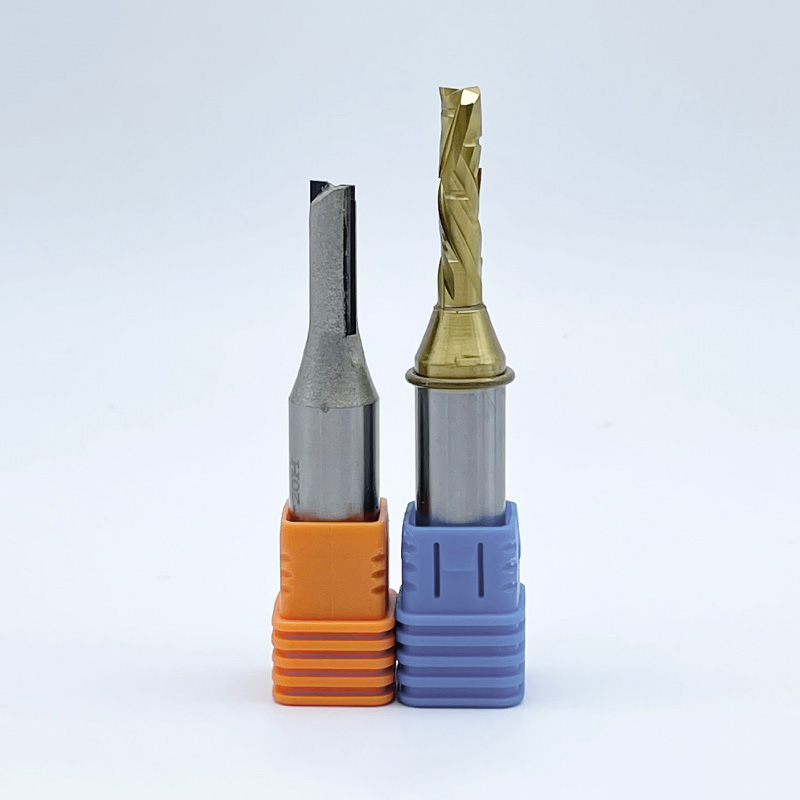
The foundation of any panel processing operation relies heavily on straight and spiral bits. Straight bits feature cutting edges parallel to the tool axis. They are highly effective for basic sizing and grooving where aggressive chip evacuation is not the primary concern. Spiral bits represent a massive upgrade in cutting dynamics. The spiral flute design creates a continuous shearing action against the material. This dramatically reduces the impact force on both the tool and the spindle, minimizing chatter and resulting in a noticeably smoother finish.
The transition from the router to the edge banding machine must be absolutely seamless. Any slight deviation in the squareness of a panel edge will result in poor glue adhesion and highly visible seam lines. Profile cutters are engineered to shape panel edges with strict dimensional accuracy. Advanced carbide technology allows these cutters to maintain their precise profile even after thousands of linear meters of machining.
A nesting machine is only as accurate as the bed it operates on. Panels are held firmly in place by a powerful vacuum drawn through a porous spoilboard. If this spoilboard becomes uneven, vacuum pressure drops. Panels shift during cutting, and the depth becomes wildly inconsistent. Spoilboard surfacing bits are large-diameter tools designed specifically to skim the top layer of the board, restoring a perfectly flat surface. Regular surfacing is a non-negotiable maintenance procedure.
Investing in high-end tooling is only the first step. Protecting that investment through rigorous maintenance ultimately drives a favorable return on investment. Neglecting maintenance leads directly to premature wear and catastrophic tool failure. Implementing a standardized protocol can extend the operational life of your panel machining tools significantly.
Intense friction heats the resins and glues present in engineered woods. This heat causes binders to melt and stubbornly adhere to the tool flutes. Resin buildup alters the precision geometry, drastically reducing chip clearance. This creates a vicious cycle. Poor chip clearance leads to more friction, generating more heat, eventually causing the carbide to crack under pressure. Tools should be meticulously inspected at the end of every shift. Visible resin must be dissolved using specialized, non-corrosive solvents. Operators should never use wire brushes to clean carbide, as this causes micro-abrasions on the delicate cutting edge.
The collet is the critical interface between the spindle and the cutting tool. A compromised, dirty, or rusted collet will inevitably introduce runout. Runout is a microscopic condition where the tool rotates slightly off its true axis. Even a few thousandths of a millimeter of runout causes unequal chip loads, leading to severe vibration. Collets and tool holders must be cleaned daily using specialized brushes and compressed air. Industry standards strongly suggest replacing collets every 400 to 600 hours of operation. Ensure the tool is seated to the correct depth to guarantee maximum gripping force and rigidity.
High-quality carbide can often be professionally sharpened multiple times. However, sharpening removes material from the cutting face, inherently reducing the overall cutting diameter. Operators must update the tool radius compensation parameters in the machine software to account for this change. Otherwise, final machined parts will be undersized. A tool must be permanently retired if the carbide tip exhibits visible chipping, if the steel shank shows signs of blueing from heat damage, or if chip clearance is severely compromised.
Supply chain reliability directly impacts daily production stability. Sourcing tools from unverified vendors often results in inconsistent batch quality. This leads to unpredictable tool life and frustrating manufacturing bottlenecks. Selecting a tooling partner requires carefully evaluating their engineering capabilities, material sourcing, and quality control processes.
A reputable industrial tooling supplier operates with incredibly strict manufacturing tolerances. They utilize advanced multi-axis grinding centers to ensure every flute is dynamically balanced to G2.5 standards at 24,000 revolutions per minute. The grade of carbide is absolutely paramount. High-volume furniture production requires sub-micron virgin carbide. This offers a superior balance of extreme hardness for wear resistance and high transverse rupture strength to prevent snapping.
To radically optimize machining processes, standardize your inventory with high-tolerance tooling from an industry leader like SSENDMILL. Upgrading your tooling strategy provides operators with the precision instruments necessary to maintain tight tolerances and pristine finishes. Explore SSENDMILL's comprehensive catalog of industrial-grade wood cutting tools to find the exact specifications matched to your production requirements. Investing in premium tooling today safeguards your factory productivity for tomorrow.
The operational lifespan depends heavily on the specific material being processed, feed rates applied, and overall machine rigidity. Under standard operating conditions, a high-quality carbide bit typically outlasts standard steel by a factor of 10 to 25. A well-maintained bit can cleanly cut several thousand linear meters of highly abrasive materials before requiring professional sharpening.
While physically possible, it is highly inefficient and strongly discouraged. Solid wood requires tools optimized for aggressive chip clearance, such as standard up-cut spirals, to prevent burning along the grain. In contrast, laminated panels require specialized geometries, like compression bits, which actively push material fibers toward the center of the panel to prevent chipping on delicate laminate layers.
Burn marks clearly indicate excessive heat buildup caused by friction rather than a clean shearing action. This is most commonly the result of an incorrect chip load. If the feed rate is too slow, or the spindle speed is set too high, the tool rubs against the material instead of cutting it. Additionally, burn marks can be caused by a dull cutting edge or severe resin buildup on the flutes.
Standard router bits are generally manufactured for intermittent use in hand-held routers, often using lower-grade steel and carbide. Industrial panel tools are engineered to incredibly strict tolerances specifically for continuous, automated operations. They utilize advanced, impact-resistant micro-grain carbide designed to withstand highly abrasive glues. Industrial tools feature enhanced dynamic balancing to eliminate vibration at high speeds.
Optimal spindle speed depends on the tool diameter and the number of flutes. For a standard two-flute compression bit cutting MDF, industrial machines typically run between 18,000 and 24,000 revolutions per minute. However, this must be perfectly matched with a feed rate of 15 to 25 meters per minute to maintain an appropriate chip load. Always consult the manufacturer's specific speed and feed charts to prevent overheating.
Tool chatter is caused by harmonic vibration. To reduce it, first ensure your collet is clean and less than 600 hours old to minimize runout. Second, verify that the shank is inserted to the manufacturer's recommended depth. Third, optimize your chip load by either increasing your feed rate or decreasing your spindle speed. If chatter persists, switch to a spiral or multi-flute bit which maintains continuous contact with the material, drastically reducing impact vibration.